How DevOps Engineers Can Use AI to Automate Tasks
Modern software teams ship faster than ever, and the pressure on DevOps engineers to keep pace has never been higher. Learning how DevOps engineers can use AI to automate tasks is quickly becoming a core skill, not an optional add-on. From writing infrastructure code to triaging production incidents, AI-powered DevOps is reshaping how teams build, deploy, and operate software at scale.
This shift is not about replacing engineers. It is about removing repetitive, error-prone work so teams can focus on architecture, reliability, and business outcomes. Engineers who understand where AI fits into the DevOps tool chain are already seeing measurable gains in deployment speed and system uptime.
What AI Means for DevOps
AI in DevOps refers to the use of machine learning models, generative AI, and intelligent automation to support tasks across the software delivery lifecycle. This includes writing code, analyzing logs, predicting failures, and optimizing infrastructure without constant manual intervention.
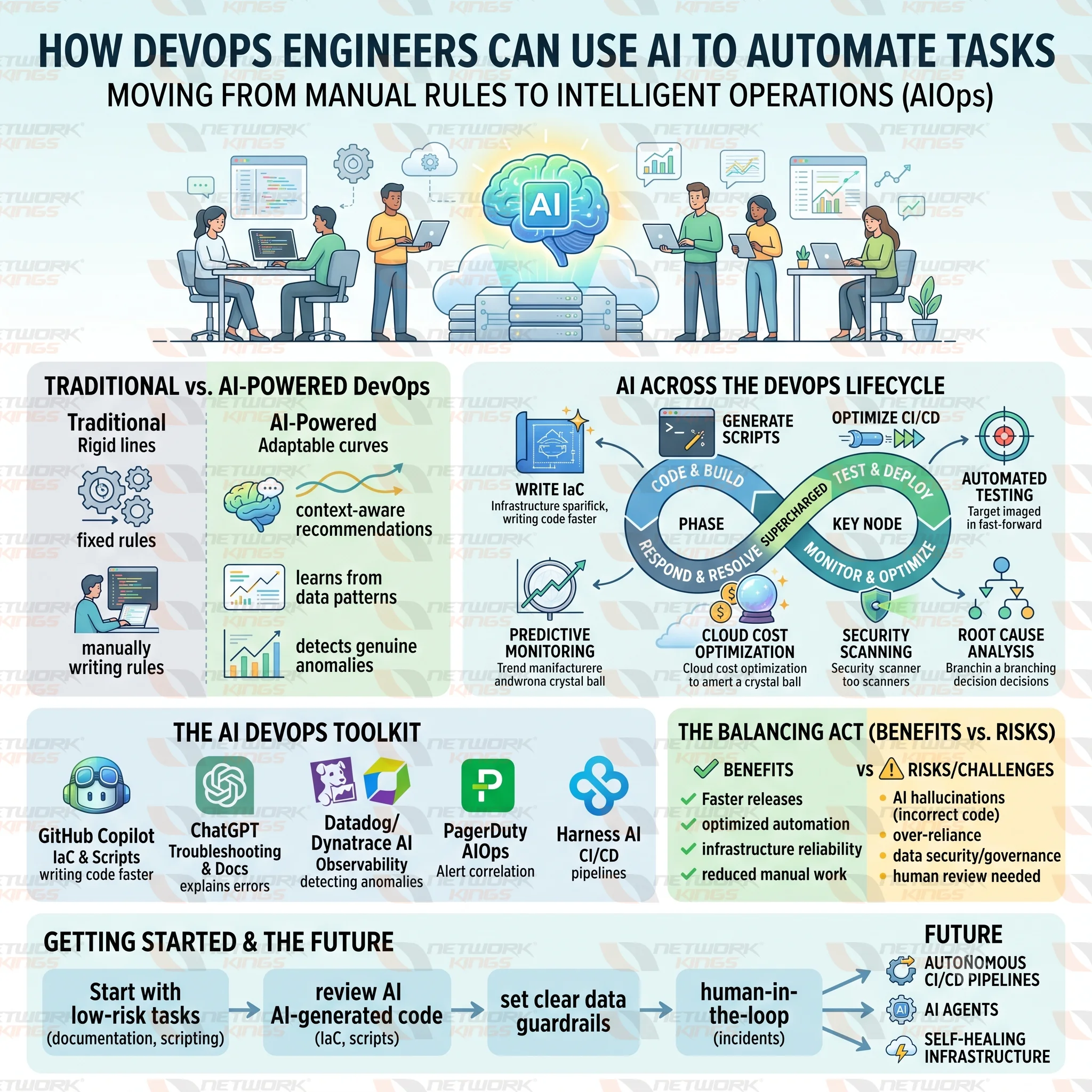
Traditional automation follows fixed rules. If a condition is met, a script runs. AI-powered DevOps goes further by recognizing patterns, learning from historical data, and making context-aware recommendations. A monitoring tool built on machine learning in DevOps does not just alert on a threshold breach. It learns what normal behavior looks like for a specific service and flags genuine anomalies while ignoring noise.
This distinction matters because it changes the engineer's role. Instead of writing every rule manually, engineers train, tune, and supervise systems that adapt over time. That shift is why AI operations, often called AIOps, has become a standard part of platform engineering conversations.
How DevOps Engineers Can Use AI to Automate Tasks
There are dozens of practical entry points for AI DevOps workflow automation. Below are the areas where engineers are seeing the most consistent value today.
Writing Infrastructure as Code
Generative AI tools can draft Terraform modules, CloudFormation templates, and Kubernetes manifests from plain language descriptions. An engineer can describe a three-tier VPC architecture and get a working starting template in seconds, then refine it for their environment. This does not eliminate the need to understand Infrastructure as Code, but it dramatically reduces boilerplate writing time.
Generating Scripts
Bash, Python, and PowerShell scripts for routine operations, such as log rotation, backup verification, or bulk resource tagging, can be generated and explained by AI coding assistants. Engineers still need to review and test the output, but the first draft no longer starts from a blank file.
CI/CD Optimization
AI can analyze pipeline execution history to identify slow stages, flaky tests, and redundant build steps. Some platforms now recommend parallelization strategies or caching adjustments automatically, directly improving CI/CD automation and reducing build times.
Automated Testing
Machine learning models can generate test cases based on code changes, predict which tests are most likely to fail, and prioritize test execution order. This shortens feedback loops without reducing coverage.
Log Analysis
Sifting through millions of log lines during an incident is one of the most time-consuming DevOps tasks. AI-driven log analysis tools cluster similar log entries, surface outliers, and highlight the specific lines most relevant to an ongoing issue.
Incident Response
AI can correlate alerts from multiple systems into a single incident timeline, reducing alert fatigue. Instead of an engineer receiving twenty separate pages for one underlying failure, an AIOps platform groups them and points to the likely source.
Root Cause Analysis
By analyzing metrics, traces, and deployment history together, AI models can suggest probable root causes for an outage, often before a human has finished reading the alert. This does not replace investigation, but it narrows the search significantly.
Monitoring
Predictive monitoring uses historical trends to forecast capacity issues, such as disk space exhaustion or memory leaks, before they cause outages. This proactive approach is a major upgrade over static threshold alerting.
Security Scanning
AI-assisted DevSecOps tools scan code, dependencies, and container images for vulnerabilities, then prioritize findings by actual exploitability rather than raw severity scores. This helps teams focus remediation effort where it matters most.
Configuration Management
AI can detect configuration drift across environments and recommend corrective actions, keeping staging and production environments consistent without manual audits.
Documentation
Generative AI can produce runbooks, API documentation, and architecture summaries directly from code and commit history, keeping documentation closer to current reality.
Cloud Resource Optimization
AI cloud automation tools analyze usage patterns and recommend rightsizing, reserved instance purchases, or auto-scaling adjustments, directly supporting infrastructure automation and cost control.
Best AI Tools for DevOps Engineers
Choosing the right DevOps automation tools depends on the specific workflow being improved. The table below outlines popular options and where each one fits.
Tool | Primary Use | Best For |
GitHub Copilot | Code and script generation | Writing IaC, scripts, and unit tests faster |
ChatGPT | General reasoning and troubleshooting | Explaining errors, drafting documentation, quick scripting |
Amazon Q Developer | AWS-focused code and operations assistance | Teams building primarily on AWS |
Google Gemini | Multimodal reasoning and code assistance | Google Cloud workflows and data-heavy tasks |
Azure AI | Cloud automation and integration | Microsoft-centric DevOps environments |
Dynatrace Davis AI | Automated root cause analysis | Enterprise observability at scale |
New Relic AI | Natural language querying of telemetry data | Faster incident investigation |
Datadog AI | Anomaly detection and log intelligence | Unified monitoring across infrastructure |
Harness AI | AI-assisted CI/CD pipeline optimization | Continuous delivery automation |
PagerDuty AIOps | Alert correlation and incident automation | Reducing alert fatigue during outages |
Benefits of AI in DevOps
Organizations adopting AI for DevOps automation experience measurable improvements across software delivery.
Key benefits include:
Faster software releases with optimized CI/CD automation
Reduced manual and repetitive operational work
Improved infrastructure reliability
Smarter monitoring and predictive maintenance
Faster incident resolution
Better security posture through continuous analysis
Improved documentation quality
Lower cloud infrastructure costs
Increased developer and DevOps productivity
Better collaboration between development and operations teams
Real-world organizations already use AI to analyze deployment risks, optimize Kubernetes clusters, detect anomalies in production environments, and automate routine operational tasks.
Challenges and Risks
AI adoption in DevOps is not without friction, and engineers should approach it with clear eyes.
Over-reliance on AI is a real risk. Teams that accept generated code or infrastructure changes without review can introduce subtle bugs or security gaps. AI hallucinations, where a model confidently produces incorrect information, remain a known limitation of generative AI for DevOps, especially for niche or rapidly changing tools.
Security concerns also apply to the AI tools themselves. Sending sensitive logs, credentials, or proprietary code to third-party AI services requires careful data governance. Compliance requirements in regulated industries may restrict which AI tools can be used at all.
Human oversight remains essential. AI should support decision-making, not replace the final approval step for production changes. Cost is another factor, since AI-powered observability and automation platforms often carry usage-based pricing that needs to be budgeted carefully.
Best Practices
Adopting AI responsibly in a DevOps environment works best with a structured approach.
Start with low-risk, high-repetition tasks like documentation or script drafting before automating production-impacting decisions
Always review AI-generated Infrastructure as Code before applying it to any environment
Set clear guardrails on what data can be shared with external AI tools
Keep a human in the loop for incident response and rollback decisions
Measure results with real metrics such as deployment frequency and mean time to recovery
Train the team on prompt writing and AI tool limitations, not just the tools themselves
Revisit AI tool choices periodically as the landscape evolves quickly
Future of AI in DevOps
The trajectory of AI in DevOps points toward increasingly autonomous systems. Autonomous CI/CD pipelines are beginning to self-adjust build and test strategies based on historical outcomes without manual configuration.
AI agents capable of executing multi-step tasks, such as diagnosing an alert, checking logs, and proposing a fix, are moving from experimental to production use in leading organizations. Predictive operations will continue to mature, shifting teams from reactive firefighting to proactive capacity planning.
Self-healing infrastructure, where systems detect and remediate common failures automatically, is already in use for scenarios like restarting unhealthy containers or scaling under load. Intelligent cloud optimization will keep pushing cost efficiency without sacrificing performance, and AI-assisted DevSecOps will make security scanning a continuous, low-friction part of every pipeline rather than a periodic gate.
Practical Tips for Getting Started
Beginners should start by using AI coding assistants for everyday scripting and IaC drafting, since this is the fastest way to build comfort with the technology. Experienced engineers should look at AIOps platforms for monitoring and incident response, where the time savings compound quickly during high-pressure situations.
Whatever the starting point, treat AI output as a first draft written by a capable but occasionally wrong colleague. Verify, test, and iterate.
Conclusion
Artificial intelligence is rapidly becoming a core capability for modern DevOps teams. From Infrastructure as Code generation and CI/CD automation to intelligent monitoring, security scanning, and cloud optimization, AI enables engineers to deliver software faster and more reliably. However, success depends on combining AI-driven automation with human expertise, governance, and continuous validation. DevOps professionals who embrace AI responsibly today will be better prepared for the increasingly automated software delivery landscape of tomorrow.
FAQs
What skills do DevOps engineers need to work with AI tools
Engineers benefit from understanding prompt writing, basic machine learning concepts, and how to critically evaluate AI-generated code and recommendations rather than accepting them blindly.
Can AI fully automate CI/CD pipelines
AI can optimize and partially automate CI/CD pipelines by improving test selection and build efficiency, but fully autonomous pipelines that require no human review are still an emerging capability rather than the norm.
Are AI tools safe to use with production infrastructure code
They can be safe when used with proper review processes, access controls, and testing in staging environments first. Generated code should never be applied directly to production without validation.
How does AI help with DevSecOps
AI-assisted DevSecOps automation prioritizes vulnerabilities by real-world exploitability, scans code and dependencies continuously, and reduces the manual effort needed to keep security checks current with every release.
What is the difference between traditional automation and AI-powered automation in DevOps
Traditional automation follows fixed, predefined rules, while AI-powered DevOps automation learns patterns from data and adapts its behavior, making it better suited for tasks like anomaly detection and predictive scaling.
Which AI tool is best for beginners in DevOps
GitHub Copilot and ChatGPT are commonly recommended starting points because they help with everyday coding, scripting, and troubleshooting tasks without requiring a dedicated observability platform.
Will AI increase or decrease demand for DevOps engineers
AI is expected to shift demand toward engineers who can design, supervise, and validate AI-assisted systems rather than reduce overall demand, since human oversight remains critical for reliable software delivery.

The founder of Network Kings, is a renowned Network Engineer with over 12 years of experience at top IT companies like TCS, Aricent, Apple, and Juniper Networks. Starting his journey through a YouTube channel in 2013, he has inspired thousands of students worldwide to build successful careers in networking and IT. His passion for teaching and simplifying complex technologies makes him one of the most admired mentors in the industry.