How Cloud Engineers Can Use AI to Improve Productivity in 2026
Cloud engineering has evolved far beyond deploying virtual machines and managing cloud storage. In 2026, cloud engineers are expected to automate infrastructure, strengthen security, optimize costs, and manage increasingly complex multi-cloud environments. This is exactly where artificial intelligence is making a measurable difference.
Understanding How Cloud Engineers Can Use AI is no longer optional. AI has become a practical assistant that helps engineers write Infrastructure as Code (IaC), troubleshoot production issues, generate documentation, detect security risks, and automate repetitive tasks. Instead of replacing cloud professionals, AI allows them to focus on architecture, problem-solving, and innovation.
Whether you work with AWS, Microsoft Azure, or Google Cloud Platform (GCP), learning how to integrate AI into your daily workflow can significantly improve productivity while reducing manual effort.
What Is AI in Cloud Engineering
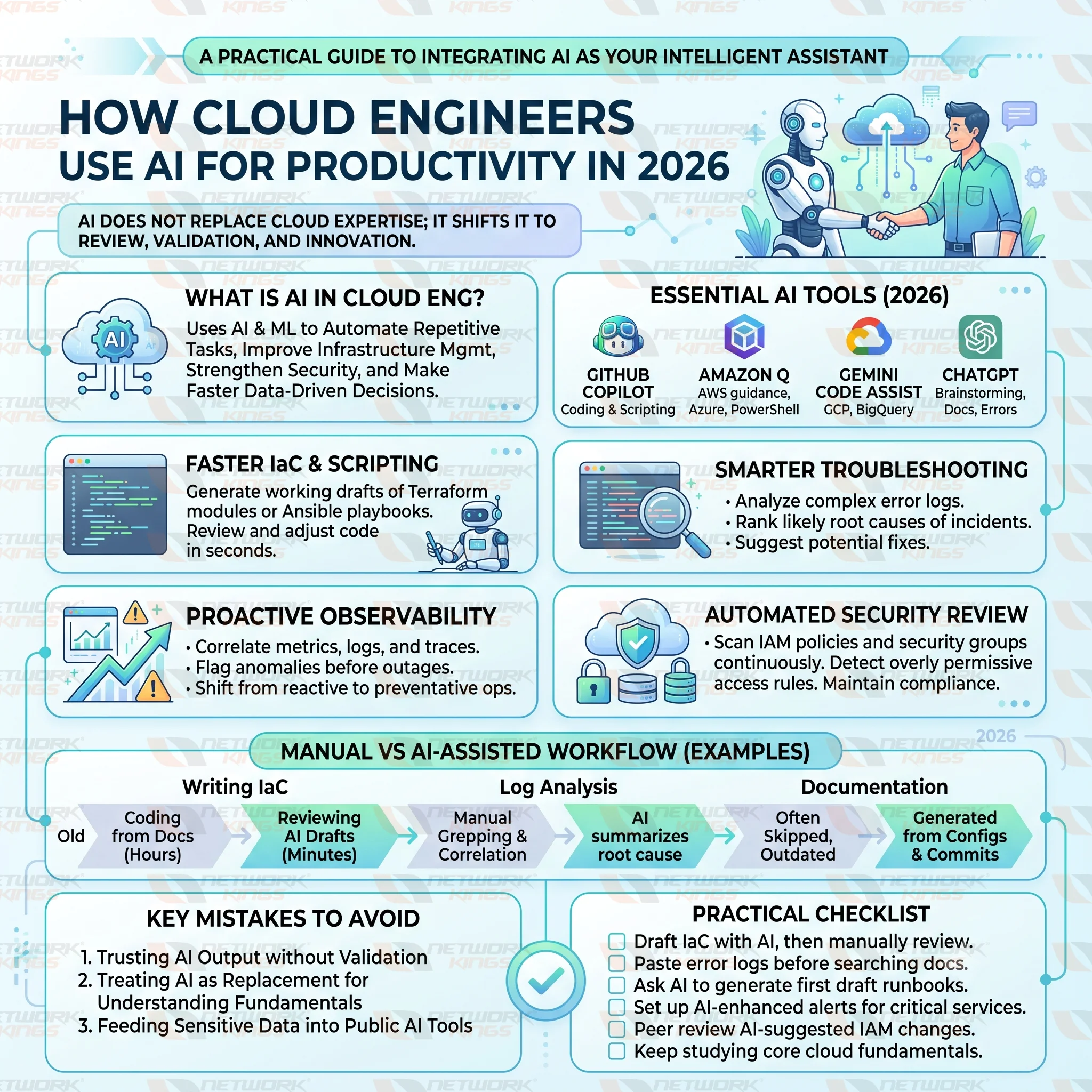
Artificial Intelligence (AI) in cloud engineering refers to using AI-powered tools and machine learning to automate repetitive tasks, improve infrastructure management, strengthen cloud security, and help engineers make faster, data-driven decisions. Rather than replacing cloud engineers, AI works as an intelligent assistant that boosts productivity across the entire cloud lifecycle.
Today, AI supports cloud professionals in a wide range of daily activities, including:
Automating Infrastructure as Code (IaC) with Terraform and CloudFormation
Writing and optimizing Bash, PowerShell, and Python scripts
Troubleshooting cloud infrastructure and application issues
Analyzing logs and identifying the root cause of incidents
Generating technical documentation and architecture summaries
Optimizing cloud costs with AI-driven recommendations
Detecting security risks, misconfigurations, and compliance issues
Assisting with Kubernetes, Docker, and CI/CD pipeline management
Popular AI tools such as ChatGPT, GitHub Copilot, Amazon Q, Microsoft Copilot, and Gemini Code Assist are becoming valuable companions for cloud engineers working with AWS, Microsoft Azure, and Google Cloud Platform (GCP). These tools can generate code, explain complex concepts, review configurations, and recommend improvements, allowing engineers to spend more time on architecture, innovation, and solving complex business challenges.
However, AI is not a replacement for technical expertise. Successful cloud engineers still need a strong understanding of cloud architecture, networking, security, Infrastructure as Code, and troubleshooting. AI delivers the best results when it is used to enhance human decision-making rather than replace it. By combining cloud fundamentals with AI-powered automation, engineers can build more secure, scalable, and efficient cloud environments while significantly improving productivity in 2026 and beyond.
Why AI Is Becoming Essential for Cloud Engineers
Cloud environments have grown more complex, not simpler. A single organization might run workloads across multiple regions, several Kubernetes clusters, and a mix of serverless and containerized services. Manually monitoring, securing, and scripting for all of that takes real time.
AI tools now handle much of the repetitive cognitive load. They read logs faster than a human ever could, they suggest Infrastructure as Code snippets in seconds, and they catch misconfigurations before they become security incidents. This does not remove the need for cloud expertise. It shifts the engineer's role toward reviewing, validating, and directing AI output rather than typing every line by hand.
Generative AI for cloud engineers has also matured past simple autocomplete. Tools like GitHub Copilot, Amazon Q, Microsoft Copilot, and Gemini Code Assist now understand cloud-specific context, including AWS service limits, Azure resource naming conventions, and GCP IAM policies.
Top Ways AI Improves Productivity
Faster Scripting and Infrastructure as Code
Writing Terraform modules or Ansible playbooks from scratch takes time. AI coding assistants can generate a working draft in seconds, which you then review and adjust. This is one of the clearest wins in AI for Infrastructure as Code, since most IaC work follows repeatable patterns that AI models have already seen thousands of times.
Smarter Troubleshooting
Instead of manually grepping through thousands of log lines, engineers now paste error messages into an AI assistant and get a ranked list of likely causes. This is especially useful for AI for Kubernetes, where pod failures often trace back to obscure resource limits or misconfigured probes.
Documentation That Actually Gets Written
Most engineers admit documentation is the first thing to slip when deadlines hit. AI tools can generate runbooks, architecture summaries, and change logs directly from your commit history or configuration files, closing a gap that used to hurt teams during incidents.
Proactive Monitoring and Alerting
AI-driven observability platforms correlate metrics, logs, and traces automatically, flagging anomalies before they trigger a full outage. This shifts cloud operations automation from reactive firefighting to genuine prevention.
Security Review at Scale
AI for cloud security tools scan IAM policies, security groups, and container images continuously, catching overly permissive access rules that a human reviewer might miss during a routine audit.
Best AI Tools for Cloud Engineers in 2026
GitHub Copilot for general coding and script generation across languages
Amazon Q for AWS-specific guidance, troubleshooting, and cost insights
Microsoft Copilot for Azure resource management and PowerShell automation
Gemini Code Assist for Google Cloud Platform workflows and BigQuery queries
ChatGPT for architecture brainstorming, documentation, and explaining unfamiliar error messages
AI-enhanced CI/CD platforms that auto-suggest pipeline fixes when Jenkins or GitHub Actions builds fail
Manual Workflow vs AI-Assisted Workflow
Cloud engineers spend a significant amount of time on repetitive tasks such as writing Infrastructure as Code (IaC), troubleshooting issues, reviewing security policies, and maintaining documentation. AI doesn't replace these responsibilities, but it makes them faster and more efficient. The table below highlights how AI transforms common cloud engineering workflows in 2026.
Cloud Engineering Task | Traditional Method | AI-Assisted Method | Productivity Benefit |
Writing Terraform modules | Manual coding from documentation | AI generates draft code for review | Saves hours per module |
Log analysis during incidents | Manual grep and correlation | AI summarizes root cause, candidates | Faster mean time to resolution |
Kubernetes troubleshooting | Manual kubectl investigation | AI suggests likely misconfigurations | Reduces downtime |
Security policy review | Manual IAM audit | AI flags risky permissions automatically | Fewer missed vulnerabilities |
Documentation | Written after the fact, often skipped | AI drafts docs from configs and commits | Consistent, up to date records |
Cost optimization | Manual billing dashboard review | AI recommends rightsizing and FinOps actions | Lower cloud spend |
AI Makes Cloud Operations Smarter
Cloud Operations Automation is one of the biggest advantages AI offers.
Instead of manually investigating alerts across monitoring tools, AI can summarize events, identify likely root causes, and recommend possible fixes.
Similarly, DevOps AI Tools help engineers improve CI/CD pipelines by identifying failed deployments, suggesting configuration updates, and optimizing build processes.
AI also assists with Infrastructure as Code by detecting syntax errors, recommending best practices, and identifying security misconfigurations before deployment.
These improvements allow teams to spend less time on repetitive maintenance and more time building reliable cloud solutions.
AI Strengthens Cloud Security
Security remains one of the most important responsibilities for cloud engineers.
AI for Cloud Security helps identify exposed storage buckets, excessive IAM permissions, vulnerable configurations, and unusual activity across cloud environments.
While AI accelerates threat detection, it should never replace human validation. Engineers must review recommendations carefully because AI may overlook organization-specific security policies or compliance requirements.
Combining AI with strong cloud security knowledge creates a more reliable defense against evolving threats
Common Mistakes to Avoid When Using AI
Trusting AI output without validation is the biggest risk. AI-generated Terraform code can reference deprecated resources or miss provider-specific quirks, so always test in a staging environment first.
Another mistake is treating AI coding assistants as a replacement for understanding networking, IAM, and container fundamentals. When something breaks in production, you still need to reason through the system yourself.
Finally, avoid feeding sensitive credentials, customer data, or proprietary architecture details into public AI tools that were not approved by your organization's security policy.
The Future of AI in Cloud Engineering
Expect AI in DevOps to move toward autonomous remediation, where systems detect an issue, propose a fix, and apply it after a human approves the change. FinOps will also become more AI-driven, with continuous cost recommendations built directly into cloud consoles.
Cloud engineer careers in 2026 will increasingly reward professionals who can prompt, validate, and integrate AI tools into existing DevOps pipelines rather than those who avoid AI altogether.
Practical Checklist for AI-Assisted Cloud Work
Use AI to draft Terraform or CloudFormation code, then manually review every resource
Paste error logs into an AI assistant before manually searching documentation
Set up AI-enhanced observability alerts for your most critical services
Ask AI to generate a first draft of your next runbook or postmortem
Run AI-suggested IAM changes through a peer review before applying them
Keep studying core AWS, Azure, or GCP fundamentals alongside AI tool usage
Understanding How Cloud Engineers Can Use AI is becoming a critical skill for modern cloud professionals. AI can automate repetitive work, accelerate troubleshooting, improve cloud security, simplify Infrastructure as Code, and help engineers deliver projects more efficiently. However, the best results come from combining AI with solid cloud fundamentals, hands-on experience, and continuous learning. If you want to stay competitive in 2026 and beyond, mastering both cloud platforms and AI-powered workflows will help you build a successful and future-ready cloud engineering career.
FAQs
Can AI replace cloud engineers?
No. AI can automate repetitive tasks like scripting and log analysis, but cloud engineers are still needed to design architecture, make security decisions, and validate AI output.
Which AI tools should cloud engineers learn?
Start with a coding assistant like GitHub Copilot or Amazon Q, then add a general-purpose model like ChatGPT for documentation and troubleshooting support.
How does AI help with AWS?
Amazon Q and similar tools can answer AWS-specific questions, suggest cost optimizations, and help troubleshoot service configurations without switching between multiple documentation pages.
Can AI generate Terraform code?
Yes, AI coding assistants can draft Terraform modules based on a plain language description, though the output should always be reviewed before applying it to production.
Is AI useful for Kubernetes management?
Yes. AI tools can analyze pod logs, suggest resource limit adjustments, and identify common misconfigurations faster than manual kubectl investigation.
Should beginners learn cloud before AI?
Yes. Understanding core cloud concepts like networking, IAM, and compute services first makes it much easier to evaluate whether AI suggestions are actually correct.
What are the limitations of AI in cloud engineering?
AI can produce outdated or incorrect code, misses organization-specific context, and should never be trusted with production changes without human review.
Which cloud certification is best in the AI era?
Foundational certifications like AWS Solutions Architect Associate, Azure Administrator Associate, or Google Cloud Associate Engineer remain valuable, since they build the fundamentals AI cannot replace

The founder of Network Kings, is a renowned Network Engineer with over 12 years of experience at top IT companies like TCS, Aricent, Apple, and Juniper Networks. Starting his journey through a YouTube channel in 2013, he has inspired thousands of students worldwide to build successful careers in networking and IT. His passion for teaching and simplifying complex technologies makes him one of the most admired mentors in the industry.