Azure AZ-700 Deep Dive into Hybrid Networking and Cloud Connectivity

Azure networking has become one of the most valuable cloud skills for modern IT professionals. As organizations embrace hybrid cloud strategies, they need experts who can securely connect on-premises infrastructure with Microsoft Azure while maintaining performance, scalability, and security. This growing demand makes the Azure AZ-700 certification an excellent choice for cloud engineers, network administrators, DevOps professionals, and aspiring Azure architects.
The Azure AZ-700 exam focuses on designing, implementing, and managing Microsoft Azure networking solutions. It validates your ability to build enterprise-grade networking environments using Azure networking services such as Virtual Networks, VPN Gateway, ExpressRoute, Azure Firewall, Virtual WAN, and Azure DNS. Whether your goal is career growth or mastering enterprise networking, Azure AZ-700 provides practical skills that employers actively seek.
What Is Azure AZ-700
Azure AZ-700, officially titled Designing and Implementing Microsoft Azure Networking Solutions, is the certification exam for professionals pursuing the Azure Network Engineer Associate credential.
The certification measures your ability to:
Design and implement Azure Virtual Networks (VNets)
Configure hybrid cloud networking
Implement Azure network security
Manage private and public connectivity
Monitor and troubleshoot Azure networking services
Optimize network performance and availability
Professionals with Azure AZ-700 certification commonly work as:
Azure Network Engineers
Infrastructure Architects
Network Administrators
Cloud Consultants
Industries including finance, healthcare, manufacturing, retail, education, and government increasingly rely on Azure networking expertise to support digital transformation initiatives.
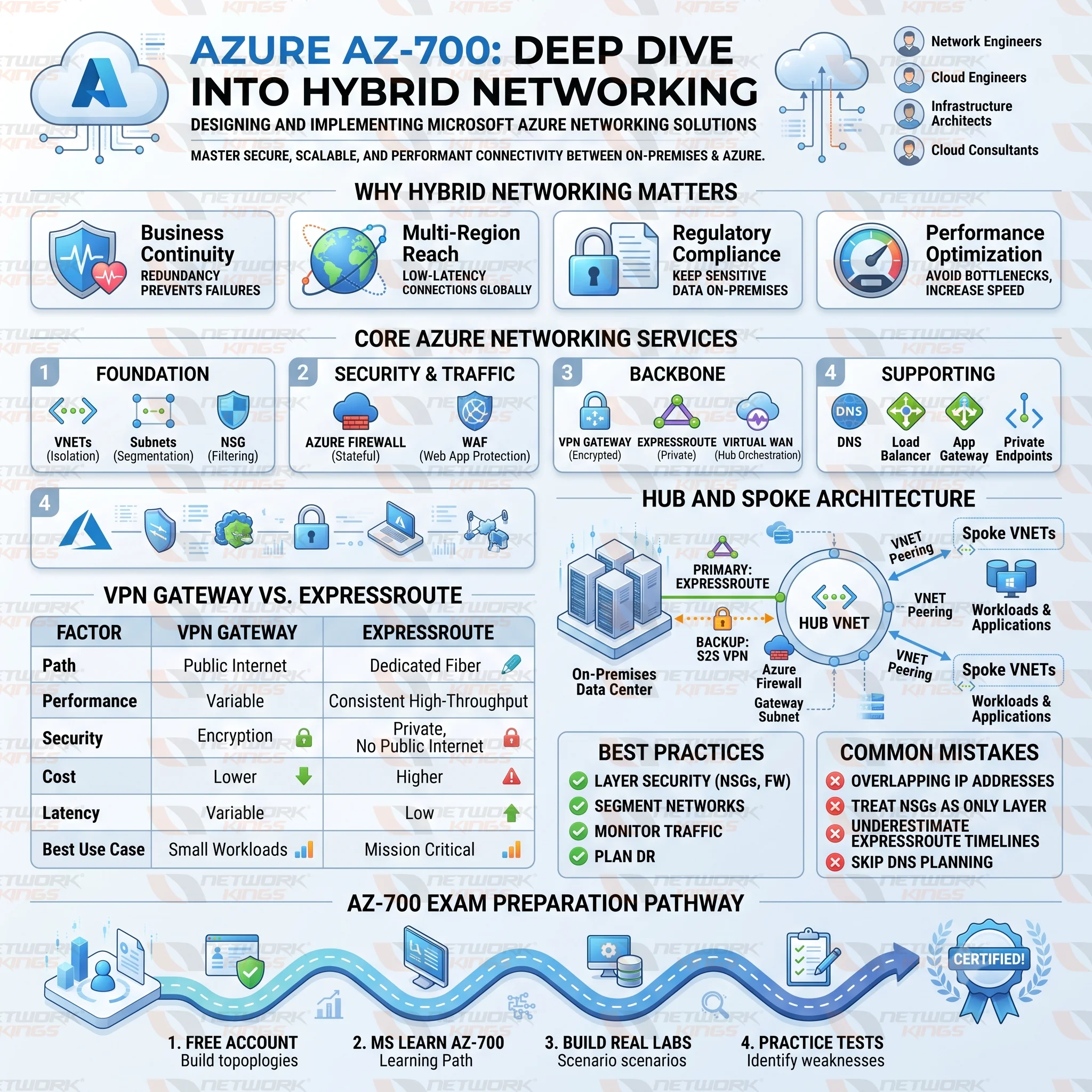
Why Hybrid Networking Matters
Very few organizations move to the cloud all at once. Most keep critical systems on-premises for years while gradually shifting workloads to Azure, which makes hybrid networking a practical necessity rather than a theoretical concept.
A few reasons hybrid connectivity has become so central to enterprise IT strategy:
Business continuity depends on having redundant paths between on-premises systems and the cloud, so a single point of failure does not take down operations.
Multi-region deployments require secure, low-latency connections between Azure regions and headquarters to keep applications responsive for global users.
Regulatory and data residency requirements often force certain workloads to stay on-premises while others move to Azure, meaning both environments need to talk to each other securely.
Performance optimization matters when applications split traffic between local infrastructure and cloud resources, since poor network design creates bottlenecks that frustrate users and increase costs.
Core Azure Networking Services Covered in AZ-700
The exam covers a broad set of services, and understanding how they fit together matters more than memorizing individual features.
Virtual Networks, Subnets, and NSGs
A Virtual Network, or VNet, is the foundation of any Azure networking design. Subnets divide that VNet into smaller segments, and Network Security Groups control traffic flow in and out of those subnets using rules based on source, destination, port, and protocol.
Azure Firewall and Network Security
Azure Firewall provides centralized, stateful traffic filtering across VNets, often paired with NSGs for layered defense. It supports application rules, network rules, and threat intelligence filtering, giving architects a single point to enforce policy across an entire hub and spoke design.
Load Balancer and Application Gateway
Azure Load Balancer distributes traffic at layer 4, which works well for general TCP and UDP workloads. Application Gateway operates at layer 7, adding features like SSL termination, URL based routing, and web application firewall capabilities for HTTP and HTTPS traffic.
VPN Gateway, ExpressRoute, and Virtual WAN
These three services form the backbone of hybrid connectivity, and understanding their differences is one of the most heavily tested areas on the exam.
Azure DNS, Traffic Manager, Route Server, Bastion, and Private Endpoints
Azure DNS handles domain resolution within your environment. Traffic Manager routes users to the best-performing endpoint across regions. Route Server simplifies dynamic routing between network virtual appliances and VNets. Bastion provides secure remote access to VMs without exposing public IPs. Private Endpoints bring Azure PaaS services directly into your VNet using private IP addresses.
Azure VPN Gateway vs ExpressRoute
Choosing between these two connectivity options is a decision every network architect faces, and the right answer depends entirely on the workload.
Factor | VPN Gateway | ExpressRoute |
Connectivity | Encrypted connection over the public internet | Private, dedicated connection through a provider |
Performance | Variable, dependent on internet conditions | Consistent, high throughput |
Security | Strong encryption but travels over public internet | Traffic never touches the public internet |
Cost | Lower upfront and ongoing cost | Higher cost, especially at larger bandwidth tiers |
Latency | Higher and less predictable | Low and predictable |
Reliability | Good, but subject to internet outages | Excellent, backed by SLA guarantees |
Best Use Case | Small to medium workloads, backup connectivity | Mission critical, high volume enterprise workloads |
Many enterprise designs actually use both, with ExpressRoute as the primary path and VPN Gateway as a failover option.
Hybrid Connectivity Architecture
Enterprises rarely rely on a single connection type. A typical hybrid architecture connects an on-premises data center to Azure through ExpressRoute for reliability, with a VPN Gateway configured as backup connectivity in case the ExpressRoute circuit goes down.
Branch offices often connect through Virtual WAN, which centralizes routing and simplifies management across many sites without requiring a full mesh of individual connections. Remote users typically connect through point-to-site VPN or Azure Virtual Desktop, depending on the use case.
For organizations operating across multiple Azure regions, VNet peering and Virtual WAN work together to create low latency paths between regions while keeping traffic off the public internet. A common pattern is a hub and spoke design, where a central hub VNet hosts shared services like firewalls and gateways, while spoke VNets host individual application workloads.
AZ-700 Exam Preparation Tips
Passing AZ-700 requires more than reading documentation. Hands-on practice is what separates candidates who pass comfortably from those who struggle.
Set up an Azure free account and build real network topologies rather than just reading about them.
Work through Microsoft Learn's official AZ-700 learning path, since it aligns directly with exam objectives.
Build labs that mirror real scenarios, such as connecting two VNets with peering, configuring a site-to-site VPN, or deploying Azure Firewall in a hub and spoke design.
Take practice tests to identify weak areas, then go back and rebuild those specific labs instead of just rereading notes.
Avoid the common mistake of memorizing exam dumps, since AZ-700 questions often test scenario-based decision-making rather than simple recall.
Best Practices
Strong Azure network design follows a handful of consistent principles regardless of company size.
Segment networks logically using subnets and NSGs so that a breach in one area does not automatically expose everything else.
Layer security controls using NSGs, Azure Firewall, and private endpoints together rather than relying on a single defense mechanism.
Monitor traffic continuously using Network Watcher and Azure Monitor to catch misconfigurations and unusual patterns early.
Optimize costs by right-sizing gateway SKUs and reviewing ExpressRoute circuit bandwidth against actual usage.
Design for high availability using availability zones and redundant gateways wherever the workload justifies the added cost.
Plan disaster recovery with cross-region replication and tested failover paths, not just documentation that has never been exercised.
Integrate identity carefully, since network security and identity access management work best when designed together rather than as separate afterthoughts.
Common Mistakes Beginners Make
New Azure network engineers tend to repeat the same handful of mistakes. Overlapping IP address spaces between VNets is one of the most frequent, and it quickly becomes a painful problem once peering or hybrid connections are involved.
Another common issue is treating NSGs as the only security layer, which leaves gaps that Azure Firewall or additional controls could have closed. Many beginners also underestimate ExpressRoute provisioning timelines, which can take weeks depending on the connectivity provider, causing project delays if not planned for early.
Finally, skipping proper DNS planning often causes hybrid name resolution failures that are frustrating to diagnose after the fact.
Azure AZ-700 is one of the most practical certifications available for anyone serious about cloud networking. It covers the exact skills enterprises need right now, from VPN Gateway and ExpressRoute design to Virtual WAN architecture and network security best practices.
The candidates who pass with confidence are the ones who build labs, break things, and fix them again rather than just reading study guides. Combine hands-on Azure networking experience with focused exam prep, and AZ-700 becomes a genuinely achievable goal that opens real career opportunities in hybrid cloud connectivity.
FAQs
Is Azure AZ-700 difficult?
AZ-700 is considered moderately challenging, especially for candidates without hands-on networking experience. The exam focuses heavily on scenario-based questions rather than simple definitions, so understanding how services like VPN Gateway, ExpressRoute, and Virtual WAN work together in real designs is essential for passing comfortably.
Is AZ-700 worth it in 2026?
Yes, hybrid cloud adoption continues to grow, and networking remains one of the harder skills to hire for. AZ-700 validates practical skills that employers actively need, making it a strong investment for network engineers, cloud administrators, and architects looking to specialize and increase their earning potential.
What is Azure hybrid networking?
Azure hybrid networking refers to securely connecting on-premises infrastructure with Azure cloud resources using services like VPN Gateway, ExpressRoute, or Virtual WAN. It allows organizations to run workloads across both environments while maintaining consistent security, performance, and connectivity between systems.
What are the prerequisites for AZ-700?
Microsoft does not enforce strict prerequisites, but candidates should have solid networking fundamentals and hands-on Azure experience before attempting the exam. Familiarity with concepts like subnetting, routing, and firewalls, along with basic Azure administration skills, makes the material significantly easier to absorb.
How long does it take to prepare for AZ-700?
Preparation time varies, but most candidates with some networking background spend six to ten weeks studying, combining Microsoft Learn modules with hands-on labs. Complete beginners to networking may need longer to build foundational knowledge before tackling exam-specific content.
Does AZ-700 require coding?
No, AZ-700 does not require programming skills. It focuses on networking design, configuration, and troubleshooting within the Azure portal, CLI, and PowerShell, though basic comfort with command line tools helps when working through labs and automation tasks.
Which Azure networking services are most important?
VPN Gateway, ExpressRoute, and Virtual WAN are central to the exam since they cover hybrid connectivity, the certification's core focus. Azure Firewall, Load Balancer, Application Gateway, and Private Endpoints also carry significant weight, particularly around security and traffic management scenarios.

The founder of Network Kings, is a renowned Network Engineer with over 12 years of experience at top IT companies like TCS, Aricent, Apple, and Juniper Networks. Starting his journey through a YouTube channel in 2013, he has inspired thousands of students worldwide to build successful careers in networking and IT. His passion for teaching and simplifying complex technologies makes him one of the most admired mentors in the industry.