The Future of SD-WAN: Technology Trends, Benefits, and Predictions for 2026
Enterprise networks are carrying more traffic to more destinations than ever before, and most of that traffic never touches a data center. Applications live in SaaS platforms, workloads span three or four clouds, and employees connect from home offices, co-working spaces, and airport lounges. Analysts tracking the space expect the global SD-WAN market to climb well past 10 billion dollars in 2026 alone, with double-digit growth continuing for years. That kind of investment does not happen by accident. It happens because traditional WAN architectures, built around fixed circuits and hairpinned traffic, simply cannot keep pace with how modern businesses operate.
This is where the future of SD-WAN becomes one of the more important conversations in enterprise IT. Software-defined wide area networking has moved from a cost-saving alternative to MPLS into a strategic platform for security, automation, and cloud performance. In this article, we will walk through where SD-WAN is headed in 2026, the benefits driving adoption, how it stacks up against legacy MPLS, and what network leaders should prepare for next.
What Is SD-WAN and Why It Matters in 2026
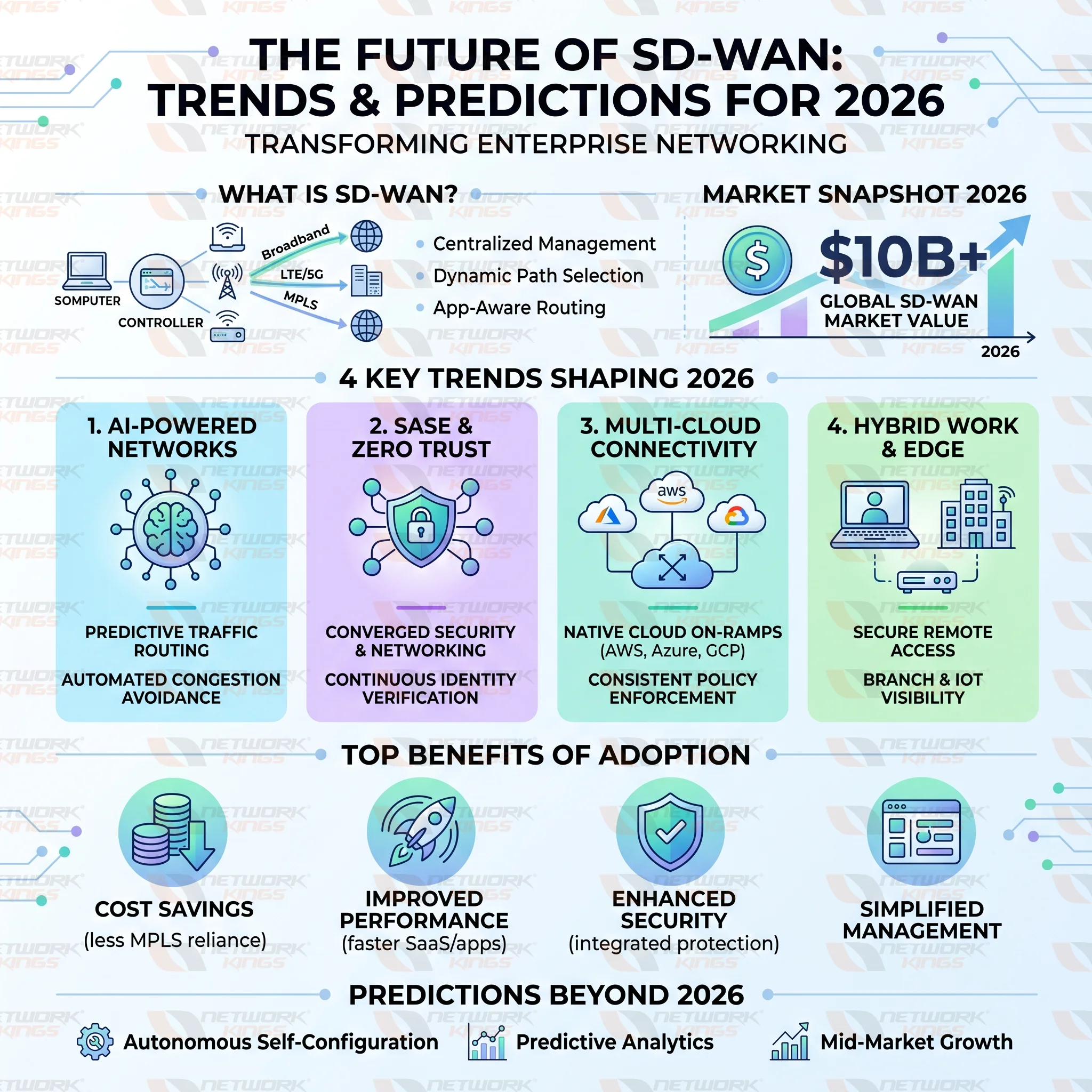
SD-WAN, or Software-Defined Wide Area Network, is a networking architecture that centrally manages and optimizes traffic across multiple connections, including broadband, MPLS, LTE, and 5G networks.
Unlike traditional WAN solutions that rely heavily on expensive private circuits, SD-WAN dynamically selects the best path for application traffic based on real-time network conditions. This improves application performance while reducing operational costs.
In 2026, SD-WAN plays a critical role in enterprise WAN modernization because organizations increasingly depend on cloud networking solutions, hybrid work environments, and multi-cloud connectivity strategies. Businesses need networks that are agile, scalable, secure, and easy to manage, and SD-WAN delivers exactly that.
Major SD-WAN Trends Shaping 2026
AI-Powered Traffic Optimization
Machine learning models are now built directly into SD-WAN controllers, predicting congestion before it happens and rerouting sensitive traffic like voice or video automatically. This shift toward AI-powered SD-WAN reduces the manual tuning that used to consume hours of an engineer's week.
SASE Convergence
Secure Access Service Edge, commonly known as SASE, continues to reshape enterprise networking. Organizations are increasingly combining SD-WAN with cloud-delivered security services such as:
Secure web gateways
Cloud access security brokers
Zero Trust network access
Firewall as a Service
The convergence of networking and security simplifies infrastructure while improving protection against modern cyber threats.
Multi-Cloud Networking
Enterprises rarely commit to a single cloud provider anymore. Modern SD-WAN platforms now offer native integrations with major cloud on-ramps, giving consistent policy enforcement whether traffic is headed to AWS, Azure, or Google Cloud.
Zero Trust Security Integration
Perimeter-based security assumptions are fading fast. SD-WAN vendors are embedding zero trust network access directly into their fabric, verifying every session rather than trusting anything inside the corporate network by default.
Network Automation and Self-Healing Networks
Intent-based automation now allows networks to detect a failing link and reroute traffic without a human ever opening a ticket. Self-healing capabilities are becoming a baseline expectation rather than a premium feature.
Edge Computing Support
As compute moves closer to where data is generated, SD-WAN is extending into edge locations, retail stores, factories, and IoT deployments to manage connectivity for devices that never touch a traditional data center.
Hybrid Work and Branch Connectivity
With hybrid work now permanent for most enterprises, SD-WAN platforms increasingly extend policy-based security and performance optimization all the way to individual remote users, not just branch offices.
Key Benefits of SD-WAN for Modern Enterprises
Organizations investing in SD-WAN benefits often see improvements across multiple areas of their business.
Some of the most important advantages include:
Lower WAN connectivity costs
Better application performance
Increased network visibility
Faster deployment of new locations
Enhanced security integration
Simplified centralized management
Greater scalability for future growth
Perhaps the most valuable benefit is flexibility. Businesses can quickly adapt their networks to support new applications, cloud services, and workforce requirements without major infrastructure overhauls.
SD-WAN vs Traditional MPLS Networks
Factor | SD-WAN | Traditional MPLS |
Cost | Lower, uses broadband and LTE | Higher, dedicated circuits |
Performance | Application-aware, dynamic routing | Fixed routing, less adaptive |
Security | Built-in encryption, SASE-ready | Requires separate security stack |
Scalability | Rapid, software-based provisioning | Slower, hardware-dependent |
Deployment Speed | Days to weeks | Weeks to months |
Cloud Readiness | Native cloud on-ramps | Limited, often requires backhaul |
Management Complexity | Centralized, single console | Distributed, device-by-device |
Expert Predictions for the Future of SD-WAN
Looking beyond 2026, several patterns are becoming clear. AI-driven autonomous networking will move from optimization to genuine self-configuration, where networks adjust policy without waiting for engineer approval. SASE adoption will keep expanding as security and networking budgets merge into a single line item. Cloud-native integration will deepen further, with SD-WAN control planes running directly inside hyperscaler environments. Predictive analytics will shift network operations from reactive troubleshooting to proactive capacity planning. And mid-sized businesses, once priced out of enterprise-grade networking, will keep adopting SD-WAN at a faster rate as vendors introduce simpler, subscription-based packages.
Challenges Organizations Should Prepare For
Security considerations grow more complex as the attack surface expands to every branch and remote worker, making zero trust design essential rather than optional.
Skills gaps are real. Many network teams still need training on software-defined concepts, automation scripting, and cloud networking fundamentals.
Vendor selection matters enormously, since SASE and SD-WAN features vary widely between providers, and switching later can be costly.
Migration complexity should not be underestimated, particularly for enterprises with legacy MPLS contracts or highly customized routing policies.
Conclusion
The future of SD-WAN is not just about replacing MPLS with cheaper circuits. It is about building a network that can think, adapt, and secure itself in a world where applications, users, and data are scattered across the internet. Enterprises that invest in AI-powered SD-WAN and SASE-aligned architectures today are positioning themselves for a decade of cloud-first, hybrid-work-driven growth. The organizations still running static, hardware-bound WANs will find themselves increasingly unable to compete on performance or security. As 2026 progresses, SD-WAN is no longer a nice-to-have upgrade. It is becoming the operating layer for how modern enterprises connect.
FAQs
1. What is SD-WAN in simple terms?
SD-WAN is a software-based approach to managing wide area networks that lets IT teams control routing, security, and performance centrally instead of configuring hardware at every location individually.
2. Is SD-WAN replacing MPLS completely?
Not entirely. Many enterprises run a hybrid model, keeping MPLS for critical traffic while using SD-WAN to intelligently manage broadband, LTE, and cloud connections alongside it.
3. What is the difference between SD-WAN and SASE?
SD-WAN focuses on network connectivity and performance, while SASE combines SD-WAN with a full security stack, including zero trust access, delivered from the cloud as a unified service.
4. Is SD-WAN secure enough for enterprise use?
Modern SD-WAN platforms include encryption, segmentation, and increasingly zero trust access controls, making them suitable for enterprise security requirements when properly configured.
5. How does AI improve SD-WAN performance?
AI models analyze traffic patterns in real time, predicting congestion and automatically rerouting sensitive applications before users experience slowdowns.
6. Can small and mid-sized businesses benefit from SD-WAN?
Yes. Subscription-based SD-WAN offerings have made enterprise-grade networking accessible to smaller organizations that previously could not justify MPLS costs.
7. What industries benefit most from SD-WAN?
Retail, healthcare, financial services, and any multi-location business with heavy cloud application usage tend to see the fastest return on SD-WAN investment.
8. How long does an SD-WAN migration typically take?
Timelines vary by network size, but most organizations can provision new sites within days to weeks, though full enterprise-wide migrations from MPLS may take several months.

The founder of Network Kings, is a renowned Network Engineer with over 12 years of experience at top IT companies like TCS, Aricent, Apple, and Juniper Networks. Starting his journey through a YouTube channel in 2013, he has inspired thousands of students worldwide to build successful careers in networking and IT. His passion for teaching and simplifying complex technologies makes him one of the most admired mentors in the industry.