AI-Powered Network Troubleshooting Tools and Techniques
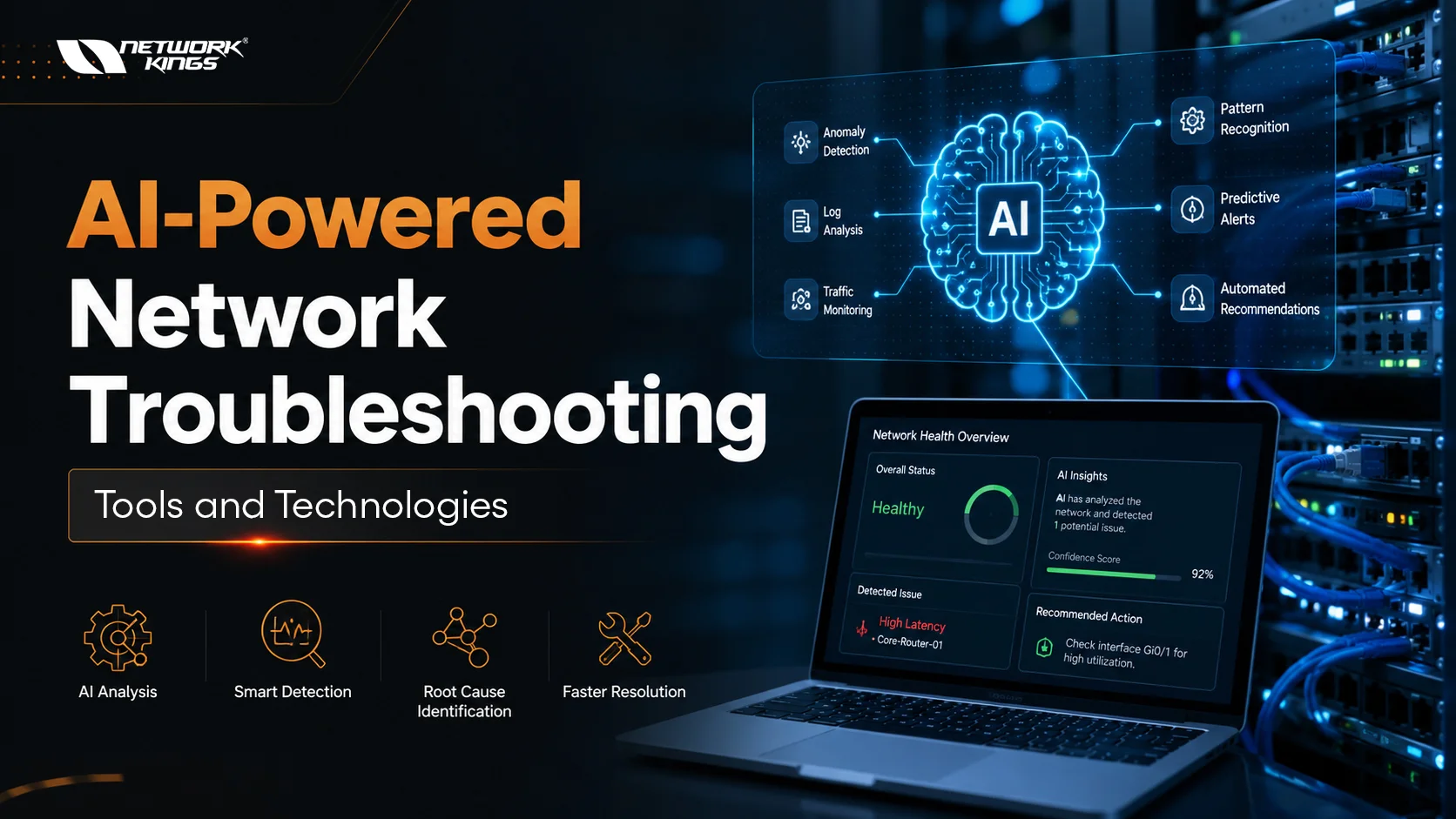
Network outages cost enterprises an average of thousands of dollars per minute, and most IT teams still spend hours chasing root causes across sprawling, hybrid infrastructures. As networks grow more complex, with cloud, SD-WAN, remote endpoints, and on-premises hardware all talking to each other, traditional troubleshooting simply cannot keep pace.
AI-powered network troubleshooting is the answer more network teams are turning to. In simple terms, it uses machine learning, automation, and real-time telemetry to detect, diagnose, and often resolve network issues faster and more accurately than manual methods ever could. This article breaks down how it works, the tools leading the space, and the techniques your team can start using today.
What Is AI-Powered Network Troubleshooting
AI-powered network troubleshooting refers to the use of artificial intelligence and machine learning models to monitor network behavior, identify anomalies, and pinpoint the root cause of performance issues automatically.
Instead of a network engineer manually sifting through logs and dashboards, AI systems continuously analyze telemetry data, including packet flows, latency metrics, device health, and traffic patterns. When something deviates from the norm, the system flags it, correlates it with related events, and often suggests or executes a fix.
This is where AIOps, short for artificial intelligence for IT operations, comes into play. AIOps platforms combine big data analytics, machine learning, and automation to give network operations center teams a unified view of network health, replacing fragmented monitoring tools with one intelligent layer.
Why Traditional Network Troubleshooting Falls Short
Manual troubleshooting worked reasonably well when networks were simpler. Today, it struggles for several reasons.
Alert fatigue overwhelms engineers with thousands of notifications daily, many of them false positives or duplicates
Manual root cause analysis across hybrid and multi-cloud environments can take hours or even days
Modern networks span physical, virtual, and cloud layers, making visibility fragmented and inconsistent
Scaling manual processes to match growing traffic volumes and device counts is simply not sustainable
Human-dependent diagnosis introduces delays and inconsistency, especially during high-pressure incidents
These limitations directly impact uptime, customer experience, and IT team morale, which is why enterprise network troubleshooting is shifting toward automated, data-driven approaches.
Key Benefits of AI-Powered Network Troubleshooting
Organizations adopting AI network monitoring report measurable improvements across several areas.
Faster root cause analysis through automated correlation of events across the network stack
Predictive issue detection that flags potential failures before they impact users
Reduced downtime thanks to quicker detection and, in many cases, automated remediation
Improved network visibility across cloud, on-premises, and hybrid environments
Enhanced operational efficiency, freeing up engineers to focus on strategic work instead of firefighting
Here is a side-by-side look at how the two approaches compare.
Traditional Troubleshooting | AI-Powered Troubleshooting |
Manual diagnosis | Automated analysis |
Reactive approach | Predictive approach |
Slower resolution | Faster resolution |
Limited scalability | High scalability |
Human-dependent insights | Data-driven insights |
Top AI-Powered Network Troubleshooting Tools
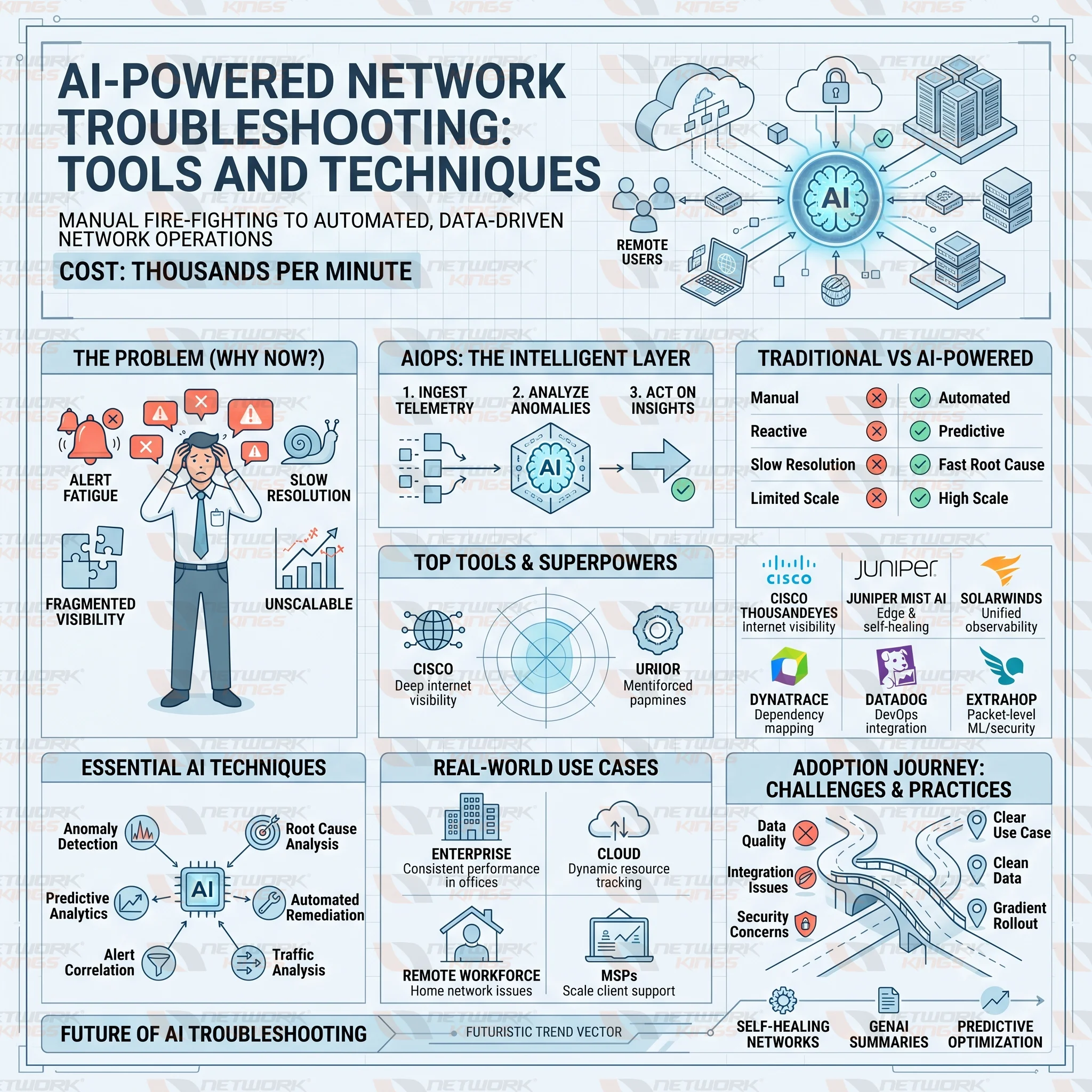
Several platforms have established themselves as leaders in this space, each with a distinct approach to network observability and automation.
Cisco ThousandEyes offers deep internet and cloud path visibility, mapping how traffic flows across ISPs, SaaS applications, and cloud providers. It is ideal for enterprises troubleshooting issues that originate outside their own network, and it benefits teams that need to prove whether a problem sits with their infrastructure or a third party.
Juniper Mist AI focuses heavily on wireless and wired access networks, using AI to automatically detect and resolve connectivity issues at the edge. It suits organizations with large campus or branch deployments and delivers strong self-healing capabilities for Wi-Fi environments.
SolarWinds Observability combines infrastructure, application, and network monitoring into a single platform with AI-driven alerting. It works well for IT teams that need broad visibility without juggling multiple point tools, and it helps reduce alert noise through smart correlation.
Dynatrace applies its Davis AI engine to automatically map dependencies and pinpoint root causes across complex, distributed systems. It is a strong fit for organizations running large-scale cloud native applications that need automated root cause analysis at speed.
Datadog provides network performance monitoring alongside its broader observability suite, correlating network metrics with application and infrastructure data. It benefits DevOps and cloud engineering teams that want network insights integrated into their existing monitoring workflows.
ExtraHop specializes in network detection and response, using machine learning to analyze traffic at the packet level for both performance issues and security threats. It is particularly valuable for teams that need network security and troubleshooting insights from a single data source.
Essential AI-Powered Troubleshooting Techniques
Beyond the tools themselves, several core techniques power AI-driven network operations.
Anomaly detection identifies deviations from established traffic and performance baselines
Root cause analysis correlates symptoms across the network to isolate the actual source of a problem
Predictive analytics uses historical data to forecast failures before they occur, supporting predictive maintenance
Automated remediation triggers scripted or AI-driven fixes without waiting for human intervention
Intelligent alert correlation groups related alerts into a single incident, cutting through noise
Network traffic pattern analysis spots unusual behavior that could indicate congestion, misconfiguration, or security threats
Real-World Use Cases of AI in Network Operations
AI-driven network analytics is being applied across multiple environments.
In enterprise networks, AI helps IT managers maintain consistent performance across offices and data centers without adding headcount. In cloud infrastructure, it tracks dynamic, ephemeral resources that traditional tools struggle to monitor. Data centers use AI to manage capacity and detect hardware degradation before it causes outages.
Remote workforce environments rely on AI to troubleshoot connectivity issues across countless home networks and VPN connections. Managed service providers use AI network automation to support multiple client networks simultaneously, scaling their operations without proportionally scaling staff.
Challenges and Best Practices
AI-powered troubleshooting is not without its hurdles.
Data quality concerns can undermine model accuracy if telemetry is incomplete or inconsistent
Integration challenges arise when connecting AI tools with legacy infrastructure
AI model accuracy depends on continuous tuning and quality training data
Security considerations matter, since AI systems often require broad network visibility
Best practices for successful adoption include starting with a clear use case, ensuring clean and comprehensive telemetry, involving experienced network engineers in model validation, and rolling out automation gradually rather than all at once.
Future of AI-Powered Network Troubleshooting
Looking ahead, autonomous networking and self-healing networks are gaining real traction, with systems capable of detecting and resolving issues without human input. Generative AI is beginning to assist engineers by summarizing incidents in plain language and recommending fixes conversationally. Predictive network optimization will continue to mature, allowing networks to adjust proactively rather than just reactively.
Conclusion
AI-powered network troubleshooting is reshaping how network engineers, NOC teams, and IT managers keep systems running smoothly. From faster root cause analysis to predictive issue detection, the benefits are too significant to ignore for any team managing modern, hybrid infrastructure.
As networks continue to grow in complexity, investing time in learning AIOps platforms and AI-driven network analytics tools will be one of the most valuable moves a networking professional can make this year.
FAQs
What is AI-powered network troubleshooting?
It is the use of artificial intelligence and machine learning to automatically detect, diagnose, and often resolve network performance issues, replacing much of the manual analysis engineers traditionally performed.
How does AI improve network troubleshooting?
AI improves troubleshooting by analyzing telemetry in real time, correlating related alerts, predicting failures before they happen, and in some cases triggering automated fixes.
What is AIOps in networking
AIOps stands for artificial intelligence for IT operations. In networking, it refers to platforms that combine machine learning and automation to monitor, analyze, and manage network health from a single system.
What are the best AI network monitoring tools?
Popular options include Cisco ThousandEyes, Juniper Mist AI, SolarWinds Observability, Dynatrace, Datadog, and ExtraHop, each suited to different environments and use cases.
Can AI fully replace network engineers
No. AI handles detection, correlation, and routine remediation, but experienced engineers are still needed for strategic decisions, complex incidents, and validating AI recommendations.
What is root cause analysis in network troubleshooting
Root cause analysis is the process of identifying the actual underlying source of a network issue, rather than just addressing its visible symptoms.
How does predictive analytics help prevent network outages
Predictive analytics examines historical and real-time data to identify patterns that typically precede failures, allowing teams to address problems before they cause downtime.
Is AI network troubleshooting suitable for small businesses
Yes. Many AI-powered observability platforms offer scalable pricing and cloud-based deployment, making them accessible to smaller IT teams as well as large enterprises.
What is network observability?
Network observability is the ability to understand the internal state of a network based on the data it produces, including logs, metrics, and traces, giving teams deeper insight than basic monitoring alone.
What skills do network engineers need for AI-driven networking
Engineers benefit from understanding data analytics fundamentals, AIOps platforms, automation scripting, and how to interpret and validate AI-generated recommendations.

The founder of Network Kings, is a renowned Network Engineer with over 12 years of experience at top IT companies like TCS, Aricent, Apple, and Juniper Networks. Starting his journey through a YouTube channel in 2013, he has inspired thousands of students worldwide to build successful careers in networking and IT. His passion for teaching and simplifying complex technologies makes him one of the most admired mentors in the industry.