DevOps Fundamentals Explained with Core Pillars and Essential Tools
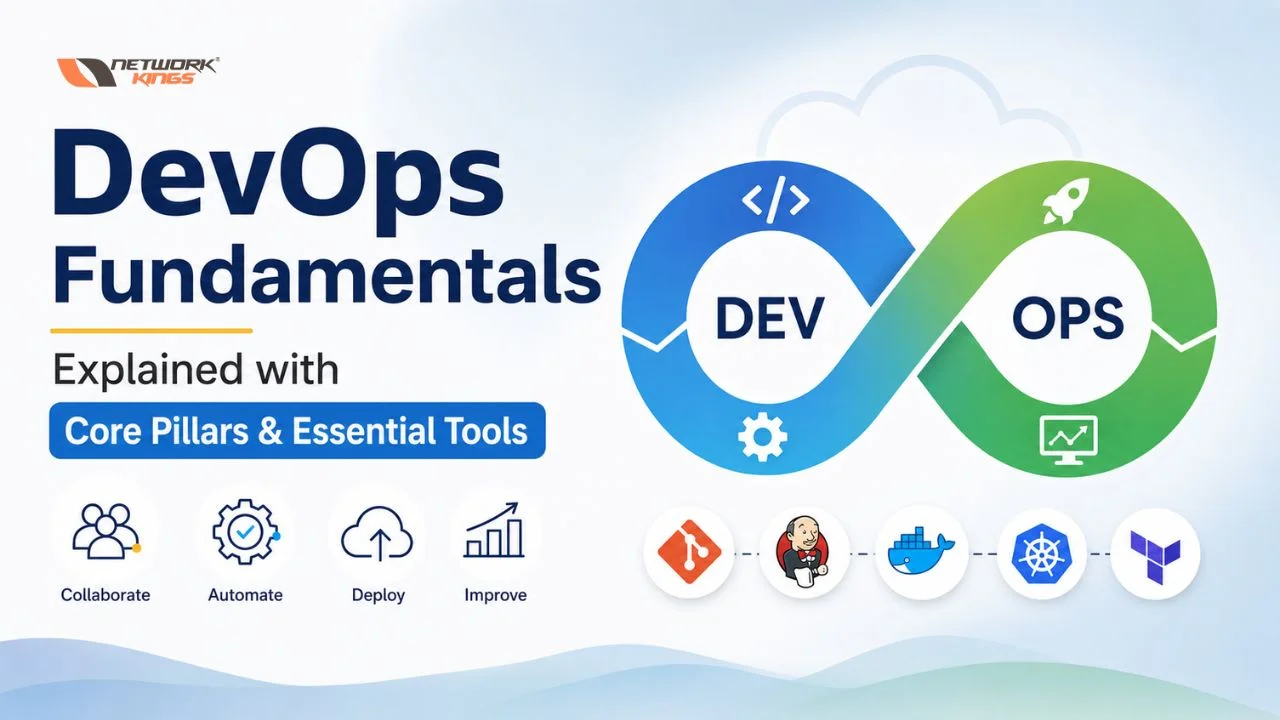
DevOps has transformed the way organizations build, deploy, and manage software. In today's cloud-driven world, businesses need faster releases, reliable infrastructure, and seamless collaboration between development and operations teams. This is where DevOps becomes a critical part of modern IT strategies.
DevOps fundamentals refer to the core principles, practices, and technologies that enable development and operations teams to work together efficiently. These fundamentals include collaboration, automation, Continuous Integration, Continuous Delivery, Infrastructure as Code, monitoring, security, and continuous improvement. Together, they help organizations deliver software faster, improve reliability, and reduce operational risks.
Whether you're a beginner exploring DevOps, a system administrator moving toward automation, or an aspiring cloud engineer, understanding these fundamentals is essential for long-term success.
What Are DevOps Fundamentals
DevOps is a combination of development and operations practices designed to shorten the software development lifecycle while maintaining high-quality releases.
The primary goal of DevOps is to eliminate traditional silos between development and operations teams. Instead of working independently, teams collaborate throughout the entire Software Development Lifecycle.
Organizations implementing DevOps practices often experience:
Faster software releases
Improved deployment success rates
Better infrastructure reliability
Reduced downtime
Increased customer satisfaction
DevOps is not just about tools. It is a culture that promotes communication, shared responsibility, and continuous improvement.
Why DevOps Matters in Modern IT
Organizations do not adopt DevOps because it is trendy. They adopt it because the alternative, siloed development and operations teams throwing code over a wall, simply does not scale in a cloud computing world.
A few concrete benefits show up repeatedly in real deployments:
Faster software delivery, since automated pipelines remove manual bottlenecks between coding and release
Improved collaboration, because developers and operations share ownership of the same production outcomes
Higher reliability, driven by automated testing and consistent deployment processes
Scalability, since infrastructure as code and container orchestration make it easy to grow capacity on demand
Reduced operational risk, because smaller, more frequent releases are easier to test, monitor, and roll back
I have seen teams cut deployment time from days to minutes simply by automating what used to be a manual checklist. That is not a marketing claim; it is what happens when you remove human bottlenecks from repeatable processes.
The Core Pillars of DevOps
Culture and Collaboration
DevOps culture starts with shared responsibility. Developers care about how their code performs in production, and operations engineers get involved earlier in the design process. Blame-free postmortems and open communication channels matter more here than any specific tool.
Automation
Automation is the engine behind every other pillar. Manual processes do not scale, and they introduce human error. Whether it is provisioning servers, running tests, or deploying containers, DevOps automation removes repetitive work so engineers can focus on higher-value problems.
Continuous Integration
Continuous Integration means developers merge code into a shared repository frequently, with automated builds and tests running on every commit. This catches integration issues early, before they compound into larger problems.
Continuous Delivery
Continuous Delivery extends CI by ensuring that every code change that passes automated tests is packaged and ready for release at any time. Continuous Deployment goes a step further and automatically pushes that code to production, though many organizations keep a manual approval gate for compliance reasons.
Monitoring and Observability
You cannot fix what you cannot see. Monitoring and observability provide real-time visibility into application health, infrastructure performance, and user experience, which is essential for catching problems before customers do.
Infrastructure as Code
Infrastructure as Code treats servers, networks, and cloud resources as version-controlled configuration files rather than manually configured systems. This makes environments reproducible, auditable, and far less prone to configuration drift.
Security and DevSecOps
DevSecOps embeds security checks directly into the CI/CD pipeline instead of treating security as a final gate before release. Scanning dependencies, container images, and infrastructure code early catches vulnerabilities when they are cheapest to fix.
Continuous Feedback and Improvement
DevOps is a loop, not a straight line. Continuous feedback from monitoring, user behavior, and incident reviews feeds back into planning, which is what separates mature DevOps organizations from teams that just automated a few scripts and stopped there.
Essential DevOps Tools Every Professional Should Know
Tool Name | Category | Primary Function | Common Use Case |
Git | Version Control | Tracks and manages source code changes | Branching and merging code across teams |
GitHub | Code Hosting | Hosts repositories and enables collaboration | Pull requests, code review, CI triggers |
GitLab | DevOps Platform | Combines source control with built-in CI/CD | End-to-end pipeline management |
Jenkins | CI/CD Automation | Automates build, test, and deployment tasks | Custom, self-hosted CI/CD pipelines |
Docker | Containerization | Packages applications with dependencies | Consistent environments across dev and prod |
Kubernetes | Container Orchestration | Manages, scales, and heals containerized apps | Runs microservices at production scale |
Terraform | Infrastructure as Code | Provisions cloud infrastructure declaratively | Managing multi-cloud environments consistently |
Ansible | Configuration Management | Automates server configuration and provisioning | Applies consistent configs across fleets |
Prometheus | Monitoring | Collects and stores time-series metrics | Alerting on infrastructure and app health |
Grafana | Observability Dashboarding | Visualizes metrics and logs | Building real-time monitoring dashboards |
How DevOps Tools Support the DevOps Lifecycle
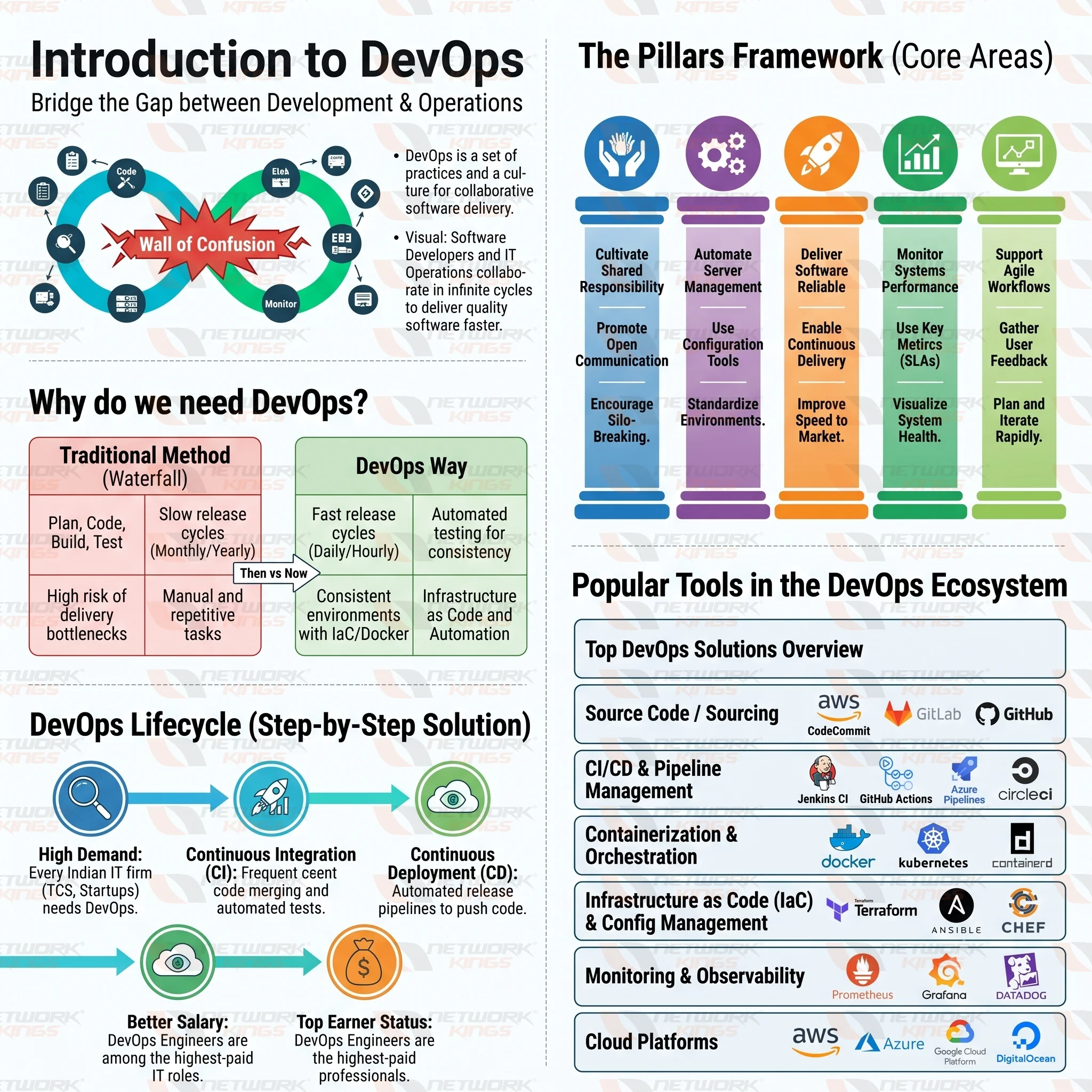
No single tool delivers DevOps on its own. Git and GitHub handle version control. Jenkins or GitLab CI automate the build and test stages. Docker packages the application consistently, and Kubernetes takes over orchestration and scaling in production. Terraform and Ansible provision and configure the underlying infrastructure, while Prometheus and Grafana close the loop with monitoring and observability.
Each tool hands off to the next in a way that mirrors the DevOps lifecycle itself: plan, code, build, test, release, deploy, operate, and monitor.
Real-World Example of a DevOps Workflow
Picture a typical enterprise workflow. A developer commits code to a Git repository. That commit triggers a CI pipeline in Jenkins or GitLab, which runs unit tests and builds a Docker image. If the image passes automated testing, it gets pushed to a container registry and deployed to a Kubernetes cluster using a GitOps approach, where the desired state lives in a Git repository and an operator like Argo CD reconciles the cluster to match it.
Once live, Prometheus scrapes metrics from the application and infrastructure, and Grafana dashboards give the team real-time visibility. If something breaks, alerts fire, the team investigates, and lessons from the incident feed back into the next sprint. That is the DevOps lifecycle in action, not a diagram on a slide.
Common Challenges When Adopting DevOps
Cultural resistance often shows up when teams have worked in silos for years. Start small, prove value with one pipeline, and let results build momentum.
Tool complexity can overwhelm teams new to Kubernetes or Terraform. Invest in training and start with managed services before running everything self-hosted.
Security concerns grow as deployment frequency increases. Embedding DevSecOps practices early, rather than bolting security on at the end, solves this before it becomes a blocker.
Skills gaps are real, especially around cloud platforms and container orchestration. Pairing junior engineers with mentors and investing in certifications closes this gap faster than hoping people figure it out alone.
Legacy infrastructure rarely disappears overnight. A hybrid approach, containerizing new services while gradually modernizing legacy systems, tends to work better than a forced rewrite.
DevOps Career Opportunities and Skills
A strong DevOps engineer typically brings together several skill areas:
Solid Linux knowledge, since most production infrastructure runs on it
Familiarity with at least one major cloud platform, such as AWS, Microsoft Azure, or Google Cloud
Hands-on automation skills using scripting languages and tools like Ansible
Container experience with Docker and orchestration experience with Kubernetes
Comfort building and maintaining CI/CD pipelines
Working knowledge of Infrastructure as Code tools like Terraform
These fundamentals also map directly onto industry certifications, and understanding the core pillars covered here gives you a real foundation rather than memorized exam answers. As organizations continue investing in platform engineering and cloud-native development, professionals who understand both the cultural and technical sides of DevOps will keep finding strong career opportunities.
DevOps is not about adopting every tool on the market. It is about building a culture of collaboration, automating what should not be manual, and continuously learning from feedback. Get those fundamentals right, and the tools become far easier to choose.
FAQs
What are the fundamentals of DevOps?
DevOps fundamentals are the culture, practices, and automation principles that unify development and operations teams to deliver software faster and more reliably.
What are the core pillars of DevOps?
The core pillars include culture and collaboration, automation, continuous integration, continuous delivery, monitoring and observability, infrastructure as code, security, and continuous feedback.
Which tools are used in DevOps?
Common DevOps tools include Git, GitHub, GitLab, Jenkins, Docker, Kubernetes, Terraform, Ansible, Prometheus, and Grafana.
Is DevOps difficult for beginners?
DevOps has a learning curve, especially around cloud platforms and containers, but beginners with basic Linux and scripting knowledge can build proficiency steadily through hands-on practice.
How long does it take to learn DevOps fundamentals?
Most learners grasp core DevOps fundamentals within three to six months of consistent, hands-on practice with version control, CI/CD, and cloud platforms.
What is the role of automation in DevOps?
Automation removes manual, repetitive tasks from building, testing, and deploying software, reducing errors and speeding up delivery.
Why is Kubernetes important in DevOps?
Kubernetes automates the deployment, scaling, and management of containerized applications, making it essential for running reliable microservices at scale.
What skills are required to become a DevOps engineer?
Key skills include Linux administration, cloud platform experience, scripting and automation, containerization, CI/CD pipeline management, and infrastructure as code.

The founder of Network Kings, is a renowned Network Engineer with over 12 years of experience at top IT companies like TCS, Aricent, Apple, and Juniper Networks. Starting his journey through a YouTube channel in 2013, he has inspired thousands of students worldwide to build successful careers in networking and IT. His passion for teaching and simplifying complex technologies makes him one of the most admired mentors in the industry.