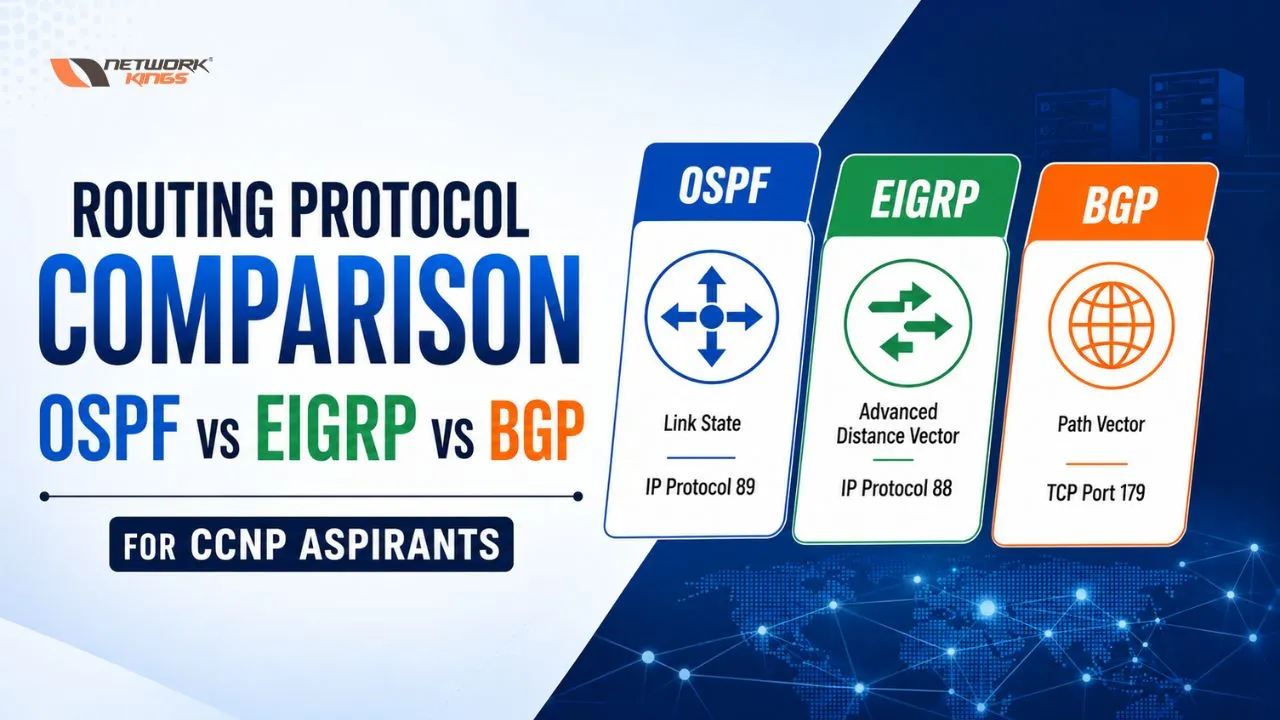
Routing Protocol Comparison OSPF vs EIGRP vs BGP for CCNP Aspirants
If you are preparing for CCNP Enterprise, you have probably already noticed that routing protocols are not just an exam topic. They are the backbone of every network you will ever design, troubleshoot, or defend at 2 a.m. when something breaks. OSPF, EIGRP, and BGP appear frequently in study guides, lab exercises, and real job interviews, yet many candidates memorize commands without truly understanding why one protocol wins over another in a given scenario.
You will see how each protocol works, where it fits in enterprise networking, and which one deserves most of your study hours before exam day. By the end, you should be able to walk into a design conversation or a CCNP question and confidently explain OSPF vs EIGRP vs BGP without hesitating.
Why Routing Protocol Selection Matters for CCNP Enterprise
Dynamic routing protocols exist to solve one problem: how do routers learn about networks they are not directly connected to, and how do they pick the best path to reach them? Interior Gateway Protocols like OSPF and EIGRP handle routing within a single Autonomous System, while Exterior Gateway Protocols like BGP handle routing between different Autonomous Systems, including the entire internet.
CCNP candidates need more than textbook definitions. Exam scenarios often test your ability to choose the right protocol for a described environment, troubleshoot convergence issues, or explain trade-offs between complexity and scalability. That is exactly what we will unpack here.
Understanding OSPF Routing Protocol
Open Shortest Path First is a link-state routing protocol. Instead of trusting a neighbor's word about the best path, every OSPF router builds its own map of the entire network topology using link-state advertisements, then runs the Dijkstra algorithm to calculate the shortest path independently.
This link state approach gives OSPF fast, accurate convergence and strong scalability when the network is properly divided into areas. Area design is actually where most real-world OSPF headaches come from. Get your area boundaries wrong, and you end up with unnecessary flooding and messy summarization.
Advantages of OSPF
Open standard, so it works across Cisco, Juniper, and other vendors
Fast convergence through link-state flooding
Scales well with hierarchical area design
Strong support for route summarization at area borders
Limitations of OSPF
More complex configuration than EIGRP, especially with a multi-area design
Higher CPU and memory usage on larger topologies
Requires careful planning to avoid suboptimal area structure
Understanding EIGRP Routing Protocol
EIGRP, or Enhanced Interior Gateway Routing Protocol, is often described as an advanced distance vector protocol, though Cisco has also positioned it closer to a hybrid model because of its use of the Diffusing Update Algorithm, or DUAL. EIGRP calculates routes using a composite metric based on bandwidth and delay by default, with load and reliability available as optional factors.
What makes EIGRP appealing in Cisco-heavy environments is simplicity. It configures faster than OSPF, converges quickly using DUAL's feasible successor concept, and handles unequal cost load balancing, something OSPF cannot do natively.
Advantages of EIGRP
Simple configuration and fast deployment
Rapid convergence using precomputed backup paths
Unequal cost load balancing for better bandwidth utilization
Lower administrative distance than OSPF, giving it default preference when both run together
Limitations of EIGRP
Historically, Cisco proprietary, though now partially open through an IETF informational draft
Less ideal in mixed vendor environments
Can become harder to manage at a very large internet scale compared to link state or path vector designs
Understanding BGP Routing Protocol
BGP, or Border Gateway Protocol, is a path vector routing protocol and the only Exterior Gateway Protocol most engineers will ever touch. BGP is what holds the internet together, connecting Autonomous Systems across service providers, enterprises, and cloud environments.
Unlike OSPF and EIGRP, BGP does not care about bandwidth or delay by default. It makes decisions based on path attributes like AS path length, local preference, and MED, giving network administrators granular policy control over how traffic enters and leaves their network.
Advantages of BGP
Extremely scalable, capable of holding the entire internet routing table
Highly flexible policy-based routing through attributes
Essential for multi-homed enterprises and service providers
Industry standard for internet-scale routing
Limitations of BGP
Slower convergence compared to OSPF and EIGRP
Steeper learning curve, especially around attributes and path selection
Overkill for small or single-site internal networks
Routing Protocol Comparison Table
Feature | OSPF | EIGRP | BGP |
Protocol Type | Link State (IGP) | Advanced Distance Vector (IGP) | Path Vector (EGP) |
Administrative Distance | 110 | 90 (internal) | 20 (external) / 200 (internal) |
Metric | Cost, based on bandwidth | Composite of bandwidth and delay | Path attributes (AS path, local preference, MED) |
Scalability | High, with area design | Moderate to high | Extremely high, internet scale |
Convergence Speed | Fast | Very fast | Slower, policy-driven |
Complexity | Moderate to high | Low to moderate | High |
Best Use Cases | Multi-vendor enterprise networks | Cisco-centric enterprise networks | ISPs, multi-homed enterprises, cloud interconnects |
Vendor Support | Multi-vendor, open standard | Primarily Cisco | Multi-vendor, open standard |
CCNP Exam Relevance | Very high | High | Very high |
Key Differences Between OSPF, EIGRP, and BGP
When comparing OSPF vs EIGRP vs BGP, the biggest distinction lies in their intended purpose.
OSPF and EIGRP are designed for routing within an organization's network. BGP is designed for routing between organizations and service providers.
Another major difference is scalability. OSPF works exceptionally well in large enterprise networks, while BGP is built for internet-scale environments. EIGRP excels in medium- to large Cisco-based deployments where simplicity and fast convergence are priorities.
Routing metrics also vary significantly.
OSPF uses cost based on interface bandwidth.
EIGRP uses a composite metric that includes bandwidth and delay.
BGP relies on path attributes such as AS Path, Local Preference, and MED for route selection
Real-World Scenarios Where Each Protocol Wins
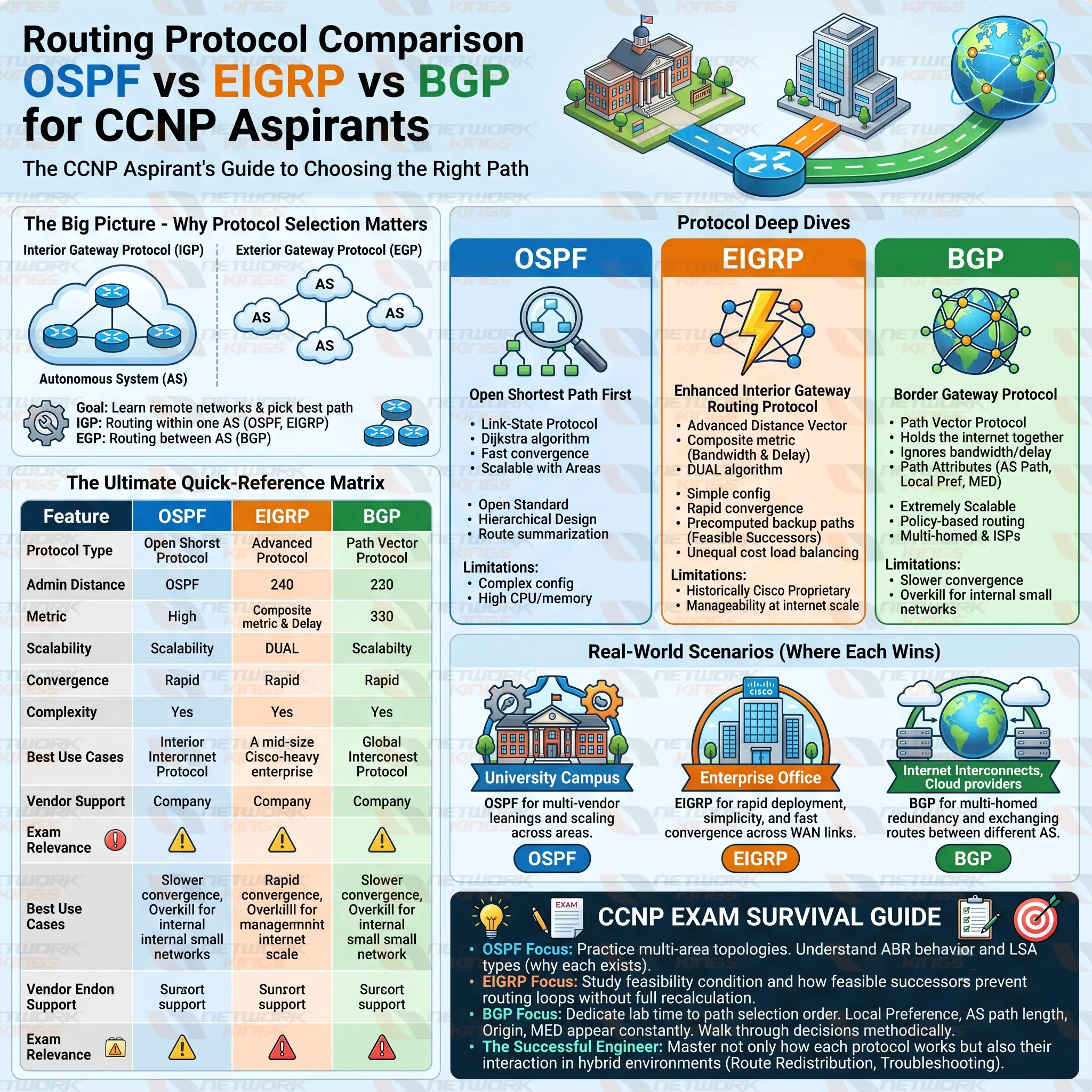
A university campus running a mix of Cisco, Juniper, and Arista switches will typically lean on OSPF because it is vendor-neutral and scales cleanly across multiple buildings using areas.
A mid-size enterprise that has standardized entirely on Cisco gear, and wants quick deployment with minimal tuning often chooses EIGRP for its simplicity and fast convergence, especially across WAN links with varying bandwidth.
A company connecting to two different internet service providers for redundancy, or a data center connecting to multiple cloud providers, has no real alternative to BGP. Anytime you are exchanging routes between separate Autonomous Systems, BGP is the tool for the job.
Which Protocol Should CCNP Aspirants Focus on Most
For CCNP Enterprise candidates, OSPF deserves the highest priority because it appears extensively throughout the exam blueprint and real-world enterprise deployments.
However, focusing exclusively on OSPF would be a mistake.
A strong CCNP candidate should understand:
OSPF area design and route calculation.
EIGRP metric computation and DUAL operations.
BGP path selection and policy-based routing concepts.
Route redistribution between multiple protocols.
Routing protocol troubleshooting methodologies.
The most successful network engineers understand not only how each protocol works individually but also how they interact in hybrid environments.
Practical Exam Tips and Implementation Insights
Practice configuring OSPF multi-area topologies until area border router behavior feels automatic. Memorize LSA types, but more importantly, understand why each one exists.
For EIGRP, focus on the feasibility condition and how feasible successors prevent routing loops without needing a full topology recalculation.
For BGP, spend real lab time on path selection order. Local preference, AS path length, origin type, and MED show up constantly in scenario-based questions, and candidates who can walk through the decision process methodically tend to perform better under exam pressure.
Conclusion
Understanding the routing protocol comparison OSPF vs EIGRP vs BGP is one of the most valuable skills you can build on your path to CCNP Enterprise. OSPF gives you scalable, vendor-neutral interior routing. EIGRP offers simplicity and speed in Cisco-centric environments. BGP handles the massive, policy-driven task of connecting Autonomous Systems across the internet.
Rather than memorizing isolated facts, focus on understanding why each protocol was designed the way it was. That mindset will carry you through CCNP exam scenarios and, more importantly, through real network design decisions once you are working in the field.
FAQs
Is OSPF better than EIGRP?
Neither is universally better. OSPF is the stronger choice in multi-vendor environments and large hierarchical networks, while EIGRP is simpler and faster to deploy in Cisco-only environments.
When should I use BGP instead of OSPF or EIGRP?
Use BGP when you need to exchange routes between separate Autonomous Systems, such as connecting to an ISP, another organization, or multiple cloud providers. OSPF and EIGRP are designed for routing within a single Autonomous System.
Does CCNP Enterprise require deep BGP knowledge?
Yes. BGP is a significant portion of the ENCOR exam and continues to grow in relevance because of multi-cloud and SD-WAN architectures.
Can OSPF and EIGRP run on the same network?
Yes, though redistribution between them requires careful metric and administrative distance planning to avoid routing loops or suboptimal paths.
Which protocol converges the fastest?
EIGRP typically converges the fastest due to its feasible successor mechanism, followed closely by OSPF. BGP converges more slowly because it is policy-driven rather than purely metric-driven.

The founder of Network Kings, is a renowned Network Engineer with over 12 years of experience at top IT companies like TCS, Aricent, Apple, and Juniper Networks. Starting his journey through a YouTube channel in 2013, he has inspired thousands of students worldwide to build successful careers in networking and IT. His passion for teaching and simplifying complex technologies makes him one of the most admired mentors in the industry.