SD-WAN Training and AI-Powered Network Operations in 2026
Enterprise networking looks nothing like it did five years ago. Branch offices no longer connect to a single data center over a leased line. Instead, traffic moves across multiple clouds, SaaS platforms, and remote work environments, all at once, all day long.
This shift has pushed two technologies to the center of every serious networking conversation in 2026: software-defined WAN and artificial intelligence. Network teams are no longer just routing packets. They are managing distributed, cloud-first environments where downtime costs real money and security gaps cost even more.
AI and automation have moved from buzzwords to daily tools inside network operations centers. Engineers who understand how to pair SD-WAN with AI-driven monitoring and remediation are the ones getting hired, promoted, and trusted with mission-critical infrastructure.
This is exactly why SD-WAN Training has become one of the most practical investments a networking professional can make right now. It is not just about learning a new acronym. It is about staying relevant in a job market that is rapidly shifting toward intelligent, self-optimizing networks.
What Is SD-WAN
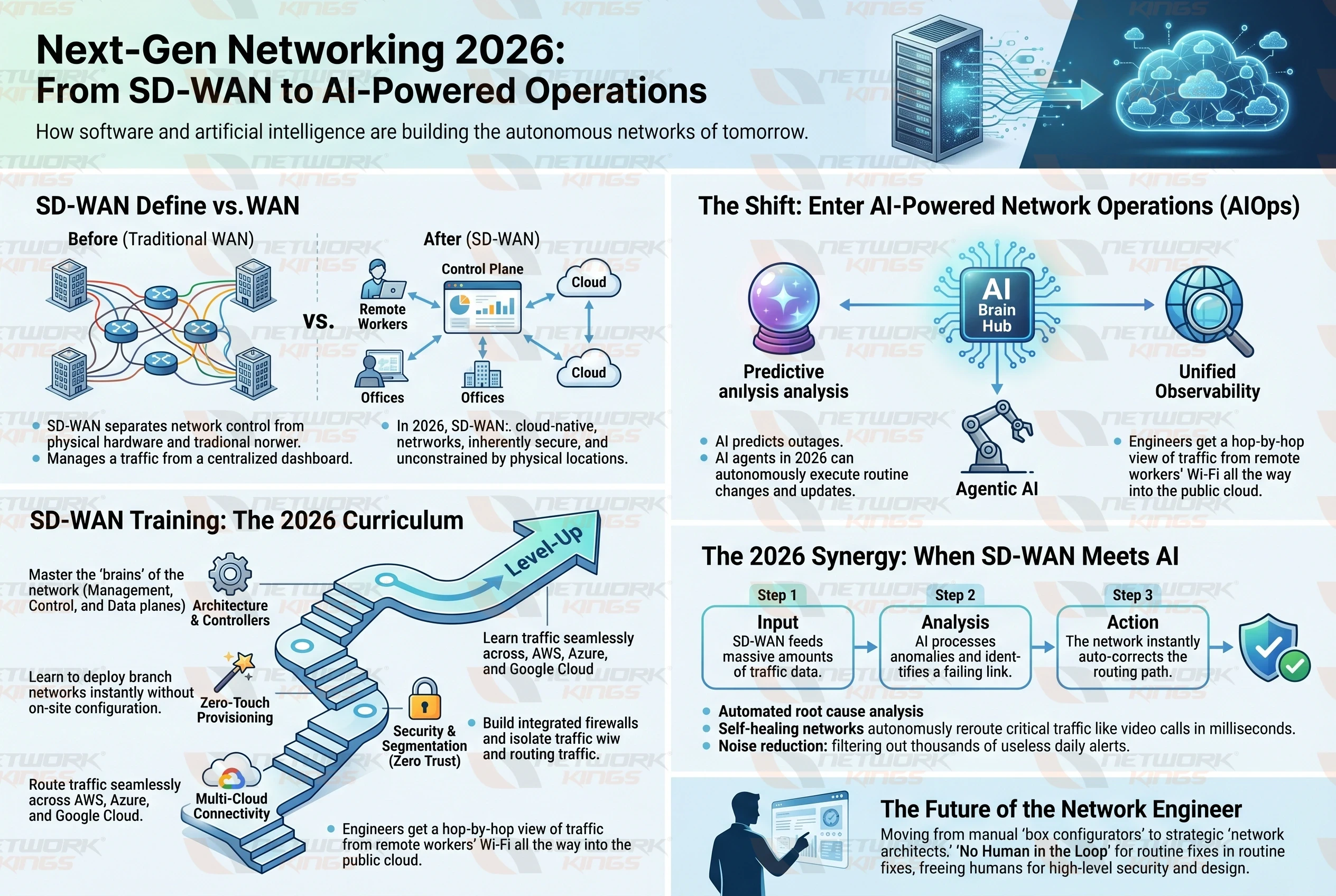
Software-defined WAN, or SD-WAN, is an architecture that separates network control from the underlying hardware. Instead of manually configuring routers at every branch location, network teams manage connectivity through a centralized software controller.
How Software-Defined WAN Works
An SD-WAN deployment typically includes edge devices at each site, a centralized orchestrator, and policies that determine how traffic moves across available links. The system constantly evaluates link quality and routes traffic over the best available path, whether that is broadband, LTE, or MPLS.
If a primary connection degrades, SD-WAN can shift traffic to a backup path in near real time, often without anyone noticing.
Traditional WAN vs SD-WAN
Traditional WAN relies heavily on MPLS circuits and manual, device-by-device configuration. Every change request can take days. Traditional WAN also struggles with cloud traffic, since it was designed for hub-and-spoke models pointing back to a data center.
SD-WAN flips this model. Traffic destined for cloud applications can go directly to the internet instead of being forced through a central hub. Configuration changes happen centrally and push out to hundreds of sites within minutes.
Business Benefits
Organizations adopt SD-WAN because it reduces WAN costs, improves application performance, and simplifies network management. It also gives IT teams better visibility into traffic patterns across the entire enterprise, something traditional WAN architectures never offered well.
Why SD-WAN Skills Are in High Demand in 2026
Cloud Adoption
Most enterprise applications now live in the cloud. Networks built for on-premises data centers cannot efficiently route this traffic. SD-WAN gives organizations direct, optimized cloud connectivity, and someone needs to design and manage that.
Hybrid Workforce
Remote and hybrid work are permanent fixtures of enterprise life. Employees connect from home offices, co-working spaces, and branch locations, all expecting consistent application performance. SD-WAN, paired with secure access service edge frameworks, makes this possible.
Multi-Cloud Networking
Few enterprises rely on a single cloud provider anymore. A retail chain might run inventory systems on one cloud platform and customer analytics on another. Cloud networking professionals who understand multi-cloud SD-WAN design are increasingly difficult to find, which drives up demand and salaries.
Enterprise Digital Transformation
Digital transformation initiatives almost always touch the network. A manufacturing company rolling out IoT sensors across factory floors needs a WAN that can handle massive data volumes with low latency. SD-WAN engineers are the ones designing these rollouts.
Security Requirements
Security and networking have merged. SD-WAN platforms increasingly bake in firewall, segmentation, and threat detection capabilities. Professionals trained in SD-WAN security integration are positioned well above generalist network administrators.
What Are AI-Powered Network Operations
AI-powered network operations, often shortened to AIOps for networking, apply machine learning to the massive volume of telemetry data flowing through modern networks.
AIOps
AIOps platforms ingest logs, metrics, and flow data from across the network, then use machine learning models to detect patterns humans would likely miss. Instead of an engineer manually correlating ten different alerts, the AIOps system identifies the root cause and surfaces it directly.
Machine Learning in Networking
Machine learning models trained on historical network behavior can recognize what normal traffic looks like for a specific organization. When something deviates, the system flags it long before it becomes a noticeable outage.
Predictive Analytics
Predictive analytics tools forecast issues before they happen. A network analytics platform might notice that a particular branch circuit degrades every afternoon during peak hours and recommend a proactive fix.
Intelligent Troubleshooting
Intelligent troubleshooting tools can trace an issue across multiple network layers automatically. What used to take a senior engineer hours of manual log review now takes minutes.
Automated Network Optimization
AI systems can adjust quality-of-service policies, reroute traffic, and rebalance loads automatically, often without human intervention. This is where AI for network management moves from theory into daily operational value.
SD-WAN and AI-Powered Network Operations Comparison Table
Capability | Traditional Network Operations | SD-WAN Operations | AI-Driven Network Operations |
Management Approach | Manual, device by device | Centralized software control | Centralized with adaptive automation |
Visibility | Limited, siloed | Improved, application-aware | Full visibility with predictive insight |
Automation | Minimal | Policy-based automation | Self-optimizing automation |
Troubleshooting Speed | Slow, reactive | Faster, centralized diagnostics | Near real-time, AI-assisted |
Security | Perimeter based | Integrated segmentation | AI-driven threat detection |
Scalability | Difficult, hardware dependent | Easier, software driven | Highly scalable, self-adjusting |
Operational Efficiency | Low | Moderate to high | Very high |
How AI Enhances SD-WAN Deployments
Traffic Optimization
AI continuously analyzes application performance and adjusts routing decisions dynamically. A video conferencing application gets prioritized automatically during a live executive meeting without manual policy changes.
Predictive Failure Detection
Machine learning models can flag a degrading circuit days before it fails. NOC engineers for network operations centers can schedule maintenance proactively instead of responding to outages.
Root Cause Analysis
When multiple alerts fire simultaneously, AI correlates them into a single incident with a likely root cause. This dramatically reduces mean time to resolution.
Network Performance Monitoring
Continuous AI-driven monitoring tracks latency, jitter, and packet loss across every link, flagging anomalies that human reviewers might overlook during routine checks.
Automated Remediation
Some platforms now trigger automatic remediation steps, such as rerouting traffic or restarting a failing service, without waiting for human approval on low-risk fixes.
Real-World Enterprise Use Case
A national logistics company recently deployed AI-enhanced SD-WAN across 400 distribution centers. Predictive analytics flagged a recurring circuit issue at twelve sites weeks before it would have caused outages, saving the company significant downtime during peak shipping season.
Essential Skills Covered in Modern SD-WAN Training
Quality SD-WAN training programs go far beyond product certifications. They build a foundation across multiple disciplines.
SD-WAN architecture and design principles
Security integration, including firewall and segmentation policies
Network automation using scripting and APIs
Cloud connectivity for AWS, Azure, and Google Cloud
Policy management for application aware routing
Performance optimization techniques
AI-driven analytics interpretation and response
Engineers who understand both the networking fundamentals and the AI tools layered on top are far more valuable than those who only know one side.
Best SD-WAN Technologies to Learn in 2026
Cisco SD-WAN
Cisco SD-WAN, built on the Viptela platform, remains one of the most widely deployed solutions in large enterprises. It is common in organizations already invested in Cisco's broader networking ecosystem.
VMware SD-WAN
VMware SD-WAN is popular among organizations prioritizing flexible cloud integration and strong application performance management, particularly in mid-size to large enterprises.
Fortinet Secure SD-WAN
Fortinet's solution is frequently chosen by security-conscious organizations because it combines SD-WAN functionality with Fortinet's firewall and threat protection capabilities.
Versa Networks
Versa is known for its strong multi-tenant capabilities, making it a frequent choice for managed service providers offering SD-WAN to multiple clients.
Juniper Session Smart Networking
Juniper's session-based approach is gaining traction in environments that need granular, application-level traffic control, particularly in service provider and large enterprise networks.
Career Opportunities After SD-WAN Training
SD-WAN Engineer
SD-WAN engineers design, deploy, and maintain SD-WAN infrastructure across enterprise locations. This role sits at the center of most modern networking teams.
Network Engineer
General network engineers increasingly need SD-WAN knowledge as more organizations migrate away from traditional WAN architectures entirely.
Network Automation Engineer
This role focuses on scripting and API-driven automation across SD-WAN and broader infrastructure, often working closely with AIOps platforms.
Cloud Network Engineer
Cloud network engineers design connectivity between on-premises environments and multiple cloud platforms, a role that depends heavily on SD-WAN expertise.
NOC Engineer
Modern NOC engineers rely on AI-driven dashboards and SD-WAN visibility tools to monitor enterprise networks around the clock.
Enterprise Network Architect
Architects design the overall network strategy for large organizations, requiring deep expertise in SD-WAN, security, and AI-driven operations.
Professionals moving into these roles often see meaningful salary growth, particularly when they combine SD-WAN certification with hands-on automation and cloud networking experience.
Future Trends in AI Networking
Autonomous Networks
Networks are moving toward self-managing systems that detect, diagnose, and resolve issues with minimal human input.
Intent-Based Networking
Intent-based networking allows administrators to define desired outcomes, such as prioritizing video traffic, while the system automatically configures the underlying infrastructure to achieve that goal.
Generative AI for Operations
Generative AI tools are starting to assist engineers by drafting configuration changes, summarizing incidents, and even answering natural language queries about network health.
Self-Healing Networks
Self-healing capabilities allow networks to detect degraded performance and automatically reroute or remediate without waiting for a ticket to be filed.
AI-Driven Security
AI is increasingly used to detect anomalous behavior that signals a security threat, often catching issues that signature-based tools miss entirely.
Multi-Cloud Automation
As enterprises spread workloads across multiple cloud providers, automation tools are evolving to manage connectivity and policy consistently across all of them.
Over the next five years, these trends will continue shifting network engineering roles away from manual configuration and toward oversight, strategy, and AI tool management. Engineers who adapt early will lead this transition rather than be displaced by it.
Why Investing in SD-WAN Training Matters
For Students
Students entering networking should prioritize SD-WAN and basic AIOps concepts early. Employers increasingly expect graduates to understand cloud networking fundamentals, not just legacy routing and switching.
For Working Professionals
Professionals already in networking roles should pursue SD-WAN certification to stay competitive, particularly if their current experience is concentrated in traditional WAN environments.
For System Administrators
System administrators looking to move into networking roles will find SD-WAN training builds a practical bridge, especially when combined with basic scripting skills.
For Network Engineers
Experienced network engineers should focus on pairing SD-WAN expertise with AI-driven analytics tools, since this combination is becoming the new baseline for senior roles.
For Cloud Professionals
Cloud professionals benefit from SD-WAN training because it strengthens their ability to design secure, high-performance connectivity between cloud environments and physical locations.
Final Thoughts
SD-WAN and AI-powered network operations are no longer separate trends. They are converging into a single operational model that defines modern enterprise networking. SD-WAN provides the flexible, software-driven foundation, while AI brings the predictive intelligence needed to manage increasingly complex, distributed networks.
For professionals at any stage of their career, SD-WAN Training remains one of the most valuable investments available in 2026. It builds the technical foundation employers expect while preparing engineers to work alongside the AI-driven tools that are quickly becoming standard across network operations centers worldwide.
Those who invest in this skill set now are positioning themselves for long-term relevance in an industry that shows no signs of slowing down.
Frequently Asked Questions
Is SD-WAN a good career choice in 2026?
Yes. Enterprise demand for SD-WAN engineers continues to grow as organizations migrate away from traditional WAN architectures toward cloud-first, software-defined networking models.
How does AI improve network operations?
AI improves network operations through predictive analytics, automated troubleshooting, and real-time anomaly detection, reducing downtime and speeding up issue resolution.
Which SD-WAN certification is best?
The best certification depends on career goals. Cisco SD-WAN certifications suit those in Cisco-heavy environments, while Fortinet and VMware certifications fit organizations prioritizing security or cloud flexibility.
Can AI replace network engineers?
AI cannot fully replace network engineers. It automates repetitive tasks and improves visibility, but skilled professionals are still needed to design networks, interpret AI insights, and handle complex decision-making.
What skills are required for SD-WAN jobs?
SD-WAN jobs typically require strong routing fundamentals, hands-on experience with at least one major SD-WAN platform, scripting basics, and familiarity with cloud networking concepts.
What is AIOps in networking?
AIOps in networking refers to using artificial intelligence and machine learning to analyze network data, detect anomalies, and automate operational tasks across the network.
How long does it take to learn SD-WAN?
Most professionals with existing networking experience can build foundational SD-WAN skills within a few months through structured training, though mastering advanced deployment and security integration takes longer.

The founder of Network Kings, is a renowned Network Engineer with over 12 years of experience at top IT companies like TCS, Aricent, Apple, and Juniper Networks. Starting his journey through a YouTube channel in 2013, he has inspired thousands of students worldwide to build successful careers in networking and IT. His passion for teaching and simplifying complex technologies makes him one of the most admired mentors in the industry.