HTTP vs HTTPS in 2026: Which One Protects Your Users Better
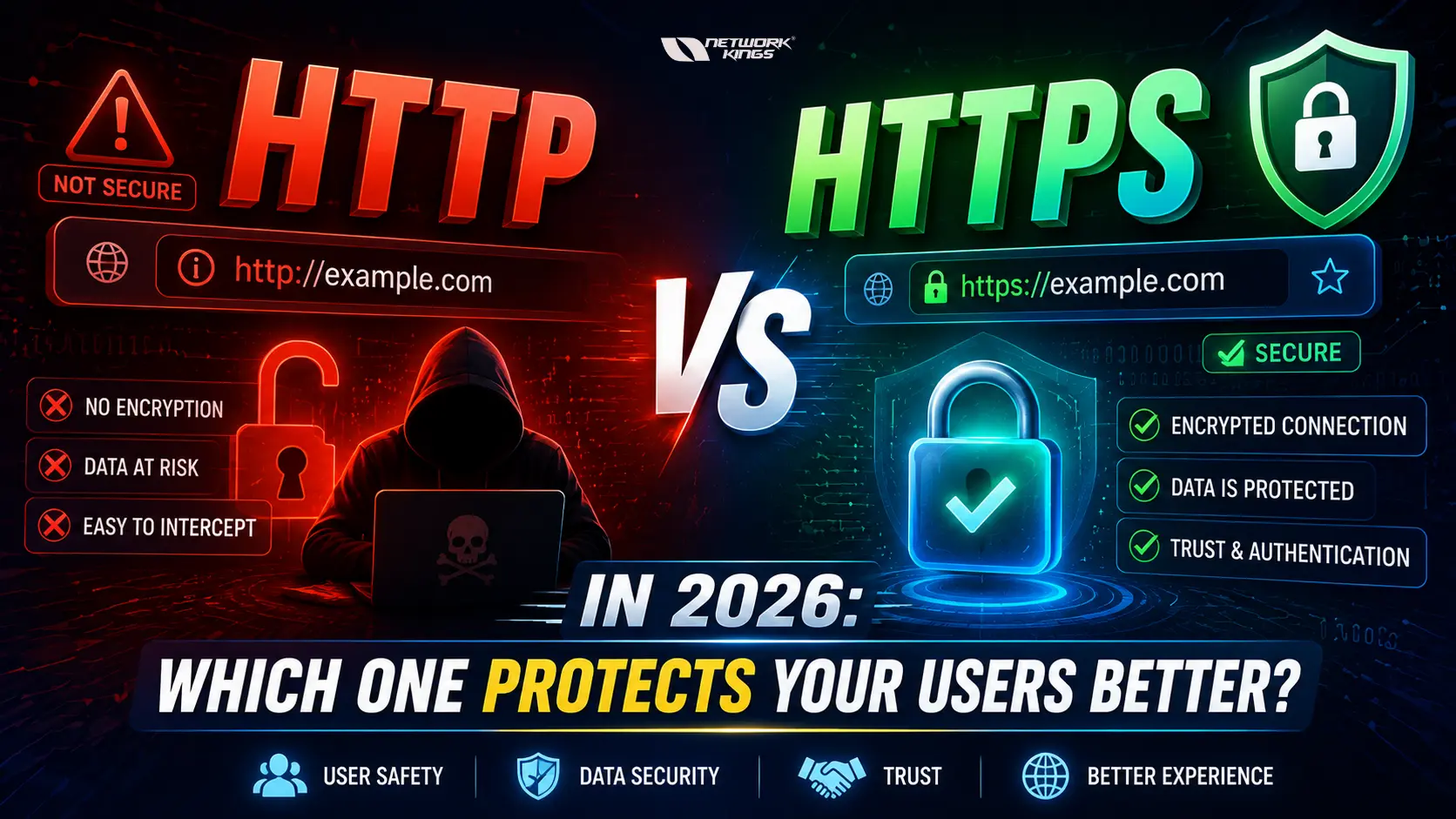
Website security is no longer just a concern for online stores and financial institutions. In 2026, every website owner, developer, and business must think seriously about how user data is transmitted across the internet. As cyber threats evolve and privacy regulations tighten, choosing the right communication protocol directly impacts website security, user trust, search rankings, and compliance.
This is where the debate around HTTP vs HTTPS becomes important. While both protocols are used to transfer information between a web browser and a web server, they differ significantly in how they protect data. Understanding these differences can help organizations create a secure website connection that protects users and supports long-term business growth.
What Is HTTP
HTTP, or Hypertext Transfer Protocol, is the original method browsers use to request and receive web pages. It was designed in the early days of the internet, when security was not a primary concern.
How HTTP Works
When a browser sends an HTTP request to a server, the data travels as plain text. Anyone intercepting that traffic, whether on a public Wi-Fi network, a compromised router, or through an internet service provider, can read it without any special tools.
Advantages and Limitations
HTTP is simple and fast to set up, and it still works for very basic, non-sensitive use cases. But its core limitation is severe: it offers no encryption, no data integrity checks, and no way for a browser to verify it is actually talking to the real server. That gap is exactly what HTTPS was built to close.
What Is HTTPS
HTTPS, or Hypertext Transfer Protocol Secure, is the encrypted version of HTTP. It is now the default expectation for any legitimate website.
How HTTPS Works
HTTPS wraps standard HTTP communication in an encrypted layer using TLS (Transport Layer Security), the modern successor to SSL. Before any data is exchanged, the browser and server perform a TLS handshake, agreeing on encryption methods and verifying identity.
Role of SSL Certificates and TLS Encryption
An SSL certificate, issued by a trusted certificate authority, confirms that a website is who it claims to be. Once validated, TLS encryption scrambles all data exchanged between browser and server, so even if traffic is intercepted, it appears as unreadable noise.
Why HTTPS Became the Web Standard
Major browsers now flag HTTP sites as "Not Secure." Search engines reward HTTPS sites in rankings. Regulations increasingly require encrypted data transmission. Together, these forces turned HTTPS from a nice-to-have into a baseline requirement for secure web browsing.
HTTP vs HTTPS Comparison Table
Factor | HTTP | HTTPS |
Security | No protection against interception | Strong protection via encryption |
Encryption | None | TLS encryption on all data |
SEO impact | Negative, flagged by Google | Positive, a recognized ranking factor |
Browser trust indicators | "Not Secure" warning | Padlock icon, trusted display |
User privacy | Exposed to third parties | Protected end to end |
Performance | Marginally faster on paper | Comparable with HTTP/2 and HTTP/3 |
Compliance support | Fails most modern standards | Required by GDPR, PCI DSS, and similar laws |
Data protection | Vulnerable to tampering | Verified data integrity |
Cost | Free | Often free, with paid options for advanced certificates |
Ideal use cases | Internal testing only | All public-facing websites |
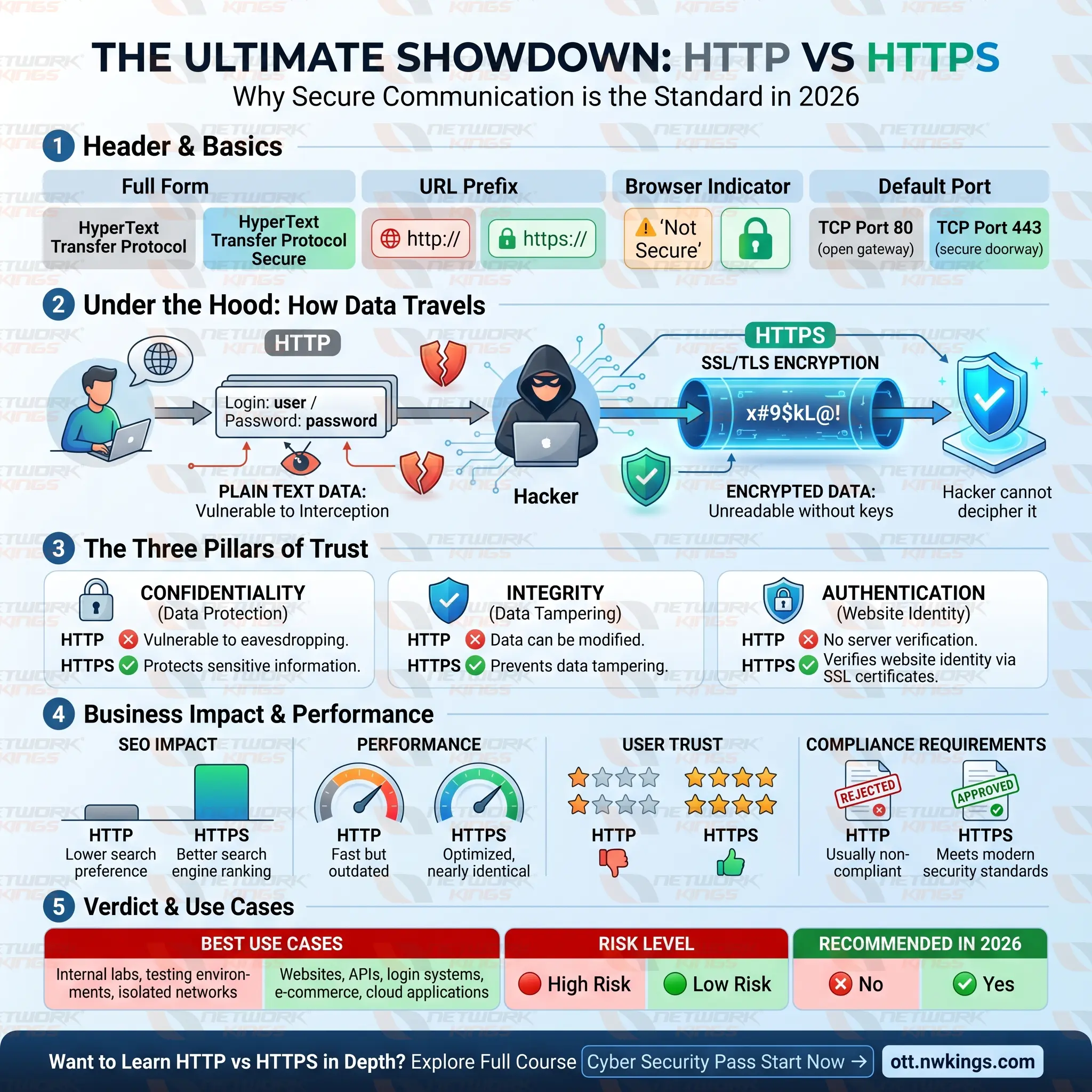
HTTP vs HTTPS Security Comparison
The real-world security gap between these two protocols becomes obvious once you look at specific attack types.
Data Interception Risks
On an HTTP connection, anyone sharing the same network, like a coffee shop Wi-Fi hotspot, can capture unencrypted traffic using freely available packet-sniffing tools. Usernames, passwords, and form data can be read in plain text.
Man-in-the-Middle Attacks
A man-in-the-middle attack happens when a third party secretly sits between a user and a website, intercepting and sometimes altering communication. HTTP offers no protection here. HTTPS security makes this attack vastly harder because the encrypted channel cannot be easily decoded or manipulated without detection.
Credential Theft
Login forms submitted over HTTP send credentials as readable text. This is one of the most common ways attackers harvest usernames and passwords on poorly secured sites.
Session Hijacking
Session cookies sent over HTTP can be captured and reused by an attacker to impersonate a logged-in user. HTTPS encrypts these cookies in transit, closing off this common attack path.
Data Integrity Protection
Beyond eavesdropping, HTTP traffic can be modified mid-transit, allowing attackers to inject malicious scripts or swap legitimate content for fake versions. TLS encryption includes integrity checks that detect tampering, so HTTPS protects against both reading and altering data.
Encryption Benefits
The combined effect of encryption is straightforward: it converts readable data into something attackers cannot use even if they capture it, neutralizing most passive surveillance and many active attacks at once.
How HTTPS Impacts SEO in 2026
HTTPS for SEO is not a minor technical detail. Google has confirmed encrypted connections as a ranking signal for years, and the bar has only risen since.
Google Ranking Signals
Sites running on HTTPS receive a measurable, if modest, ranking advantage over otherwise identical HTTP pages. Combined with other quality signals, this can meaningfully affect visibility.
User Trust and Bounce Rates
When visitors see a security warning instead of a padlock, many leave immediately. Higher bounce rates send negative signals back to search engines, compounding the SEO disadvantage of running HTTP.
Conversion Rates
Visitors are far less likely to complete a purchase, fill out a form, or enter payment details on a site that looks insecure. HTTPS removes that hesitation and supports higher conversion rates.
Website Credibility and Core Web Vitals
Modern HTTPS implementations using HTTP/2 or HTTP/3 often load faster than legacy HTTP setups, supporting strong Core Web Vitals scores, which Google also factors into rankings.
Benefits of HTTPS for Modern Websites
Improved security is the headline benefit, but it extends further. HTTPS supports better search rankings, builds customer trust through visible website trust signals like the padlock icon, and helps meet regulatory requirements such as GDPR and PCI DSS. It protects sensitive data, including payment details and personal information, and makes online transactions meaningfully safer for both businesses and customers.
Common Misconceptions About HTTPS
A few persistent myths still confuse.
HTTPS Makes a Website Completely Secure
This is false. HTTPS protects data in transit, but it does nothing to stop SQL injection, weak passwords, outdated plugins, or phishing. It is one layer of cybersecurity best practices, not the entire strategy.
HTTPS Slows Down Websites
This was true with older TLS versions, but modern protocols like TLS 1.3 and HTTP/2 have largely eliminated the performance gap. Properly configured HTTPS sites often load just as fast, or faster, than HTTP equivalents.
Small Websites Do Not Need HTTPS
Every website that collects any data, including a simple contact form, benefits from a secure website connection. Browsers now flag all HTTP sites regardless of size, and visitors notice.
When Is HTTP Still Used
HTTP still appears in a few narrow contexts. Internal testing environments isolated from the public internet sometimes skip HTTPS for simplicity during early development. Legacy systems running on outdated infrastructure occasionally still rely on HTTP, often as technical debt. Temporary development environments, not yet exposed to real users, may use HTTP before a certificate is configured.
Even in these cases, HTTPS remains the recommended option, since free certificate authorities have removed the cost barrier and many tools now automate renewal.
Best Practices for Website Security in 2026
Strong website security today depends on more than just installing a certificate.
Use modern TLS versions, specifically TLS 1.3, and disable outdated protocols like TLS 1.0 and 1.1. Set up regular certificate renewal, ideally automated, to avoid expiration lapses that trigger browser warnings. Implement HSTS (HTTP Strict Transport Security) to force browsers to always connect via HTTPS, even if a user types an HTTP address. Add security headers such as Content-Security-Policy and X-Frame-Options to reduce attack surface. Maintain ongoing vulnerability monitoring rather than treating security as a one-time setup task. Apply Zero Trust security principles, verifying every request rather than assuming internal traffic is automatically safe.
Real-World Examples
E-Commerce Websites
An online store processing card payments without HTTPS would expose every transaction to interception. HTTPS, combined with PCI DSS compliance, protects both the business and its customers from costly data breaches.
Banking Applications
Financial platforms handle some of the most sensitive data online. HTTPS, paired with multi-factor authentication and strict session management, forms the baseline defense against credential theft and account takeover attempts.
SaaS Platforms
A SaaS company storing customer business data relies on HTTPS to protect API calls and login sessions, while also satisfying enterprise customers who require documented compliance with data protection standards before signing contracts.
Future Trends in Web Security
Looking ahead, several developments are shaping the next phase of web protection. AI-driven cyber threats are becoming more adaptive, using automation to probe for weaknesses faster than human attackers ever could. Quantum-resistant encryption is moving from theoretical research toward practical implementation, anticipating future risks to current cryptographic standards. Browsers continue tightening security advancements, including more aggressive warnings and faster certificate validation. Privacy regulations are expanding globally, pushing more websites toward stronger online privacy protection by default. And HTTPS standards themselves keep evolving, with HTTP/3 adoption growing and TLS configurations becoming more automated and less error-prone.
Conclusion
When comparing HTTP vs HTTPS in 2026, the outcome is not close. HTTP offers simplicity but leaves data exposed to interception, tampering, and theft. HTTPS provides encryption, identity verification, SEO advantages, and the trust signals modern users expect before sharing any information online.
For website owners, developers, and businesses, HTTPS is not optional anymore. It is the foundation of responsible website compliance requirements, customer trust, and basic cybersecurity hygiene. Anyone still running a production website on HTTP should treat migration as an immediate priority, not a future project.
Frequently Asked Questions
Is HTTPS more secure than HTTP?
Yes. HTTPS encrypts data in transit using TLS encryption, while HTTP sends data as plain text that can be intercepted and read.
Does HTTPS improve SEO rankings?
Yes. Google has used HTTPS as a ranking signal for years, and HTTPS also reduces bounce rates and improves user trust, both of which support better organic performance.
Can HTTPS prevent all cyberattacks?
No. HTTPS protects data in transit but does not prevent attacks like SQL injection, malware, or phishing. It must be combined with broader cybersecurity best practices.
Do small websites need HTTPS?
Yes. Browsers flag all HTTP sites as not secure regardless of size, and any site collecting form data benefits from encryption.
What is the difference between SSL and TLS?
SSL is the older protocol that has been deprecated due to security flaws. TLS is its modern replacement and is what actually powers HTTPS connections today, though people often still refer to certificates as "SSL certificates" out of habit.
Does HTTPS affect website speed?
Modern TLS versions and HTTP/2 or HTTP/3 support mean HTTPS no longer causes meaningful slowdowns, and can sometimes load faster than HTTP.
How much does an SSL certificate cost
Costs range from free, through services offering automated basic certificates, to several hundred dollars per year for premium certificates with extended validation features.
Is HTTP still safe to use in 2026
No, not for any public-facing website handling user data. HTTP should be limited to isolated internal testing environments only.

The founder of Network Kings, is a renowned Network Engineer with over 12 years of experience at top IT companies like TCS, Aricent, Apple, and Juniper Networks. Starting his journey through a YouTube channel in 2013, he has inspired thousands of students worldwide to build successful careers in networking and IT. His passion for teaching and simplifying complex technologies makes him one of the most admired mentors in the industry.