Azure VPN Gateway vs ExpressRoute Which to Choose in 2026
Hybrid cloud is no longer optional for most enterprises. It is the default. As organizations push more workloads into Azure while keeping critical systems on-premises, the connection between the two environments becomes one of the most important architecture decisions a team will make.
That is where the Azure VPN Gateway vs ExpressRoute debate comes in. Both services fall under Azure networking, and both solve the same basic problem: linking your on-premises infrastructure to Azure. But they solve it in very different ways, with different costs, different performance ceilings, and different ideal scenarios.
In 2026, with hybrid and multicloud setups more common than ever, picking the wrong connectivity model can quietly cost a business money, performance, or compliance standing. This guide breaks down both services in plain language, compares them side by side, and helps you decide which one fits your situation.
What Is Azure VPN Gateway
Azure VPN Gateway is a managed service that creates encrypted connections between your on-premises network and Azure over the public internet. It is one of the most widely used Azure connectivity solutions because it is fast to deploy and works almost anywhere.
How It Works
VPN Gateway uses IPsec and IKE protocols to build an encrypted tunnel. Your on-premises VPN device talks to the Azure-side gateway, and traffic flows through that tunnel instead of traveling unprotected across the internet. You can configure site-to-site VPN Azure connections for full office or datacenter links, or point-to-site connections for individual remote users.
There are two pricing tiers: Basic, meant for testing and small workloads, and Standard, which adds high availability and active-active configurations for production use.
Key Use Cases
Connecting branch offices to Azure without dedicated circuits
Remote employee access into Azure virtual networks
Disaster recovery and backup connectivity
Quick proof-of-concept hybrid environments
Acting as a failover path when ExpressRoute is the primary connection
What Is Azure ExpressRoute
Azure ExpressRoute is a private, dedicated connection between your on-premises infrastructure and Microsoft's network, established through a connectivity provider rather than the public internet. It is the backbone choice for organizations that need predictable performance at scale.
How It Works
Instead of routing traffic over the open internet, ExpressRoute connects through a colocation facility or network provider directly into Microsoft's edge network. This connection uses private peering or Microsoft peering, depending on whether you are accessing virtual networks or Microsoft 365 and other PaaS services.
Bandwidth options range from as low as 50 Mbps up to 100 Gbps, depending on your circuit and provider. One important detail many teams miss: ExpressRoute is private, but it is not encrypted by default. If your compliance framework requires encryption in transit, you will need MACsec on ExpressRoute Direct ports, or an IPsec VPN layered on top of the circuit.
Key Use Cases
Mission-critical production workloads with strict performance SLAs
Large-scale data migration and ongoing high-volume data transfer
Regulated industries needing private Azure connectivity (finance, healthcare, government)
Real-time applications sensitive to jitter and latency
Connecting multiple regions or large enterprise networks to Azure consistently
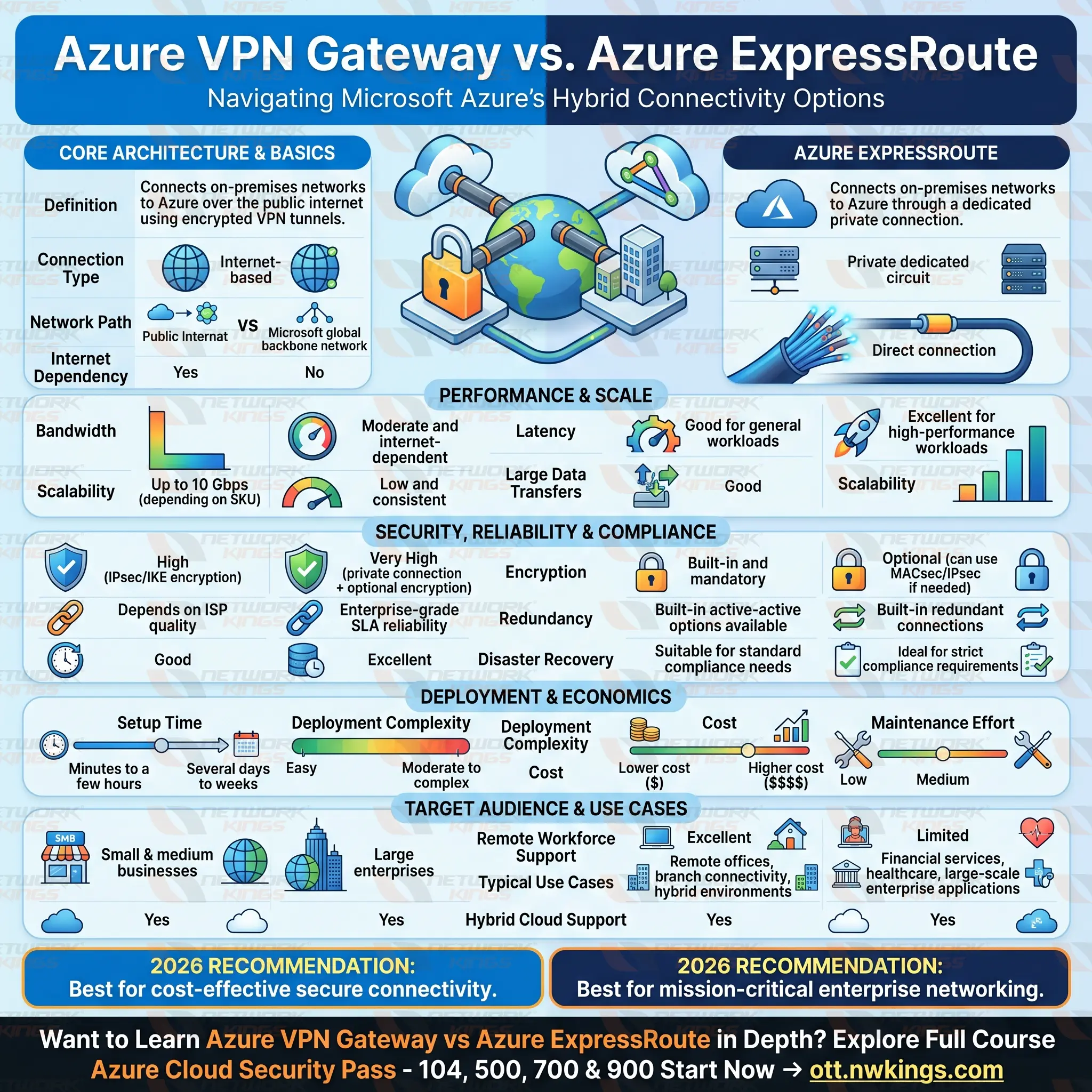
Azure VPN Gateway vs ExpressRoute Comparison Table
Factor | Azure VPN Gateway | Azure ExpressRoute |
Connectivity type | Encrypted tunnel over public internet | Private, dedicated circuit via provider |
Security | Strong encryption (IPsec/IKE) by default | Private path, but encryption is optional/extra |
Performance | Good for moderate workloads | High, consistent throughput |
Latency | Variable, internet-dependent | Low and predictable |
Reliability | Subject to internet conditions | SLA-backed, up to 99.95 percent |
Scalability | Up to roughly 10 Gbps per gateway | Up to 100 Gbps per circuit |
Cost | Lower, pay-as-you-go friendly | Higher, includes port and provider fees |
Setup complexity | Simple, self-service | More involved, needs a provider relationship |
Ideal use case | SMBs, remote access, DR, failover | Enterprises, regulated industries, high-volume workloads |
Key Differences Between Azure VPN Gateway and ExpressRoute
Connectivity path. VPN Gateway sends traffic over the same public internet everyone else uses. ExpressRoute hands your traffic off to a private circuit that never touches the public internet. A retail company processing nightly inventory syncs might be fine on VPN Gateway. A bank streaming real-time transaction data usually is not.
Bandwidth ceiling. VPN Gateway tops out around 10 Gbps on its highest SKU. ExpressRoute scales to 100 Gbps. If you are migrating petabytes of data or running constant high-volume replication, that ceiling matters a lot.
Encryption assumptions. This one trips people up. Many assume ExpressRoute is automatically more secure because it is private. Encryption is not automatic. You either add MACsec or run IPsec over the circuit. VPN Gateway, by contrast, is encrypted from the start.
Cost structure. VPN Gateway pricing is straightforward: an hourly gateway charge plus data transfer. ExpressRoute layers on a monthly port fee, provider charges, and a virtual network gateway cost on top of bandwidth.
Operational complexity. Standing up VPN Gateway can take less than an hour. ExpressRoute requires working with a connectivity provider, circuit provisioning, BGP configuration, and often weeks of lead time.
Advantages of Azure VPN Gateway
Fast to deploy, often production-ready same day
Lower upfront and ongoing cost
Available in every Azure region with no provider dependency
Built-in encryption out of the box
Works well as a backup path even in ExpressRoute-primary architectures
Supports both site-to-site and point-to-site scenarios for flexible Azure hybrid connectivity
Advantages of Azure ExpressRoute
Predictable, low-latency performance suited to real-time and high-throughput apps
Massive bandwidth headroom up to 100 Gbps
Stronger SLA commitments around availability
Better fit for strict data residency and compliance requirements
Doesn't compete with general internet traffic, so performance stays consistent during peak hours
Direct access to Microsoft 365 and other Microsoft peering services
When Should You Choose Azure VPN Gateway
Choose VPN Gateway if you are a small or mid-sized business without massive bandwidth needs, if you need to get connected quickly, or if budget is a primary constraint. It also makes sense if your team is testing a hybrid architecture before committing to anything larger, or if you simply need secure remote access for employees working outside the office.
It is also the right call as a resilient failover. Plenty of enterprises run ExpressRoute as their primary path and VPN Gateway as the safety net if that circuit ever drops.
When Should You Choose Azure ExpressRoute
Choose ExpressRoute if you run latency-sensitive applications, move large volumes of data regularly, or operate in an industry with strict compliance demands like healthcare, finance, or government. It is also the better fit once your organization has outgrown what a public-internet connection can reliably support, or when consistent performance under an SLA is non-negotiable for the business.
Cost Considerations in 2026
VPN Gateway remains the cheaper option in nearly every scenario. You pay for gateway uptime and data egress, with no provider middleman. A Standard tier deployment for a mid-sized business typically runs a fraction of what an ExpressRoute circuit costs monthly.
ExpressRoute pricing includes a port fee based on your chosen bandwidth tier, a separate virtual network gateway charge, and potentially a provider fee on top of that. Most organizations start with a 1 Gbps circuit and scale up as demand grows, rather than over-provisioning from day one.
The practical advice for 2026: model your actual bandwidth and latency requirements before committing. Many teams overpay for ExpressRoute capacity they never use, while others underestimate VPN Gateway limits and run into throughput bottlenecks during peak load.
Best Practices for Azure Hybrid Connectivity
Use ExpressRoute for production-critical paths and VPN Gateway as a redundant failover
Always clarify whether your ExpressRoute circuit needs encryption for compliance, and configure it accordingly
Right-size your gateway SKU based on actual throughput, not assumed future growth
Monitor egress data transfer closely since this is where unexpected costs tend to appear
Use Azure Virtual WAN if you are managing many branch locations and want centralized routing across both VPN and ExpressRoute connections
Test failover regularly rather than assuming it will work when you need it most
Conclusion
There is no universal winner in the Azure VPN Gateway vs ExpressRoute decision. It comes down to your workload, budget, and risk tolerance.
If you run a small or growing business, need fast setup, or want dependable encrypted access without a long procurement process, Azure VPN Gateway pricing and simplicity make it the practical choice. If you operate at enterprise scale, handle regulated data, or depend on consistent low-latency performance, Azure ExpressRoute benefits justify the added cost and setup time.
Many mature organizations eventually use both: ExpressRoute as the primary backbone and VPN Gateway as the resilient backup. That combination, more than either service alone, is often the smartest Azure connectivity solution for 2026 and beyond.
Frequently Asked Questions
Is ExpressRoute more secure than VPN Gateway?
Not automatically. ExpressRoute is private because it avoids the public internet, but it is not encrypted by default. VPN Gateway encrypts traffic from the start using IPsec and IKE. For true end-to-end encryption on ExpressRoute, you need to add MACsec or run an IPsec tunnel over the circuit.
Can Azure VPN Gateway and ExpressRoute be used together?
Yes, and it is a common and recommended pattern. Many enterprises run ExpressRoute as their primary hybrid connection and configure VPN Gateway as a failover path in case the ExpressRoute circuit experiences an outage.
Which is cheaper, VPN Gateway or ExpressRoute?
VPN Gateway is cheaper in almost all cases. It charges an hourly gateway rate plus data egress. ExpressRoute adds a monthly port fee, a virtual network gateway charge, and often a separate provider fee, making it a bigger investment overall.
Does ExpressRoute use the public internet?
No. ExpressRoute connections route through a private, dedicated circuit established via a connectivity provider, bypassing the public internet entirely. This is the main reason it delivers more predictable latency and throughput than VPN Gateway.
Is Azure ExpressRoute worth it for small businesses?
Usually not, unless the business handles regulated data or has unusually high bandwidth needs. The provider relationship, port fees, and setup complexity tend to outweigh the benefits for most small businesses. VPN Gateway typically covers their needs at a much lower cost.
How does Azure VPN Gateway handle scalability compared to ExpressRoute?
VPN Gateway scales up to around 10 Gbps depending on the SKU, which is sufficient for most small to mid-sized workloads. ExpressRoute scales much higher, up to 100 Gbps, making it the better option for large enterprises with growing data and application demands.

The founder of Network Kings, is a renowned Network Engineer with over 12 years of experience at top IT companies like TCS, Aricent, Apple, and Juniper Networks. Starting his journey through a YouTube channel in 2013, he has inspired thousands of students worldwide to build successful careers in networking and IT. His passion for teaching and simplifying complex technologies makes him one of the most admired mentors in the industry.