RHCE Fundamentals 2026: Your Complete Ansible Automation Guide
As organizations continue adopting cloud-native technologies, hybrid infrastructure, and DevOps practices, automation has become a critical skill for IT professionals. Managing hundreds or even thousands of Linux servers manually is no longer practical. Businesses now rely on automation platforms to ensure consistency, improve efficiency, and reduce operational risks.
This growing demand for automation has made the Red Hat Certified Engineer certification one of the most respected credentials in the Linux ecosystem. The RHCE certification validates your ability to automate system administration tasks using Ansible, a powerful automation platform widely used across enterprise environments.
If you are planning to move from RHCSA to RHCE or want to strengthen your Linux automation skills, understanding the fundamentals of Ansible is essential.
What Is RHCE Certification in 2026
RHCE is an advanced Red Hat certification designed for Linux professionals who want to demonstrate expertise in automation and system administration. While RHCSA focuses on core Linux administration skills, RHCE emphasizes automating those tasks using Ansible.
In 2026, RHCE remains highly relevant because organizations increasingly depend on Infrastructure as Code and automated workflows to manage large-scale environments. Employers view RHCE-certified professionals as individuals who can reduce manual effort, improve operational consistency, and support modern DevOps initiatives.
What Is RHCE in 2026
RHCE in 2026 is a certification focused on Linux automation using Ansible. It validates your ability to automate configuration management, software deployment, system updates, and infrastructure operations across multiple Red Hat Enterprise Linux systems.
Why Ansible Is the Core of Modern RHCE
The RHCE exam has evolved significantly over the years. Earlier versions focused heavily on manual system administration tasks. Modern RHCE certification places Ansible automation at the center of the curriculum because automation has become a standard requirement across enterprise IT environments.
Ansible offers several advantages:
Agentless architecture
Simple YAML-based syntax
Fast deployment
Easy integration with Linux systems
Strong support for DevOps workflows
Organizations use Ansible to automate repetitive administrative tasks, maintain configuration consistency, and accelerate infrastructure deployment.
Why Is Ansible Important for RHCE
Ansible is the primary automation tool tested in RHCE because it reflects real-world enterprise practices. Learning Ansible enables administrators to manage infrastructure efficiently while reducing errors caused by manual configuration.
Key Ansible Concepts Every RHCE Candidate Must Know
Before diving into complex playbooks, you need to understand Ansible's core components and terminology.
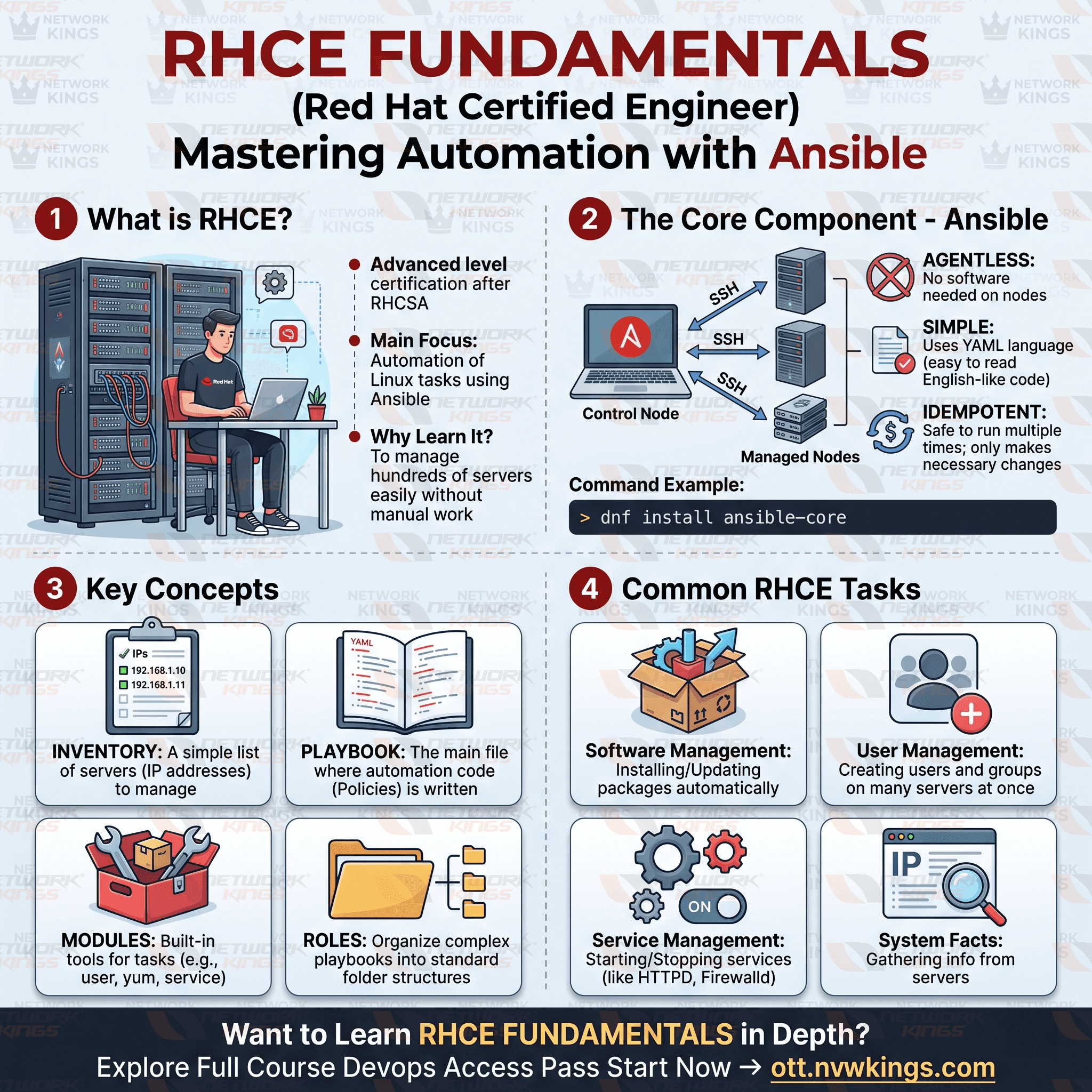
Control Node
This is the machine running Ansible. It can be your laptop, a jump server, or a dedicated automation platform. The control node needs SSH access to managed nodes and Python installed locally, but it doesn't require Ansible agents everywhere.
Managed Nodes
These are the systems Ansible controls. They need SSH connectivity and Python 2.7 or Python 3.5+ installed, but no additional software. This agentless architecture is one of Ansible's greatest strengths.
Inventory Files
Inventories define which systems you're managing. A basic inventory might list servers by IP address. More sophisticated inventories organize servers into groups, define variables, and use plugins to dynamically discover hosts. Your first RHCE tasks will likely require creating and managing inventory files effectively.
Ad-hoc Commands
These are one-off Ansible commands you run from the command line. You might use ad-hoc commands to restart services, check disk space, or gather system facts across dozens of servers instantly.
Playbooks
This is where Ansible becomes powerful. Playbooks are YAML files describing a series of tasks to execute on managed nodes. Instead of running commands manually on each server, a playbook automates the entire workflow. A single playbook might install packages, copy configuration files, start services, and validate functionality.
Variables and Templates
Real-world automation requires flexibility. Variables allow you to parameterize playbooks so they work across different environments. Templates are Jinja2-based files that dynamically generate configuration files based on variables and conditions.
Roles
Roles provide structure for larger automation projects. Instead of writing one massive playbook, you organize tasks, handlers, variables, and templates into logical roles. This modularity makes automation code reusable and maintainable.
Modules
Modules are the tools Ansible uses to accomplish tasks. The package module installs software, the user module manages accounts, and the template module deploys configuration files. The RHCE exam expects you to know dozens of commonly used modules and how to apply them correctly.
RHCE Ansible Workflow Explained
Understanding the Ansible workflow is fundamental to RHCE success. Here's how Ansible executes automation in practice.
First, you prepare your control node by installing Ansible and creating an inventory file listing the systems you want to manage. Second, you write a playbook describing the desired state of your infrastructure. Third, you execute the playbook using the ansible-playbook command. Fourth, Ansible connects via SSH to each managed node, transfers the necessary files, executes Python code to perform the tasks, and reports back results.
The power comes from reproducibility. Run the same playbook a hundred times and you'll get the same result. This is idempotence, a core Ansible principle. Modules are designed to achieve a desired state rather than just executing commands. If a package is already installed, the package module doesn't reinstall it. If a user already exists, the user module doesn't fail. This makes automation safe and predictable.
Essential RHCE Skills and Exam Objectives
The RHCE exam tests specific competencies. Here's what you need to master before exam day.
Skill Area | What You Need to Learn | Importance for RHCE |
Inventory Management | Creating static and dynamic inventories, organizing hosts into groups, defining variables | Critical |
Writing Playbooks | Creating well-structured YAML playbooks, managing plays and tasks | Critical |
Variables and Facts | Using variables, gathering facts, variable precedence rules | Critical |
Handlers and Notifications | Triggering actions when tasks change, managing service restarts | High |
Jinja2 Templating | Building dynamic configuration files, conditional templates | High |
Roles and Organization | Structuring automation code into reusable roles | High |
Error Handling | Handling failures, validating results, debugging playbooks | High |
SSH and Authentication | Configuring SSH connectivity, managing SSH keys for automation | Critical |
Common Modules | Understanding package, service, user, file, copy, template modules | Critical |
Advanced Playbooks | Loops, conditionals, blocks, and flow control | High |
What Skills Are Required to Pass RHCE
Successful RHCE candidates must understand Linux administration, Ansible playbooks, inventory management, modules, roles, variables, templates, troubleshooting techniques, and automation best practices commonly used in enterprise environments.
Common RHCE Automation Tasks
Real RHCE exam scenarios involve practical automation challenges. Understanding common tasks helps you prepare effectively.
User and Group Management
Automating user provisioning is fundamental. You'll write playbooks that create users, assign groups, set permissions, and manage sudoers configurations across infrastructure. This task combines user management knowledge from RHCSA with Ansible's multi-system capability.
Package Installation and Updates
Instead of manually installing packages on each server, playbooks automate this at scale. You'll manage package states, ensure specific versions are installed, and handle dependencies consistently across your environment.
Service Management
Services must run reliably. Playbooks enable and start services, reload services when configurations change, and verify services remain healthy. Handlers ensure services restart only when necessary, not on every playbook run.
File Deployment and Synchronization
Distributing configuration files, scripts, and templates to managed nodes is a daily operation. The copy and template modules enable this reliably, with templating allowing customization per environment.
Security Hardening
Automating security configurations ensures consistency. Playbooks can disable root login, configure firewall rules, manage SELinux contexts, and deploy security updates simultaneously across the infrastructure.
System Updates and Patches
Patching infrastructure is critical but complex. Playbooks orchestrate updates, manage reboots during maintenance windows, and verify system functionality post-update.
RHCE vs RHCSA Comparison
Understanding how RHCE builds on RHCSA clarifies the certification pathway and what new skills you're acquiring.
Feature | RHCSA | RHCE |
Focus | Manual system administration | Infrastructure automation |
Primary Tool | Linux command line | Ansible automation framework |
Scope | Single or a few systems | Many systems simultaneously |
Configuration Approach | Direct configuration changes | Infrastructure as code |
Skill Level | Foundational | Intermediate to advanced |
Exam Duration | 2.5 hours | 3.5 hours (two exams) |
Prerequisite | None | RHCSA certification |
Career Roles | Junior Linux admin | Senior admin, DevOps engineer |
Task Complexity | Basic administration | Complex orchestration |
How Does RHCE Differ From RHCSA
RHCSA validates foundational Linux administration skills, while RHCE focuses on automating those tasks using Ansible. RHCE requires a deeper understanding of infrastructure automation and enterprise-scale management.
Career Benefits of RHCE Certification
RHCE certification opens doors to advanced roles and higher compensation.
Linux and Systems Administrators
RHCE validates expertise that many organizations require for senior administrator positions. You become the person who eliminates manual processes and scales operations efficiently.
DevOps Engineers
DevOps is built on automation foundations. RHCE certification proves you can design and implement the infrastructure automation layer that supports continuous deployment pipelines and infrastructure as code practices.
Platform and Cloud Engineers
Cloud platforms like AWS and Azure often run on RHEL. RHCE skills make you valuable in managing these environments at scale, automating deployment patterns, and maintaining configuration consistency.
Automation and Infrastructure Engineers
Dedicated automation roles exist across enterprises managing complex infrastructure. RHCE positions you perfectly for these specialized positions.
The salary impact is meaningful. RHCE-certified professionals typically command 15-25% higher compensation than RHCSA-only administrators, with geographic and industry variations. Senior positions requiring RHCE certification frequently offer six-figure salaries in major tech hubs.
Best Practices for RHCE Preparation in 2026
Preparing for RHCE requires more than reading documentation. Here's what actually works.
Build a home lab or use cloud-based labs with multiple virtual machines. You need hands-on experience writing playbooks, troubleshooting failures, and managing infrastructure. Theory alone won't suffice.
Focus on YAML syntax and playbook structure before diving into complex scenarios. Many RHCE candidates struggle because YAML formatting mistakes cause playbooks to fail silently.
Practice writing playbooks repeatedly. Muscle memory matters. Write user management playbooks, service management playbooks, and file deployment playbooks. Repetition builds confidence and speed.
Study the official Red Hat documentation. While third-party courses provide value, the official docs contain the exact syntax and behavior you need for the exam.
Understand idempotence. Your playbooks should achieve desired states, not just run commands. This philosophical difference separates effective automation engineers from technicians.
Join the Ansible community. The Ansible ecosystem is mature and welcoming. Reading real playbooks from projects like Ansible Automations Galaxy exposes you to professional patterns and best practices.
Conclusion
RHCE Fundamentals in 2026 centers on Ansible automation mastery. This certification validates your ability to move beyond manual system administration into infrastructure automation, a skill increasingly central to modern IT operations. The pathway is clear: build on RHCSA knowledge, master Ansible concepts, practice extensively in lab environments, and pursue the RHCE exam with confidence.
The investment in RHCE certification pays dividends throughout your career. You'll command higher compensation, qualify for advanced roles, and possess skills that remain relevant as infrastructure becomes increasingly code-based. In 2026 and beyond, automation expertise isn't a luxury; it's a fundamental requirement for IT professionals managing complex infrastructure.
Start your preparation today. Set up a lab environment, write your first playbook, and commit to hands-on learning. The RHCE certification awaits.
FAQs
Q1. Is RHCSA certification required before attempting RHCE?
Yes, Red Hat requires active RHCSA certification to pursue RHCE. You cannot register for the RHCE exam without holding a current, valid RHCSA credential. This prerequisite ensures you have foundational Linux administration knowledge before advancing to automation-focused content, creating a logical progression through Red Hat's certification pathway.
Q2. How long does it typically take to prepare for RHCE after passing RHCSA?
Most candidates require three to six months of dedicated preparation. This timeline depends on your prior Ansible experience, lab access, and study consistency. If you have a DevOps background with infrastructure tools, you might prepare faster. Complete beginners to automation should allocate six months to regular hands-on practice.
Q3. What Ansible version does the 2026 RHCE exam cover?
The 2026 RHCE exam uses Ansible 2.14 or later versions available on Red Hat Enterprise Linux. Red Hat updates the exam annually to reflect current Ansible releases. Before your exam date, verify the specific Ansible version and RHEL version on the official Red Hat exam page to ensure your lab environment matches exam conditions.
Q4. Can I pass RHCE without using official Red Hat training?
Absolutely. Many successful candidates use community resources, online courses, and practice labs without purchasing official Red Hat training. However, studying official Red Hat documentation ensures you understand the exact module syntax and behavior expected in the exam. Combining official docs with hands-on practice tends to be most effective.
Q5. What's the passing score for the RHCE exam in 2026?
Red Hat doesn't publish specific passing scores, but reports indicate approximately 65-70% is required to pass. The RHCE exam consists of two parts: a standard multiple-choice section and a practical lab component. Both components contribute to your final score, with emphasis on practical demonstration of automation skills.

The founder of Network Kings, is a renowned Network Engineer with over 12 years of experience at top IT companies like TCS, Aricent, Apple, and Juniper Networks. Starting his journey through a YouTube channel in 2013, he has inspired thousands of students worldwide to build successful careers in networking and IT. His passion for teaching and simplifying complex technologies makes him one of the most admired mentors in the industry.