Linux Automation in 2026 Trends, Tools, and Career Opportunities
Linux automation has moved from being a specialized skill to a core requirement for modern IT operations. Organizations now manage hundreds or even thousands of servers across data centers, cloud platforms, and containerized environments. Performing routine administrative tasks manually is no longer practical.
As businesses continue adopting cloud infrastructure, DevOps practices, and Infrastructure as Code, professionals with Linux automation skills are becoming increasingly valuable. Whether you are a Linux administrator, aspiring DevOps engineer, or cloud professional, understanding Linux automation can significantly improve your career prospects. This article explores the latest trends, tools, and career opportunities shaping Linux automation in 2026.
What Is Linux Automation
Linux automation involves using scripts, tools, and frameworks to perform administrative tasks on Linux systems without manual intervention. Instead of logging into each server individually to apply configuration changes, deploy applications, or perform routine maintenance, automation handles these jobs across hundreds or thousands of machines simultaneously.
Featured snippet answer: Linux automation uses scripts and tools to handle repetitive Linux system tasks, such as configuration management, deployment, and monitoring. It eliminates manual intervention, reduces human error, and scales administration across multiple servers efficiently.
This could mean anything from simple Bash scripts that run daily backups to complex infrastructure-as-code setups where you describe your entire cloud infrastructure in version-controlled files. The scope depends on your needs, but the principle remains the same: let the computer do the work.
Why Linux Automation Matters in 2026
The growth of cloud computing, Kubernetes environments, and distributed applications has increased operational complexity. Organizations need reliable ways to manage infrastructure without constantly expanding operations teams.
Linux automation provides several benefits:
Reduces repetitive manual work
Improves consistency across environments
Minimizes configuration errors
Speeds up infrastructure deployment
Supports DevOps and CI/CD practices
Enhances scalability and reliability
Simplifies compliance and security management
In many enterprise environments, automation now handles routine server builds, application deployments, user management, and system maintenance that once required significant manual effort.
Top Linux Automation Trends
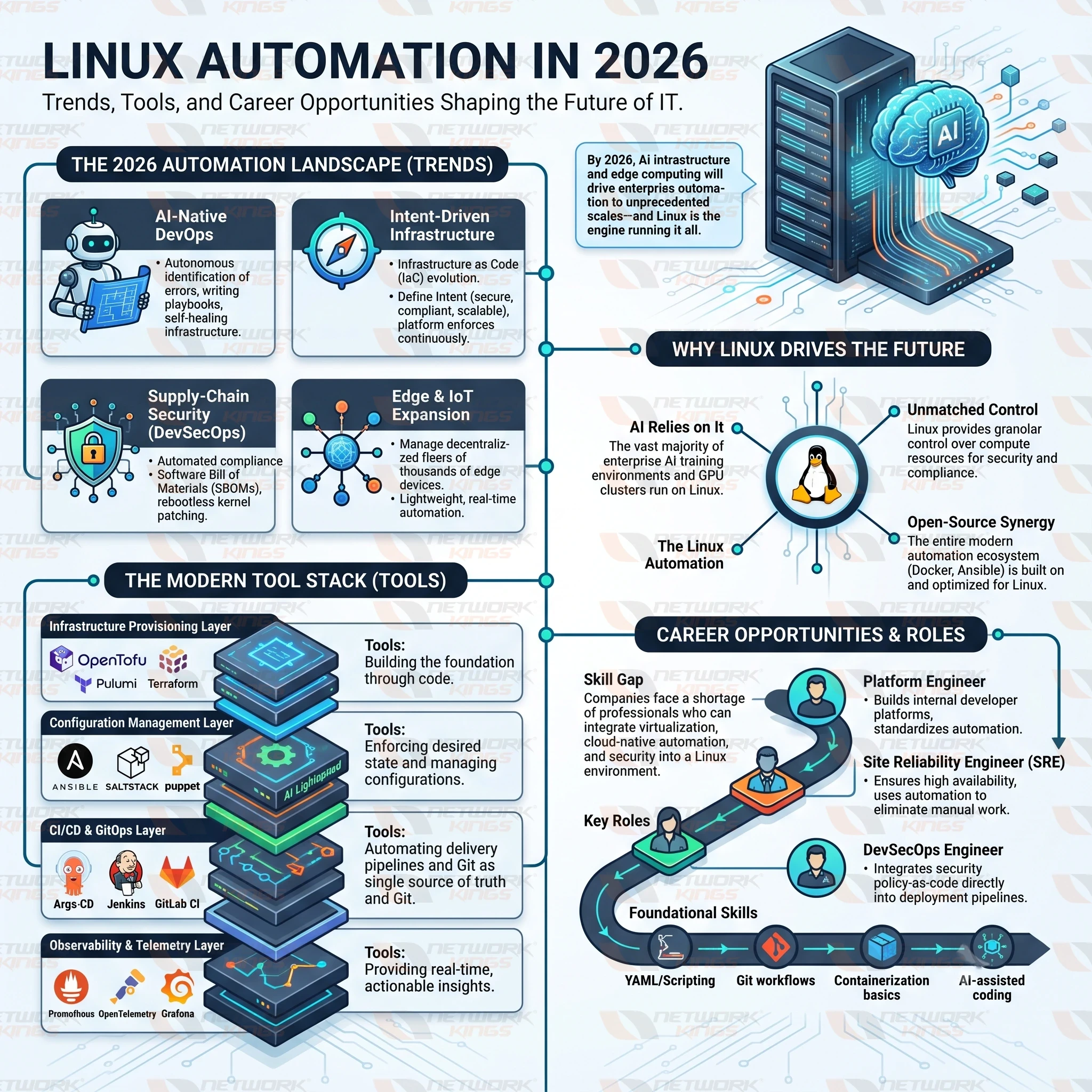
AI-Assisted Automation
Machine learning is starting to influence automation tools. Systems can now detect anomalies, predict failures before they occur, and suggest automation opportunities by analyzing your infrastructure patterns. This trend will accelerate throughout 2026.
Infrastructure as Code
Defining infrastructure through code files rather than manual configuration is now standard practice. You describe your entire cloud infrastructure in Terraform files, store them in Git, and treat infrastructure updates like software releases. This approach provides versioning, documentation, and disaster recovery built in.
Hybrid Cloud Automation
Organizations running workloads across multiple cloud providers and on-premises data centers need automation that works seamlessly across all these environments. Tools that handle multi-cloud scenarios are increasingly valuable.
DevSecOps Integration
Security scanning and compliance checking are moving earlier into the automation pipeline. Instead of discovering vulnerabilities after deployment, automation tests for security issues during the build process.
Edge Computing Automation
As computing moves closer to data sources, automating edge infrastructure is becoming critical. This requires different approaches than traditional cloud automation.
Cloud-Native Automation
Kubernetes and container orchestration dominate modern deployments. Automation in 2026 heavily emphasizes containerized environments and cloud-native patterns.
Best Linux Automation Tools
Tool | Primary Use Case | Best For |
Ansible | Configuration management and orchestration | Teams seeking simplicity and agentless architecture |
Terraform | Infrastructure as Code | Cloud infrastructure provisioning across providers |
Bash | Quick scripts and one-off tasks | System administrators and engineers |
Python | Complex automation logic and integration | Custom automation with advanced logic |
Jenkins | Continuous Integration and Continuous Deployment | Building and deploying applications automatically |
Docker | Application containerization | Packaging applications with dependencies |
Kubernetes | Container orchestration and management | Deploying and scaling containerized applications |
Puppet | Configuration management at scale | Large enterprises with thousands of servers |
GitHub Actions | CI/CD pipelines | Development teams already using GitHub |
Ansible remains the most popular choice for configuration management. Its agentless architecture means you don't need to install software on target machines, which simplifies operations significantly. Ansible uses simple YAML syntax that's easy to read and modify.
Bash and Python form the foundation of custom automation. Bash excels at quick system-level scripts, while Python handles more sophisticated automation tasks that need better error handling and logic.
Terraform has become the standard for infrastructure-as-code. If you're provisioning cloud resources, Terraform lets you manage them in a version-controlled, reproducible way across AWS, Azure, Google Cloud, and other providers.
Jenkins and GitHub Actions handle continuous integration and deployment. These tools automatically build, test, and deploy code whenever changes are committed, eliminating manual deployment steps.
Featured snippet answer: Ansible is widely considered the best entry point for Linux automation due to its simplicity, agentless design, and readable YAML syntax. For infrastructure-as-code specifically, Terraform excels at managing cloud resources across multiple providers.
Career Opportunities in Linux Automation
Linux System Administrator
System administrators increasingly need automation skills. Modern roles expect you to automate routine tasks rather than handling them manually. RHCE certification demonstrates this expertise to employers.
DevOps Engineer
DevOps professionals live and breathe automation. They design systems that automatically deploy code, monitor applications, and scale infrastructure based on demand. Salaries for DevOps engineers typically range from $110,000 to $160,000 annually.
Site Reliability Engineer
SREs use automation to ensure system reliability at scale. They build tools and frameworks that prevent outages and enable rapid recovery when issues occur.
Cloud Engineer
Cloud platforms require expertise in infrastructure-as-code and cloud automation tools. Organizations need people who can provision and manage cloud resources efficiently.
Platform Engineer
These roles focus on building internal platforms and tools that enable other teams to self-serve infrastructure and deployments through automation.
Infrastructure Automation Engineer
Specialized roles focused entirely on designing and implementing automation frameworks across organizations.
Essential Linux Automation Skills
Start with fundamentals. You need solid Linux command-line proficiency and understanding of system administration concepts. Shell scripting with Bash is essential because you'll encounter it everywhere.
Learning a programming language like Python accelerates your growth significantly. Python's readability makes it perfect for automation, and many automation frameworks use it extensively.
Pick one major automation tool and go deep. Master Ansible or Terraform depending on your path. Once you understand one tool's philosophy, picking up others becomes much easier.
Don't overlook soft skills. Communication matters when you're automating other people's infrastructure. Documentation, collaboration, and the ability to explain technical concepts to non-technical stakeholders are equally important as technical skills.
Linux Automation Career Growth and Salary
Entry-level positions as junior Linux system administrators or junior DevOps engineers typically start at $60,000 to $85,000. Within 2-3 years of focused development, reaching mid-level positions paying $95,000 to $130,000 is realistic.
Senior roles command significantly more. Senior DevOps engineers and infrastructure automation engineers earn $140,000 to $190,000 or higher depending on location and company size. Leadership positions like DevOps manager or engineering manager can exceed $200,000.
The progression depends on how actively you expand your skills. People who master multiple tools and stay current with emerging practices advance faster than those who stagnate.
Featured snippet answer: Yes, Linux automation is an excellent career choice. High demand, competitive salaries ranging from $60,000 to $200,000 depending on experience level, strong job security, and continuous learning opportunities make it attractive for both beginners and experienced professionals.
Is Linux Automation Worth Learning
Absolutely. The shortage of skilled professionals means job security and strong salary growth. Automation skills are applicable across every industry and every company using cloud infrastructure. Once you develop expertise, it remains relevant for years.
The learning curve is reasonable too. You don't need a computer science degree to start. Most people reach junior-level competency within 6-12 months of consistent practice.
Conclusion
Linux automation has moved from a nice-to-have skill to an essential requirement for modern IT professionals. The convergence of cloud adoption, container technology, and business demand for faster deployments means organizations will continue hiring people with these skills aggressively. Whether you're starting your IT career or transitioning from traditional system administration, developing Linux automation expertise positions you for lucrative opportunities in 2026 and beyond. Start building that foundation today.
Frequently Asked Questions
1. What is Linux automation?
Linux automation is the process of using scripts, tools, and frameworks to perform repetitive system administration tasks automatically. It helps IT teams manage servers, deploy applications, configure systems, and maintain infrastructure more efficiently while reducing manual errors and improving consistency.
2. Why is Linux automation important in 2026?
Linux automation is important because modern organizations manage complex environments that include cloud platforms, containers, hybrid infrastructure, and distributed applications. Automation reduces operational workload, improves scalability, speeds up deployments, and helps maintain consistent system configurations across environments.
3. Which Linux automation tool is best for beginners?
Ansible is often considered the best Linux automation tool for beginners because it uses simple YAML-based playbooks and does not require agents on managed systems. It is widely used in enterprise environments and is also a key component of RHCE certification training.
4. Is Linux automation a good career choice?
Yes, Linux automation is an excellent career choice. Companies increasingly seek professionals who can automate infrastructure, streamline operations, and support DevOps initiatives. These skills can lead to roles such as Linux Engineer, DevOps Engineer, Cloud Engineer, and Site Reliability Engineer.
5. What skills are required to learn Linux automation?
To learn Linux automation effectively, you should understand Linux administration fundamentals, shell scripting, Bash, Python, networking concepts, version control with Git, and automation tools such as Ansible and Terraform. Knowledge of cloud computing and CI/CD pipelines is also highly valuable.
6. How does Ansible help with Linux automation?
Ansible automates tasks such as server provisioning, software installation, configuration management, patch deployment, and application deployment. Its agentless architecture and easy-to-read playbooks make it one of the most popular Linux automation tools for organizations of all sizes.
7. Can Linux automation help me get a DevOps job?
Yes, Linux automation is one of the core skills required for DevOps roles. Employers expect DevOps professionals to automate infrastructure management, deployments, monitoring, and operational processes. Experience with Ansible, Terraform, Docker, Kubernetes, and CI/CD tools can significantly improve job prospects.
8. What is the future of Linux automation?
The future of Linux automation includes AI-assisted operations, cloud-native automation, Infrastructure as Code, DevSecOps integration, and edge computing management. As organizations continue adopting automation-first strategies, demand for skilled Linux automation professionals is expected to grow across multiple industries.

The founder of Network Kings, is a renowned Network Engineer with over 12 years of experience at top IT companies like TCS, Aricent, Apple, and Juniper Networks. Starting his journey through a YouTube channel in 2013, he has inspired thousands of students worldwide to build successful careers in networking and IT. His passion for teaching and simplifying complex technologies makes him one of the most admired mentors in the industry.