Multi-Cloud vs Hybrid Cloud, Which Strategy Wins?

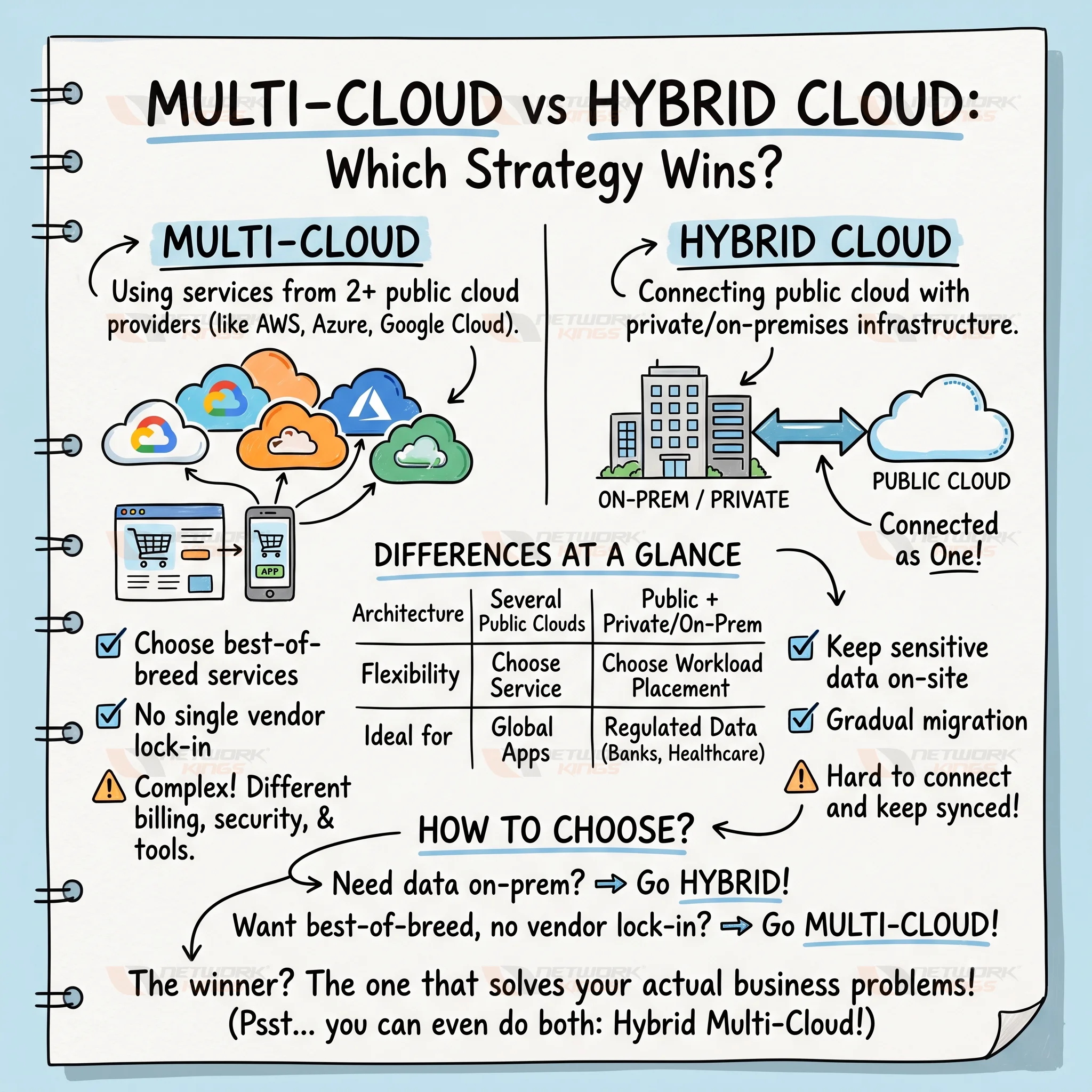
A multi-cloud strategy involves using services from two or more cloud providers, such as AWS, Microsoft Azure, or Google Cloud, to run applications and manage business operations.
Instead of relying on one provider for everything, organizations can select services based on performance, functionality, availability, and cost.
For example, an e-commerce company might host its main application on AWS, use Google Cloud for data analytics, and run selected business applications on Azure.
The main benefits include:
Greater choice of cloud services and specialized technologies.
Reduced dependence on a single cloud provider.
Flexibility to distribute workloads across different platforms.
Additional options for disaster recovery and resilience.
However, multi-cloud environments can become complicated to manage. Different platforms have separate billing systems, security controls, networking configurations, and monitoring tools. Moving applications between providers may also require significant changes if they depend on proprietary services.
A successful multi-cloud strategy therefore requires clear governance, consistent security policies, and skilled IT teams.
What Is a Hybrid Cloud Strategy?
A hybrid cloud strategy connects an organization's private infrastructure with public cloud services so that workloads and data can operate across these environments. Private infrastructure may include an on-premises data center or a privately operated cloud.
This approach is useful for businesses that want cloud scalability without moving every application or dataset away from their existing infrastructure.
Consider a healthcare organization that keeps certain sensitive records in a controlled private environment while using public cloud resources for its website, appointment systems, or analytics workloads. The exact placement must reflect applicable regulations and security requirements.
Key advantages of hybrid cloud include:
Keeping selected workloads close to existing systems or users.
Supporting gradual cloud migration instead of a complete infrastructure replacement.
Using public cloud capacity when additional resources are needed.
Maintaining control over workloads with specific latency, data residency, or operational requirements.
The trade-off is that organizations must connect and manage different environments reliably. Network connectivity, identity management, data synchronization, and consistent security policies require careful planning.
Multi-Cloud vs Hybrid Cloud Differences at a Glance
The most important difference is that multi-cloud focuses on using multiple cloud providers, while hybrid cloud focuses on integrating distinct infrastructure environments.
Factor | Multi-cloud | Hybrid cloud |
Architecture | Several public cloud providers | Public cloud plus private cloud or on-premises |
Infrastructure | Mostly provider-managed | Mix of provider-managed and self-managed |
Flexibility | Wide choice of services | Wide choice of workload placement |
Security | Policies must stay consistent across providers | Policies must stay consistent across cloud and on-premises |
Compliance | Depends on provider certifications and regions | Easier to keep regulated data in a defined location |
Cost management | Pricing varies by provider, visibility is harder | Capital and operating costs are blended |
Vendor dependency | Lower concentration on a single provider | Reliance on cloud providers and hardware vendors |
Complexity | Tooling and skills sprawl | Integration and infrastructure operations |
Ideal use cases | Best-of-breed services, provider-level resilience | Regulated data, legacy systems, low latency needs |
Neither approach automatically guarantees better security, lower costs, or higher availability. Outcomes depend on architecture, configuration, operational discipline, and workload requirements.
How the Two Approaches Differ in Practice
Multi-cloud pushes you to design for portability, while hybrid cloud pushes you to design for consistency between environments. Both depend on interoperability, but the pain points differ. Between clouds, it is usually identity federation, data transfer, and mismatched services. Between cloud and data center, it is network connectivity, latency, and keeping tooling aligned.
Data governance also looks different. In a hybrid model, data sovereignty requirements can be met by keeping specific datasets on premises. In multi-cloud, you must verify where each provider stores and processes data and apply the same cloud governance rules everywhere.
Disaster recovery is another distinction. Multi-cloud can protect against a provider-level outage, though it demands tested failover and data replication, which add cost. Hybrid cloud often uses the public cloud as a recovery site for on-premises systems, or the reverse. Neither works well unless failover is rehearsed.
When Each Strategy Fits Best
The scenarios below are illustrative, not case studies.
A global software company serving customers in many regions may favor multi-cloud. It can place workloads near users, use each provider's strongest services, and avoid dependence on one vendor's roadmap or pricing.
A bank or healthcare organization with strict residency rules may lean toward hybrid cloud. Patient or transaction records stay in a controlled environment while customer-facing applications scale in the public cloud.
A manufacturer with older systems tied to plant equipment may also choose hybrid cloud. Rewriting those systems is risky, so a phased cloud migration lets it modernize around them.
Challenges and Common Mistakes
Both models raise the bar for cloud security. More environments mean more identities, more configurations, and more places for gaps to appear. Cloud cost optimization is also harder when billing is split across providers or between capital and operating budgets. Tagging, budgets, and regular cost reviews help.
Common mistakes include adopting multi-cloud because it sounds safer rather than because a requirement demands it, lifting and shifting applications without checking whether they suit the target, and ignoring data egress fees. Another frequent error is assuming portability exists without testing it. Finally, many teams underestimate the training and tooling needed to run more than one environment well.
How to Choose the Right Strategy
Start with constraints rather than preferences. These questions usually settle most of the decision:
Do compliance or data residency rules require certain data to stay on premises or in a specific region?
How much legacy infrastructure exists, and how costly would it be to move?
Does your team have the skills to operate several platforms or a blended environment?
Is the goal to reduce provider dependence, access specialized services, or extend current investments?
What budget exists for tooling, training, and ongoing governance?
If regulation and existing systems dominate, hybrid cloud is usually the more natural starting point. If provider flexibility and service choice dominate, multi-cloud deserves a closer look. If both matter, plan for them together, and start with a small number of workloads rather than a full commitment.
Final Verdict on Multi-Cloud vs Hybrid Cloud
So, which strategy wins?
Multi-cloud wins when using multiple providers delivers meaningful flexibility, specialized capabilities, or reduced dependence on a single vendor. Hybrid cloud wins when integrating existing infrastructure with public cloud services better supports operational, regulatory, or migration needs.
The two strategies are not mutually exclusive. An organization can maintain on-premises systems, use one public cloud for core applications, and adopt another for specialized services. This creates a hybrid multi-cloud environment, which requires thoughtful architecture and unified governance.
Ultimately, choose the strategy that solves your actual business problems, not the one that sounds most advanced. A well-managed environment with clearly defined goals will usually deliver more value than a complex architecture without a strong business case.
Frequently Asked Questions
1. Can an organization combine multi-cloud and hybrid cloud architectures?
Yes. An organization can connect its on-premises infrastructure to one public cloud while using another provider for analytics, AI, or application hosting. This creates a hybrid multi-cloud environment that requires consistent security policies, centralized governance, and effective workload management.
2. How does workload portability differ between multi-cloud and hybrid cloud?
Multi-cloud portability involves moving applications between cloud providers, while hybrid cloud portability involves moving workloads between private infrastructure and public cloud environments. Both depend on application design, data dependencies, compatible platforms, networking, and the use of standardized technologies such as containers.
3. Which cloud strategy offers better disaster recovery capabilities?
Neither strategy guarantees better disaster recovery by default. Multi-cloud can reduce dependence on a single provider, while hybrid cloud can use public cloud resources to recover on-premises workloads. The better option depends on recovery time objectives (RTO), recovery point objectives (RPO), data replication, failover testing, and available recovery capacity.
4. How do organizations prevent security gaps in multi-cloud and hybrid cloud environments?
Organizations should implement centralized identity and access management, multifactor authentication, encryption, continuous monitoring, configuration management, and consistent security policies. They should also map shared security responsibilities across providers and regularly test incident response and recovery procedures.
5. What role does Kubernetes play in multi-cloud and hybrid cloud strategies?
Kubernetes can help organizations deploy and orchestrate containerized applications across supported environments. However, it does not automatically make applications portable or eliminate differences in networking, storage, identity, security, and managed cloud services. Additional platform engineering and governance are often necessary.
6. How should businesses evaluate the total cost of multi-cloud versus hybrid cloud?
Businesses should compare total cost of ownership, including compute, storage, licensing, data transfer, network connectivity, hardware maintenance, staffing, security tooling, and training. Multi-cloud may introduce cross-provider data transfer and management costs, while hybrid cloud may retain data center operating expenses alongside public cloud charges.
7. When should an organization migrate from hybrid cloud to multi-cloud?
An organization should consider expanding into multi-cloud when it has a clear business requirement, such as accessing specialized services, meeting geographic requirements, or reducing reliance on a single provider. Before expanding, it should assess application dependencies, team capabilities, interoperability, security controls, and the ongoing cost of operating another cloud platform.

The founder of Network Kings, is a renowned Network Engineer with over 12 years of experience at top IT companies like TCS, Aricent, Apple, and Juniper Networks. Starting his journey through a YouTube channel in 2013, he has inspired thousands of students worldwide to build successful careers in networking and IT. His passion for teaching and simplifying complex technologies makes him one of the most admired mentors in the industry.