Most In-Demand Networking Certifications in 2026
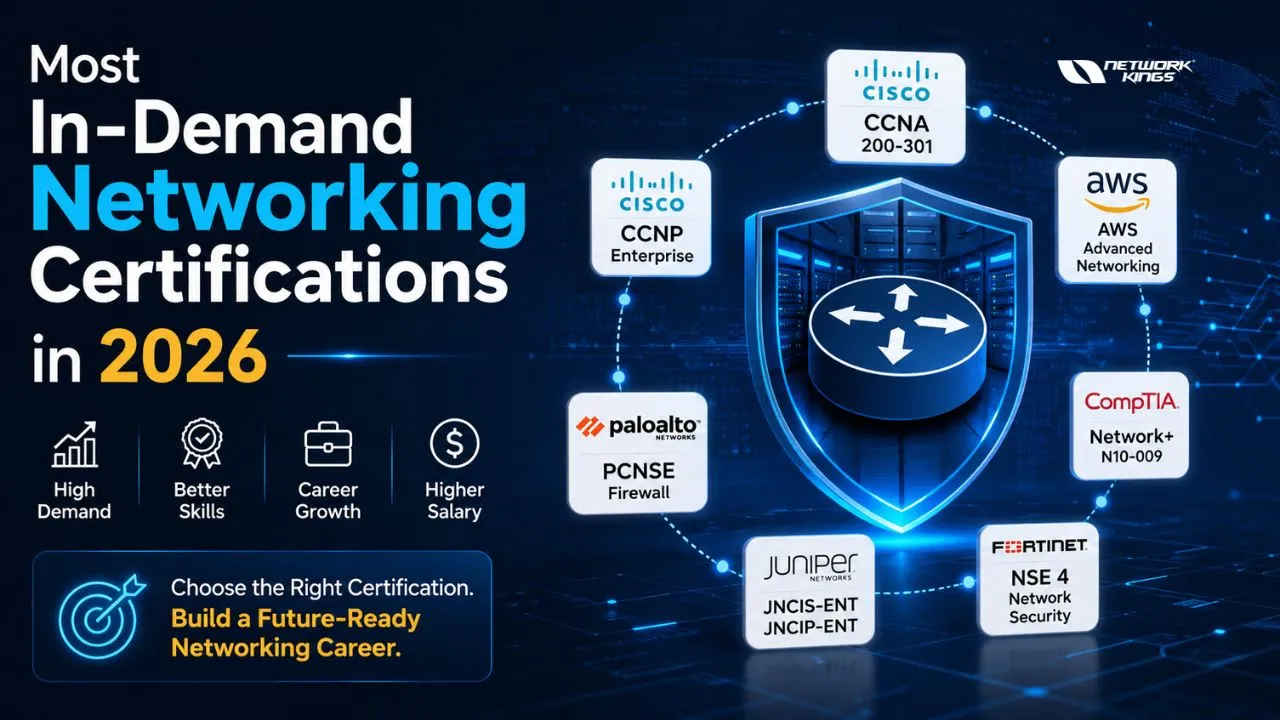
The global network infrastructure market is projected to surpass $200 billion by the end of 2026, and qualified networking professionals remain one of the most sought-after groups in IT. Despite AI-driven automation reshaping many job functions, networks still need humans who can design, secure, troubleshoot, and scale them. That demand translates directly into strong salaries, stable career paths, and real opportunities for anyone willing to put in the effort.
This guide covers the most in-demand networking certifications in 2026, how to choose the right one for your goals, and what career doors each certification can open.
Which Networking Certification Is Most Valuable in 2026?
The CCNA (Cisco Certified Network Associate) remains the most universally recognized entry-level networking certification in 2026. For mid-level professionals, the CCNP Enterprise and AWS Advanced Networking Specialty are among the highest-paying. The best certification for you depends on your experience level, target role, and whether you lean toward enterprise networking, cloud, or security.
Why Networking Certifications Matter in 2026
Employers have more candidates to evaluate than ever before. A certification does two things: it proves you have the skills, and it signals that you took the initiative to earn them.
Hiring managers in network engineering roles increasingly use certifications as a baseline filter. Without at least one recognized credential, your resume may not make the shortlist, especially in larger organizations where HR teams screen hundreds of applications. For experienced professionals, advanced certifications like CCNP or CISSP justify higher compensation and open the door to senior roles.
From a salary perspective, certified network engineers in the United States earn between $85,000 and $150,000 annually, depending on specialization and seniority. Cloud networking and security specialists consistently command the upper end of that range.
Most In-Demand Networking Certifications in 2026
CCNA (Cisco Certified Network Associate)
The CCNA is the gold standard for entry-level network engineers. It covers IP connectivity, routing and switching, basic security, automation, and network fundamentals. If you are new to networking or transitioning from IT support, this is typically the right first step.
Ideal for: students, IT support staff, aspiring network engineers
Key skills: IP addressing, VLANs, OSPF, basic security, Cisco IOS
Typical salary: $65,000 to $95,000
Industry demand: consistently high across enterprise, education, and government sectors
CCNP Enterprise (Cisco Certified Network Professional Enterprise)
The CCNP Enterprise is designed for professionals ready to move beyond entry-level work. It covers advanced routing, SD-WAN, network design, and automation. You need to pass one core exam and one concentration exam to earn it, which gives you flexibility to specialize.
Ideal for: network engineers with 3 or more years of experience
Key skills: OSPF, EIGRP, BGP, SD-WAN, Cisco DNA Center, network programmability
Typical salary: $95,000 to $135,000
Industry demand: very high, especially in large enterprises managing complex multi-site environments
CompTIA Network+
Network+ is a vendor-neutral certification that provides a solid foundation in networking concepts. It is widely accepted by government agencies and managed service providers as a baseline credential.
Ideal for: career changers, help desk technicians, junior system administrators
Key skills: network troubleshooting, protocols, infrastructure, cloud basics, security
Typical salary: $55,000 to $80,000
Industry demand: strong, particularly for roles in IT support and systems administration
Cisco Certified CyberOps Associate
This certification bridges networking and cybersecurity operations. It focuses on security monitoring, threat analysis, and incident response, skills that are central to Security Operations Center (SOC) work.
Ideal for: network professionals moving into security, aspiring SOC analysts
Key skills: security event monitoring, intrusion detection, threat intelligence, network protocols
Typical salary: $70,000 to $100,000
Industry demand: growing rapidly as organizations scale their security monitoring functions
AWS Advanced Networking Specialty
Cloud networking is one of the fastest-growing areas in IT, and this AWS certification targets professionals who manage and design complex networking architectures on Amazon Web Services.
Ideal for: network engineers working in or moving to cloud environments
Key skills: VPC design, hybrid connectivity, DNS, load balancing, Direct Connect, Transit Gateway
Typical salary: $110,000 to $155,000
Industry demand: extremely high as enterprises accelerate cloud migration
Azure Network Engineer Associate (AZ-700)
Microsoft's AZ-700 certification is for professionals who design and implement networking in Azure. As Azure continues to grow its enterprise market share, this credential is increasingly valuable for cloud-first organizations.
Ideal for: network engineers working with Microsoft Azure, hybrid cloud architects
Key skills: Azure VNets, VPN gateways, ExpressRoute, Azure Firewall, load balancers
Typical salary: $100,000 to $145,000
Industry demand: very high, especially in enterprises using Microsoft 365 and Azure services
Juniper JNCIA-Junos
The JNCIA-Junos is Juniper Networks' entry-level certification covering Junos OS fundamentals. While Cisco dominates market share, Juniper is widely deployed by telecom providers, ISPs, and large financial institutions.
Ideal for: networking students and professionals targeting telecom or service provider roles
Key skills: Junos OS CLI, routing basics, firewall filters, network interfaces
Typical salary: $70,000 to $105,000
Industry demand: moderate but consistent in telecommunications and data center environments
Fortinet NSE Certifications
Fortinet's Network Security Expert (NSE) track covers firewall administration, network security design, and threat management using FortiGate products. The NSE 4 through NSE 7 levels are the most employer-recognized.
Ideal for: security engineers, firewall administrators, network security professionals
Key skills: FortiGate configuration, VPN, intrusion prevention, web filtering, SASE
Typical salary: $85,000 to $130,000
Industry demand: high, as Fortinet has significantly expanded its enterprise market presence
Palo Alto Networks Certifications (PCNSA / PCNSE)
Palo Alto Networks certifications validate skills on one of the most widely deployed next-generation firewall platforms. The PCNSA is the associate-level credential, while the PCNSE is the professional-level exam used for advanced network security roles.
Ideal for: network security engineers, firewall administrators, security architects
Key skills: Palo Alto firewall policy management, threat prevention, Panorama, Zero Trust principles
Typical salary: $95,000 to $140,000
Industry demand: high and growing, particularly in the enterprise and government sectors
CISSP (Certified Information Systems Security Professional)
While the CISSP is primarily a security certification, it holds strong value for senior networking professionals who manage or design secure network architectures. It covers eight security domains, including network security, identity management, and risk management.
Ideal for: senior network engineers, security architects, IT managers with 5 or more years of experience
Key skills: security governance, network design, access control, cryptography, risk assessment
Typical salary: $120,000 to $170,000
Industry demand: consistently strong across finance, healthcare, government, and large enterprises
Networking Certification Comparison Table for 2026
Certification | Level | Best For | Key Focus Area | Average Salary (US) | Industry Demand |
CCNA | Beginner | Aspiring Network Engineers | Routing, Switching, Network Fundamentals | $65,000 - $95,000 | Very High |
CompTIA Network+ | Beginner | Career Changers, IT Support | Networking Basics, Troubleshooting | $55,000 - $80,000 | High |
JNCIA-Junos | Beginner | Telecom and ISP Professionals | Junos OS, Routing Fundamentals | $70,000 - $105,000 | Moderate |
CCNP Enterprise | Intermediate | Network Engineers | Enterprise Networking, SD-WAN, Automation | $95,000 - $135,000 | Very High |
Cisco CyberOps Associate | Intermediate | SOC Analysts | Security Monitoring, Incident Response | $70,000 - $100,000 | High |
Fortinet NSE | Intermediate to Advanced | Security Engineers | Firewalls, VPNs, Threat Protection | $85,000 - $130,000 | High |
PCNSA / PCNSE | Intermediate to Advanced | Network Security Engineers | Next-Generation Firewalls, Zero Trust | $95,000 - $140,000 | High |
Azure Network Engineer Associate | Advanced | Cloud Network Engineers | Azure Networking, Hybrid Connectivity | $100,000 - $145,000 | Very High |
AWS Advanced Networking Specialty | Advanced | Cloud Architects and Engineers | AWS Network Design, Hybrid Networking | $110,000 - $155,000 | Extremely High |
CISSP | Advanced | Security Architects and IT Leaders | Security Governance, Risk Management | $120,000 - $170,000 | Very High |
How to Choose the Right Networking Certification
Based on experience level
If you are just starting, CompTIA Network+ or CCNA are the most logical choices. Both build foundational knowledge without requiring prior certifications. If you already have a few years on the job, the CCNP Enterprise, AWS Advanced Networking Specialty, or Palo Alto PCNSE will carry more weight with hiring managers.
Based on career goals
Think about the kind of work you actually want to do day to day. If you enjoy designing networks and solving infrastructure problems, CCNP or JNCIA-Junos may fit well. If you are drawn to security, Fortinet NSE, Palo Alto PCNSE, or CyberOps Associate are stronger options. If cloud is your target, AWS or Azure networking certifications will get you there faster.
Based on specialization
Network engineers who want to move into cloud architecture should prioritize vendor cloud certifications. Those aiming for cybersecurity leadership should consider the CISSP. Professionals focused on firewalls and threat management will find Fortinet and Palo Alto certifications most relevant.
Based on job market demand
Search job boards in your target region for the roles you want. Note which certifications appear most frequently in job postings. In most markets, CCNA, AWS Advanced Networking, and CCNP consistently rank near the top. Matching your certification path to what employers are actively requesting gives you the best return on your study time.
Career Opportunities After Networking Certifications
Earning a recognized certification can open the door to a range of roles depending on your level and specialization. Here are the most common career paths for certified networking professionals in 2026.
Network Administrator: manages day-to-day network operations and performance monitoring
Network Engineer: designs and deploys enterprise network infrastructure
Network Security Engineer: implements and manages firewalls, VPNs, and intrusion detection systems
Cloud Network Engineer: builds and manages networking within cloud platforms like AWS or Azure
Infrastructure Engineer: oversees servers, storage, and network components across an organization
Systems Engineer: integrates hardware and software systems in enterprise environments
Security Analyst: monitors for threats and responds to security incidents, often in a SOC setting
Most of these roles fall in the $75,000 to $140,000 salary range in the US, with senior and cloud-focused positions frequently exceeding that ceiling.
Networking remains one of the most stable and rewarding fields in IT. Whether you are starting your career or looking to specialize further, the right certification will sharpen your skills, raise your profile with employers, and move you closer to your target salary.
If you are just getting started, the CCNA or CompTIA Network+ is a smart first step. If you already have experience, consider whether cloud networking, security, or enterprise infrastructure aligns best with where you want to go. Pick one certification, build a study plan, and commit to it. The demand is there. The opportunities are real, your move.
Frequently Asked Questions
1. Which networking certification should I get first in 2026?
For complete beginners, CompTIA Network+ is a great starting point because it covers vendor-neutral fundamentals. If you already have some IT experience and want to specialize in Cisco environments, the CCNA is often a better first choice with stronger employer recognition.
2. Is the CCNA still worth it in 2026?
Yes. The CCNA remains one of the most recognized networking certifications globally. It is widely requested in job postings across enterprise IT, government, and education sectors, and it provides a strong foundation for more advanced certifications like CCNP.
3. What is the highest-paying networking certification in 2026?
The CISSP, AWS Advanced Networking Specialty, and Azure Network Engineer Associate tend to command the highest salaries, often ranging from $110,000 to $170,000 depending on role and location. These are best suited for experienced professionals.
4. Do I need a degree to earn a networking certification?
No. Most networking certifications, including the CCNA, CompTIA Network+, and Fortinet NSE, have no formal education requirements. They are earned by passing an exam, making them accessible to career changers and self-taught candidates.
5. How long does it take to prepare for the CCNA exam?
Most candidates with basic IT knowledge spend three to six months preparing for the CCNA, studying for one to two hours per day. Using a combination of study guides, video courses, and hands-on practice labs significantly improves exam performance.

The founder of Network Kings, is a renowned Network Engineer with over 12 years of experience at top IT companies like TCS, Aricent, Apple, and Juniper Networks. Starting his journey through a YouTube channel in 2013, he has inspired thousands of students worldwide to build successful careers in networking and IT. His passion for teaching and simplifying complex technologies makes him one of the most admired mentors in the industry.