DevOps vs DevSecOps: What Is the Difference and Why Does It Matter?
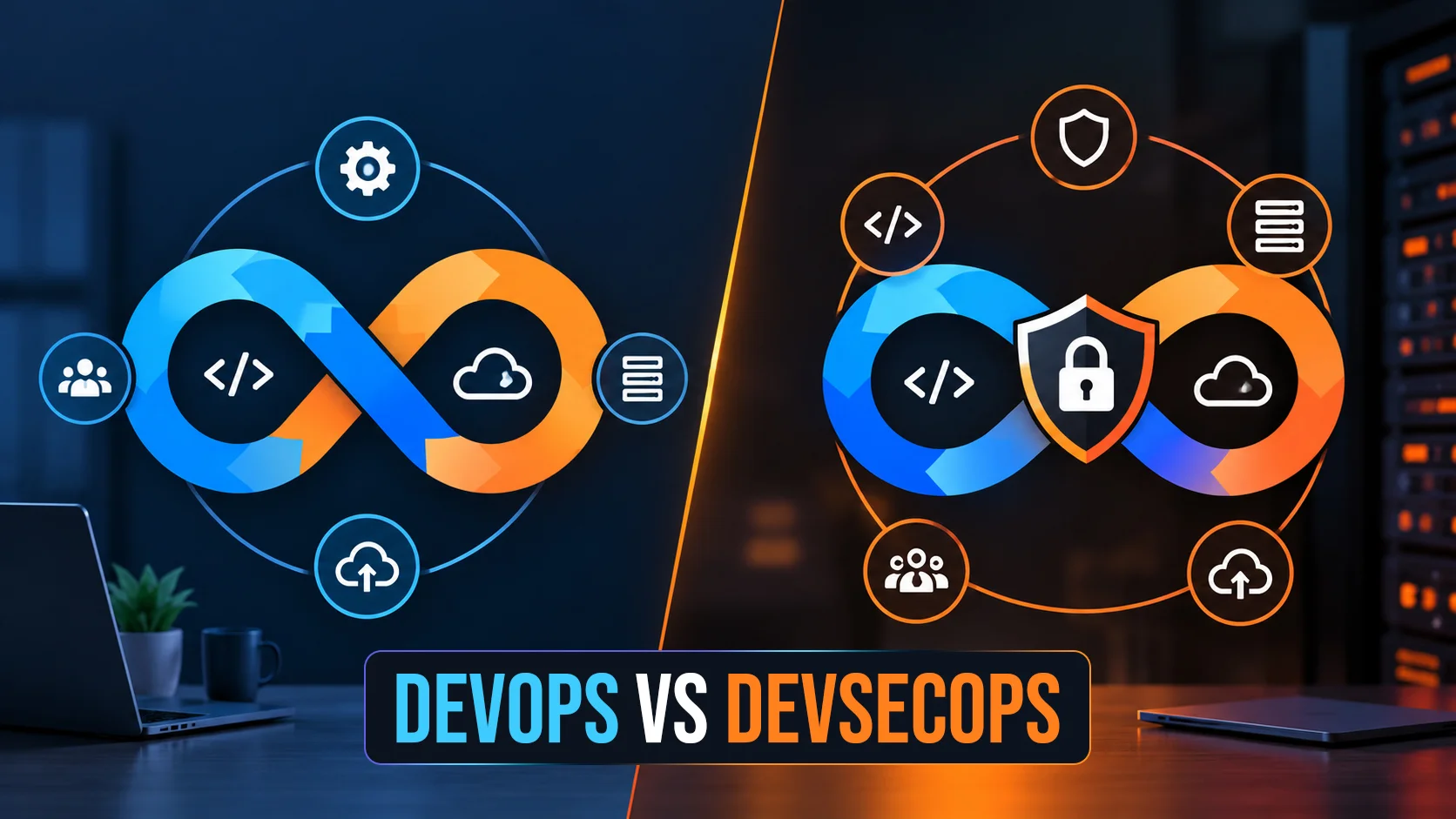
DevOps and DevSecOps both aim to make software delivery faster, more reliable, and more automated. The key difference is how they handle security. DevOps brings development and operations together through practices such as CI/CD, automation, infrastructure as code, and monitoring. DevSecOps extends this model by integrating security throughout development, testing, deployment, and operations rather than treating it as a separate activity near the end of the lifecycle.
This distinction matters because modern applications depend on cloud infrastructure, open-source packages, containers, APIs, and automated deployment pipelines. A security weakness can therefore enter through application code, a dependency, a container image, an infrastructure configuration, or even the software supply chain.
What DevOps Means in Modern Software Delivery
DevOps is a culture and set of engineering practices that merge development and operations work into a continuous flow. Instead of developers writing code and tossing it over to a separate operations team, both groups collaborate throughout the software development lifecycle.
In practice, this looks like:
Developers using Git and version control to manage changes collaboratively
Continuous integration pipelines that build and test code automatically
Continuous delivery or continuous deployment pushing changes to production frequently
Infrastructure as code replacing manual server configuration
Containers and orchestration platforms like Kubernetes standardizing how applications run across environments
Monitoring and observability tools giving teams visibility into production behavior
The goal is speed with stability. Automation removes manual bottlenecks, and shared ownership reduces the finger-pointing that used to happen when something broke in production.
What DevSecOps Adds to the DevOps Model
DevSecOps does not replace DevOps. It extends it by weaving security into every stage of the pipeline rather than treating it as a final review before release.
Traditional security models often placed a dedicated security team at the end of the development cycle, reviewing code or infrastructure right before deployment. That approach creates friction because problems surface late, when fixing them is expensive and delays are hard to absorb. A vulnerability found the day before a release can force teams to choose between shipping late or shipping risky code.
DevSecOps solves this by moving security checks earlier and running them continuously alongside development, an approach commonly called shift-left security. Security testing happens during coding and CI, not just before release.
DevOps vs DevSecOps: Key Technical Differences
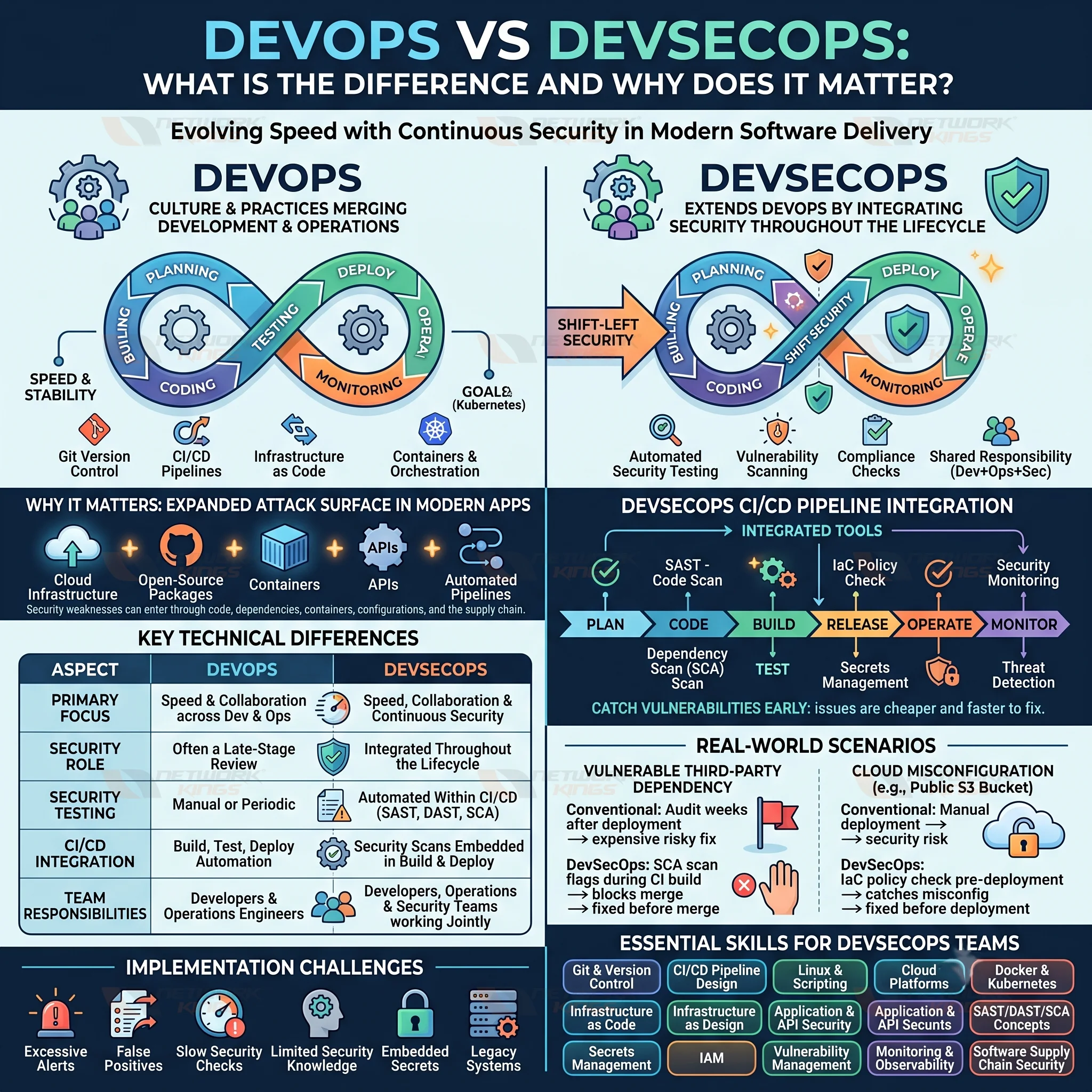
What is the difference between DevOps and DevSecOps in practical terms? DevOps optimizes the pipeline for speed and collaboration between development and operations. DevSecOps adds automated security testing, vulnerability scanning, and compliance checks directly into that same pipeline, making security a shared task across development, operations, and security teams rather than a separate function.
Aspect | DevOps | DevSecOps |
Primary focus | Speed and collaboration across dev and ops | Speed, collaboration, and continuous security |
Dev and ops collaboration | Core practice | Extended to include security teams |
Role of security | Often a late-stage or separate review | Integrated throughout the lifecycle |
Security testing | Manual or periodic | Automated within CI/CD (SAST, DAST, SCA) |
CI/CD integration | Build, test, deploy automation | Security scans embedded in build and deploy stages |
Automation | Infrastructure and deployment automation | Adds automated vulnerability and compliance checks |
Vulnerability management | Reactive, often post-deployment | Proactive, caught earlier in development |
Monitoring | Performance and uptime focused | Includes threat detection and security monitoring |
Team responsibilities | Developers and operations engineers | Developers, operations, and security working jointly |
Typical implementation | CI/CD pipeline with automated deployment | CI/CD pipeline with embedded security gates |
How Security Fits Into a DevSecOps CI/CD Pipeline
How does DevSecOps improve CI/CD? It embeds automated security checks at each pipeline stage, catching vulnerabilities in code, dependencies, and infrastructure before deployment rather than after, so issues are cheaper and faster to fix.
Security Testing During Development
Static application security testing (SAST) scans source code for insecure patterns as it's written or committed. Dynamic application security testing (DAST) probes a running application for exploitable weaknesses. Running these during CI, rather than as a pre-release audit, means developers see results while the context is still fresh.
Dependency and Container Security
Modern applications rely heavily on open-source packages and container images. Software composition analysis (SCA) tools scan dependencies for known vulnerabilities before code merges. Container security scanning checks base images for outdated or insecure components before they reach a registry.
Software Supply Chain Security
Modern DevSecOps also considers the software supply chain itself. Source repositories, third-party dependencies, container images, build systems, artifact repositories, and CI/CD credentials can all become security boundaries. Protecting these components helps reduce the risk of compromised software entering the delivery process.
Infrastructure and Cloud Security
Infrastructure as code templates can accidentally define overly permissive access, exposed storage, or misconfigured networking. DevSecOps pipelines validate these templates against security policies before provisioning, catching misconfigurations before they exist in the cloud rather than after an audit finds them.
Secrets management also matters here. Hardcoded credentials in code or config files are a common attack path, so DevSecOps workflows use dedicated secrets management tools and enforce identity and access management policies throughout.
Real-World DevSecOps Scenarios
Consider a team that discovers a vulnerable third-party dependency. In a conventional DevOps workflow, this might only surface during a scheduled security audit weeks after deployment. In a DevSecOps pipeline, an SCA scan flags the vulnerable package during the CI build, blocking the merge until it's patched or replaced.
Now consider infrastructure as code that provisions a cloud storage bucket with public read access by mistake. Without automated checks, this could deploy silently and sit exposed until someone notices. A DevSecOps pipeline runs policy checks against the IaC template pre-deployment, catching the misconfiguration before it ever reaches production.
Common Challenges When Moving Toward DevSecOps
Adding security to an existing DevOps environment is not simply a matter of installing scanners.
Common challenges include:
Excessive security alerts that create alert fatigue
False positives requiring manual investigation
Slow security checks affecting developer workflows
Limited security knowledge among development teams
Inconsistent ownership of vulnerabilities
Secrets or credentials already embedded in existing systems
Difficulty securing legacy applications and infrastructure
Lack of clear policies for accepting or remediating risk
Successful implementation usually requires appropriate tooling, clear ownership, practical security policies, and feedback that developers can understand and act on.
Automation reduces repetitive work, but it does not eliminate the need for security expertise. Teams still need people who can interpret findings, understand application and infrastructure risks, investigate threats, and decide how vulnerabilities should be remediated.
What Skills Are Useful for DevSecOps
Professionals working with DevSecOps environments benefit from a combination of development, operations, cloud, and security knowledge.
Important areas include:
Git and version control
CI/CD pipeline design
Linux and scripting
Cloud platforms
Infrastructure as code
Application and API security
SAST, DAST, and SCA concepts
Secrets management
Identity and access management
Vulnerability management
Monitoring and observability
Software supply chain security
Understanding how these areas interact is more valuable than knowing individual security tools in isolation.
Conclusion
DevOps and DevSecOps share the same foundation of collaboration, automation, continuous delivery, and operational feedback. The key distinction is that DevSecOps deliberately integrates security into those practices across the software lifecycle.
A DevSecOps environment may analyze code during CI, scan dependencies and container images, validate infrastructure as code, protect secrets, enforce access controls, and monitor applications after deployment. The goal is not to add security as another isolated gate, but to make security part of how software is designed, built, delivered, and operated.
For IT professionals, understanding the relationship between DevOps and DevSecOps means looking beyond individual tools. The real value comes from understanding how development, operations, automation, cloud infrastructure, and security work together as one software delivery process.
FAQs
Is DevSecOps part of DevOps?
DevSecOps builds on DevOps rather than existing separately. It uses the same CI/CD and automation foundation but adds continuous, integrated security practices across the lifecycle.
Why is DevSecOps important?
DevSecOps catches vulnerabilities earlier, when they're cheaper and faster to fix, and reduces the risk of shipping insecure code under release pressure.
What security practices are used in DevSecOps?
Common practices include SAST, DAST, SCA, container scanning, secrets management, and infrastructure as code validation, all integrated into CI/CD.
Does DevSecOps slow down deployment?
Well-tuned automated security checks typically add minimal delay compared to manual, late-stage security reviews, which tend to cause far bigger slowdowns.
Can small teams implement DevSecOps?
Yes. Teams can start by adding dependency scanning and basic CI security checks incrementally rather than overhauling the entire pipeline at once.

The founder of Network Kings, is a renowned Network Engineer with over 12 years of experience at top IT companies like TCS, Aricent, Apple, and Juniper Networks. Starting his journey through a YouTube channel in 2013, he has inspired thousands of students worldwide to build successful careers in networking and IT. His passion for teaching and simplifying complex technologies makes him one of the most admired mentors in the industry.