Cloud Computing Trends 2027 and What They Mean for IT Teams

Cloud computing is entering another major shift as organizations move beyond basic migration and start optimizing cloud infrastructure for AI, automation, security, resilience, and measurable business value. In 2027, the conversation will be less about whether companies should use the cloud and more about how intelligently they use it.
Recent industry forecasts point toward rapidly growing demand for AI-optimized infrastructure, while cloud strategies are also becoming more focused on governance, cost control, sovereignty, and workload placement. Gartner expects worldwide spending on AI-optimized infrastructure as a service to reach about $66 billion in 2027, reflecting the growing infrastructure demands of AI workloads and inference.
For businesses, developers, and IT teams, understanding these cloud computing trends in 2027 can help with technology planning, infrastructure investments, and long-term cloud strategy.
What is driving the future of cloud computing
Three forces keep showing up in cloud computing predictions. Generative AI has created demand for specialized compute and well-managed data. Cloud bills have grown large enough that finance teams ask hard questions. And regulation, from data residency rules to resilience requirements, is pushing companies to think harder about where workloads live. Each trend below connects to at least one of these.
AI infrastructure moves to the center of cloud planning
This is already well underway. Major providers keep expanding GPU capacity and offering custom accelerators, and enterprises are moving from pilots to production inference. By 2027, the question shifts from whether to use AI to where training and inference should run and how to feed them reliable data.
That makes cloud data management a core concern. Data lakehouses, vector databases, and governed pipelines matter because a model is only as dependable as the data it can reach. Accelerator availability and inference costs are the main constraints. Expect workload placement to depend more on chip supply and growing interest in smaller, cheaper models.
AI in cloud computing starts running the operations layer
Beyond hosting models, AI is being built into cloud management itself. Assistants already help write infrastructure code, explain incidents, and suggest fixes. The next step, which is still maturing, is agentic automation, where software takes actions such as scaling resources or remediating misconfigurations.
The benefit is faster response and less manual work. The risk is giving automated agents too much authority. Most enterprises will likely adopt these tools with narrow permissions, audit trails, and human approval for high-impact changes. Fully autonomous cloud operations in 2027 is unlikely.
Hybrid cloud and multicloud stay, now with sovereignty in the mix
Will hybrid cloud remain important? Very likely. Many companies keep sensitive data in private environments while using public cloud for scale. Others run multicloud for resilience, pricing leverage, or access to specific services.
What is changing is the reason. Data sovereignty rules and concerns about provider concentration are leading more organizations, particularly in Europe, to ask for regional or sovereign cloud options. The trade-off is complexity, since multicloud multiplies skills requirements, security tooling, and networking costs. Teams should be clear about the problem it solves before adopting it.
FinOps and cloud cost optimization become a standing discipline
How will businesses control cloud costs? Increasingly through FinOps, the practice of bringing engineering, finance, and product teams together to manage spending. AI makes this harder because GPU usage is spiky and expensive.
Practical steps include:
Tagging resources so costs map to teams and products
Rightsizing instances and using commitment discounts carefully
Setting budgets and anomaly alerts for GPU workloads
Tracking unit economics, such as cost per customer or per inference
Watch for tighter links between cost data and engineering decisions, and for some steady workloads moving back on premises when cloud pricing stops making sense.
Cloud security leans on confidential computing and identity
What role will cloud security play in 2027? A larger one, partly because AI expands the attack surface. Identity remains the most common weak point, so least privilege, strong authentication, and zero trust principles stay essential.
Confidential computing is the newer piece. It uses hardware-based trusted execution environments to protect data while it is being processed, not only at rest or in transit. That appeals to regulated industries and to teams running AI on sensitive data. Adoption is growing but uneven, and performance overhead, tooling maturity, and attestation complexity are real hurdles.
Post-quantum cryptography also deserves attention. NIST has published its first post-quantum standards, and providers are starting to support them. Taking a cryptography inventory now is sensible even if the risk is not immediate.
Edge computing grows where latency and data rules matter
Edge computing processes data closer to where it is created, in factories, stores, vehicles, and telecom networks. The pull comes from low-latency applications, bandwidth costs, and local data requirements, and AI inference at the edge is a growing use case.
The limitation is operations. Managing thousands of distributed sites is harder than managing a cloud region. Expect edge to expand in specific industries rather than replace central cloud infrastructure.
Serverless and cloud-native development keep maturing
Kubernetes is a common foundation for cloud-native development, and the focus has shifted from adopting it to making it manageable. Platform engineering teams build internal developer platforms that hide complexity behind standard templates.
Serverless computing keeps its appeal for event-driven workloads and pay-per-use pricing, while containers handle long-running services. Cold starts, provider-specific features and debugging remain limits. In 2027, expect more blending, with managed Kubernetes and serverless containers reducing operational overhead.
Sustainable cloud computing faces measurement pressure
AI-driven data center growth has raised questions about energy and water use. Sustainable cloud computing is moving from marketing claims toward reporting, with customers asking for workload-level emissions data and some regions requiring disclosures.
Efficiency practices such as rightsizing, choosing lower-carbon regions, and scheduling flexible jobs overlap with cost savings. The challenge is that provider emissions data is not always granular or comparable, so treat this as a growing reporting requirement rather than a solved problem.
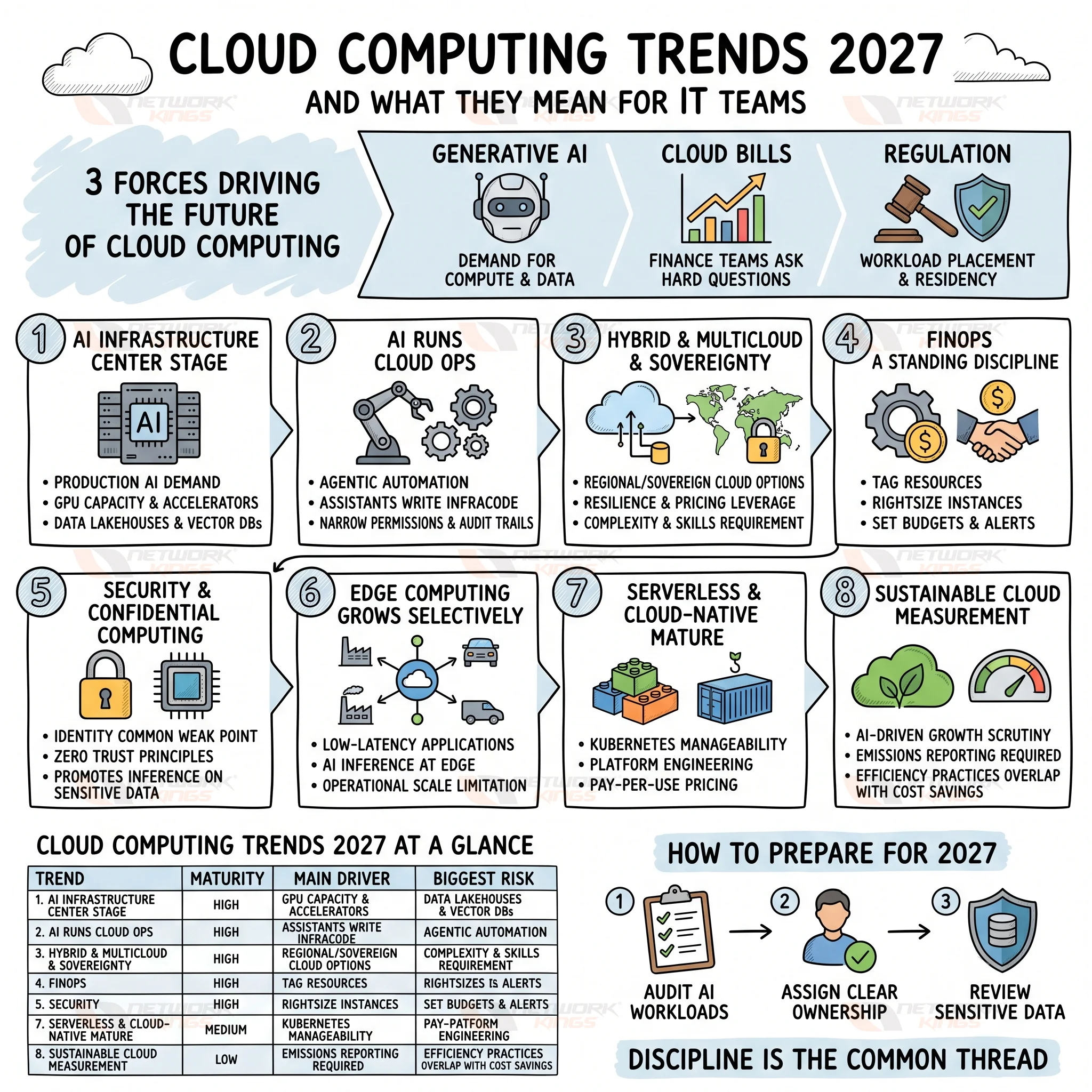
Cloud computing trends 2027 at a glance
Trend | Maturity | Main driver | Biggest risk |
AI infrastructure | Already significant | Production AI demand | Capacity and cost |
AI-driven cloud operations | Accelerating | Staffing and complexity | Over-automation |
Hybrid and multicloud | Established | Resilience, sovereignty | Complexity |
FinOps | Established, expanding | AI-inflated bills | Weak ownership |
Confidential computing | Early to growing | Regulated data and AI | Tooling maturity |
Edge computing | Selective growth | Latency, local data | Operational scale |
Serverless and Kubernetes | Established | Developer productivity | Lock-in, debugging |
Sustainable cloud | Emerging pressure | Reporting rules | Data quality |
How to prepare for 2027
The common thread is discipline. Teams that know their data, track their spending, and limit access will handle most of these trends well. A reasonable starting point is auditing AI workloads for cost and data exposure, assigning clear ownership for cloud spend, and reviewing where sensitive data is processed.
Conclusion
The future of cloud computing in 2027 is shaped by AI demand, tighter cost scrutiny, and stronger expectations around security and data location. Hybrid and multicloud stay relevant, edge and confidential computing grow in specific areas, and sustainability moves toward measurable reporting.
Cloud professionals should build skills in FinOps, security architecture, and AI infrastructure, while businesses should prioritize governance before scale. Treat these as informed expectations, and revisit them as the technology and regulations develop.
Frequently Asked Questions (FAQs)
What are the biggest cloud computing trends for 2027?
Key trends include AI-optimized infrastructure, AI-driven cloud operations, FinOps, hybrid and multicloud, confidential computing, edge computing, cloud native development, and sustainable cloud infrastructure.
How will AI impact cloud computing in 2027?
AI will influence cloud infrastructure, operations, security, and cost management. Organizations will increasingly use GPUs, AI accelerators, optimized inference infrastructure, and AI-assisted tools for managing cloud environments.
Will hybrid cloud and multicloud remain important in 2027?
Yes. Hybrid and multicloud strategies will remain useful for organizations managing sensitive data, compliance requirements, resilience, and workload placement across different environments.
Why is FinOps important for cloud computing in 2027?
FinOps helps organizations control cloud spending and connect infrastructure costs with business value. This will become increasingly important as AI workloads increase demand for expensive compute resources.
What is confidential computing in the cloud?
Confidential computing protects data while it is being processed using hardware-based trusted execution environments. It can help organizations handle sensitive workloads while reducing exposure in shared cloud environments.
Will Kubernetes still be important in 2027?
Yes. Kubernetes is expected to remain a major platform for cloud native applications and increasingly for AI workloads, although managed Kubernetes and higher-level platforms will reduce some operational complexity.
How will edge computing grow in 2027?
Edge computing will expand where applications require low latency, local processing, or tighter data control. Manufacturing, retail, telecommunications, connected vehicles, and real-time AI are likely to remain important use cases.
How should businesses prepare for cloud computing trends in 2027?
Businesses should evaluate AI workloads, cloud costs, security, data location, and performance requirements. They should adopt new cloud technologies selectively based on measurable business and technical needs.

The founder of Network Kings, is a renowned Network Engineer with over 12 years of experience at top IT companies like TCS, Aricent, Apple, and Juniper Networks. Starting his journey through a YouTube channel in 2013, he has inspired thousands of students worldwide to build successful careers in networking and IT. His passion for teaching and simplifying complex technologies makes him one of the most admired mentors in the industry.