AWS Certification Roadmap: Step-by-Step Path to Cloud Success
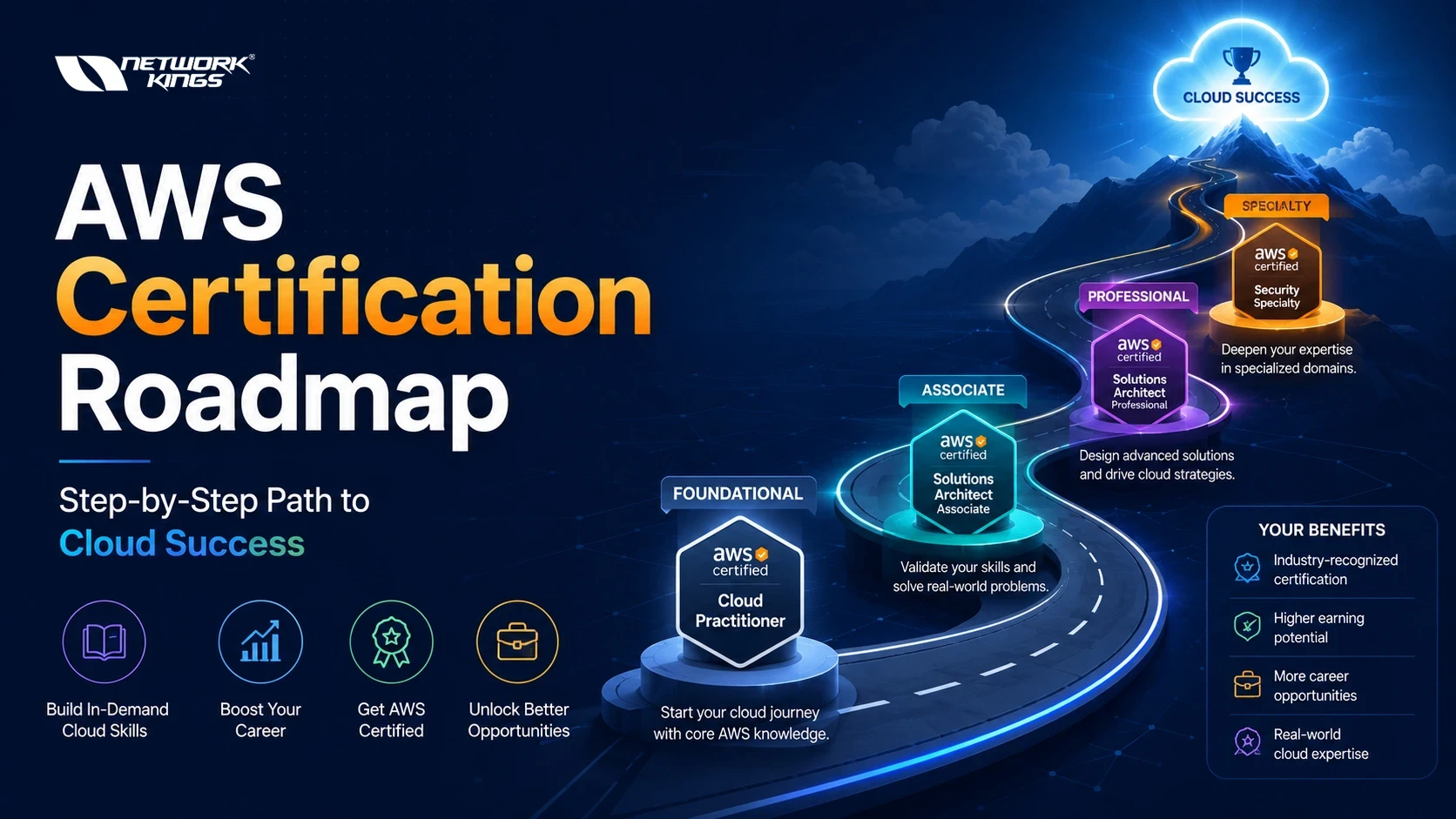
Cloud computing is no longer a niche skill. It is the backbone of how modern businesses build, scale, and secure their technology, and AWS remains the dominant platform powering that shift. If you are trying to break into cloud computing or move up in your IT career, an AWS Certification Roadmap gives you a structured way to build skills employers actually pay for.
The challenge is that AWS offers more than a dozen certifications. Without a plan, it is easy to pick the wrong one, waste months of study time, or pay for an exam that does not match your goals. This guide solves that problem with a complete, step-by-step roadmap covering every certification level, how to choose the right path, exam costs, validity periods, salary expectations, and the mistakes that trip up first-time candidates.
What Is AWS Certification
AWS Certification is a globally recognized credential program designed to validate technical expertise and practical cloud knowledge.
These certifications help professionals demonstrate their ability to design, deploy, manage, and secure workloads on AWS infrastructure.
Benefits of AWS certification include:
Improved job opportunities
Higher salary potential
Recognition of technical expertise
Increased credibility with employers
Better understanding of cloud technologies
Stronger foundation for advanced cloud roles
Organizations often prefer certified professionals because certifications provide evidence of hands-on knowledge and commitment to continuous learning.
AWS Certification Levels Explained
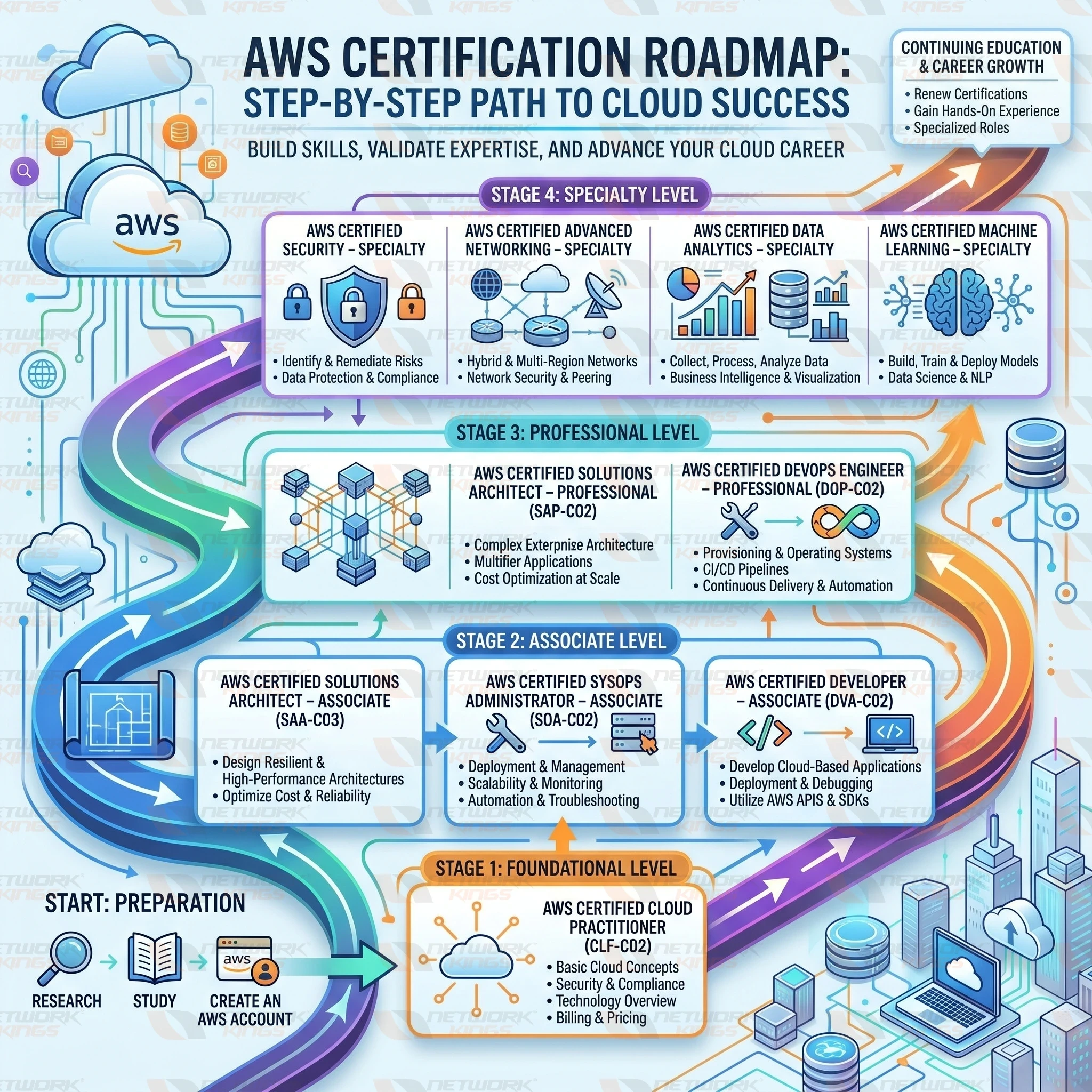
AWS organizes certifications into four levels, each targeting a different stage of experience. Understanding this structure is the foundation of any AWS certification roadmap.
Certification Level | Recommended Experience | Difficulty | Best For |
Foundational | None to six months | Easiest | Beginners, non-technical roles, career switchers |
Associate | Six months to a year of hands-on AWS use | Moderate | Developers, architects, system administrators |
Professional | Two or more years of AWS experience | Difficult | Senior engineers, architects, DevOps leads |
Specialty | Two to five years in a specific domain | Very difficult | Niche experts in security, networking, data, or ML |
Foundational certifications introduce core concepts without deep technical demands. Associate certifications test role-based skills on real workloads. Professional exams present complex, scenario-based questions that reward applied judgment over memorization. Specialty exams go narrow rather than broad, focusing entirely on one technical domain.
Complete AWS Certification Roadmap
Step 1: AWS Certified Cloud Practitioner
The Cloud Practitioner exam (CLF-C02) is the standard entry point into the AWS certification path. It suits complete beginners, project managers, sales professionals working with cloud products, and anyone exploring a cloud career.
It covers core cloud concepts, AWS global infrastructure, basic security and compliance, pricing models, and an overview of services like EC2, S3, and IAM. On its own, it will not land a senior engineering role, but it builds the vocabulary on which everything else rests and signals real foundational knowledge to employers.
Step 2: Associate-Level Certifications
This is where the roadmap branches based on career direction.
AWS Certified Solutions Architect Associate (SAA-C03) is the most widely recognized certification in the AWS ecosystem. It validates the ability to design secure, cost-effective, resilient architectures and underpins nearly every Professional and Specialty certification that follows.
AWS Certified Developer Associate (DVA-C02) is built for software developers, focusing on Lambda, DynamoDB, API Gateway, and CI/CD tooling rather than infrastructure design.
AWS Certified SysOps Administrator Associate has recently transitioned to the AWS Certified CloudOps Engineer Associate (SOA-C03), reflecting a renewed focus on operations and deployment automation. It includes a hands-on lab component, making it one of the more practically demanding associate exams.
Step 3: Professional-Level Certifications
Professional certifications mark a significant jump in difficulty and require two or more years of real production experience.
AWS Certified Solutions Architect Professional (SAP-C02) validates the ability to design complex, multi-account, multi-region architectures at enterprise scale. It builds directly on the Solutions Architect Associate certification, and candidates who skip straight to it without solid Associate-level experience tend to struggle.
AWS Certified DevOps Engineer Professional (DOP-C02) focuses on automating deployment pipelines, infrastructure as code, monitoring, and incident response. It pairs naturally with either Developer Associate or CloudOps Engineer Associate and leans heavily on services like CodePipeline, CodeBuild, and CloudFormation.
Both certifications carry real career weight, though it is the production experience behind them, not the badge alone, that drives the salary impact employers associate with them.
Step 4: AWS Specialty Certifications
Specialty certifications suit professionals who already have strong AWS fundamentals and want to demonstrate deep expertise in one domain.
Security Specialty suits cloud security engineers and compliance specialists, covering identity management, detection, and incident response, and remains one of the highest-demand specialty certifications.
Advanced Networking Specialty suits network engineers moving into cloud roles, covering VPC architecture, Direct Connect, and Transit Gateway.
Machine Learning Specialty suits data scientists and ML engineers deploying models on AWS.
Data Engineering skills are now validated mainly through the AWS Certified Data Engineer Associate certification, since the standalone Database Specialty exam has been retired and folded into that track.
SAP on AWS Specialty suits consultants who migrate and run SAP workloads on AWS.
Specialty certifications pay off when they match your actual job function rather than being collected for resume padding.
AWS Certification Roadmap Based on Career Goals
Career Goal | Recommended Certification Path |
Cloud Engineer | Cloud Practitioner, then Solutions Architect Associate, then SysOps or DevOps Professional |
Solutions Architect | Cloud Practitioner, then Solutions Architect Associate, then Solutions Architect Professional |
DevOps Engineer | Cloud Practitioner, then Developer or CloudOps Engineer Associate, then DevOps Engineer Professional |
Cloud Security Engineer | Cloud Practitioner, then Solutions Architect Associate, then Security Specialty |
Network Engineer | Solutions Architect Associate, then Advanced Networking Specialty |
Data Engineer | Cloud Practitioner, then Data Engineer Associate, then Machine Learning Specialty if pursuing AI roles |
AWS no longer enforces formal prerequisites, so you can technically sit a Professional or Specialty exam without holding the associated Associate certification. In practice, skipping levels rarely works, since higher-level exams assume you can apply foundational concepts quickly rather than learn them during the test.
AWS Certification Exam Costs and Validity
Certification Level | Exam Fee (USD) | Validity Period |
Foundational (Cloud Practitioner, AI Practitioner) | $100 | 3 years |
Associate (Solutions Architect, Developer, CloudOps Engineer, Data Engineer) | $150 | 3 years |
Professional (Solutions Architect Professional, DevOps Engineer Professional) | $300 | 3 years |
Specialty (Security, Advanced Networking, Machine Learning, SAP on AWS) | $300 | 3 years |
All certifications stay valid for three years. After that, you recertify by retaking the current exam version or earning a higher-level certification in the same track, which also extends your existing credential. AWS typically issues a fifty percent discount voucher after a passing attempt, which reduces long-term recertification costs. The exam fee is rarely the only expense, since practice exams and hands-on labs can add several hundred dollars to your total investment, particularly at the Professional and Specialty levels.
AWS Certification Salary and Career Opportunities
AWS-certified professionals often earn higher salaries than non-certified peers due to the growing demand for cloud expertise.
Popular AWS job roles include:
Solutions Architect
Cloud Security Engineer
Data Engineer
Site Reliability Engineer
Cloud Consultant
Typical salary ranges vary by country, experience, and specialization. In many markets, AWS-certified professionals can earn anywhere from $80,000 to over $180,000 annually, while experienced architects and cloud consultants often command even higher compensation.
Employers increasingly seek candidates who combine AWS certifications with hands-on project experience, automation skills, and cloud security knowledge.
Common Mistakes to Avoid
Many learners make avoidable mistakes while pursuing AWS certifications.
Common pitfalls include:
Skipping hands-on practice
Memorizing questions instead of understanding concepts
Attempting advanced certifications too early
Ignoring AWS documentation
Neglecting networking and security fundamentals
Focusing solely on certifications without building projects
Practical experience remains one of the most important factors in cloud career success.
Best Resources to Prepare for AWS Certifications
AWS Skill Builder is AWS's own learning platform, offering free and paid courses, exam prep plans, and hands-on labs for each certification.
Official AWS documentation is dense but authoritative, and reading through core services like EC2, S3, IAM, and VPC builds depth that video courses cannot match.
Hands-on labs, including AWS Builder Labs and AWS Cloud Quest, let you practice inside real environments without unexpected charges on a personal account.
Practice exams from reputable providers build familiarity with the scenario-based question style AWS uses.
Real-world projects, even small ones like deploying a static site on S3 or building a serverless API with Lambda, reinforce concepts in a way passive studying cannot, and employers respond well to candidates who can point to actual project work.
Structured training platforms like Network Kings are worth considering if you prefer live, instructor-led learning over self-paced study, since they pair certification-focused courses with 24/7 lab access and direct guidance from experienced trainers, which can shorten the learning curve for beginners working through their first few certifications.
Conclusion
Building a successful AWS career does not require chasing every certification AWS offers. It requires a clear AWS certification roadmap that matches your current experience with your long-term goals. Start with Cloud Practitioner if you are new to cloud computing, move into the Associate certification that aligns with your target role, and pursue Professional or Specialty certifications only once you have real experience to back them up.
The candidates who succeed long-term treat AWS certification as an ongoing process rather than a one-time achievement. They plan their path deliberately, renew their credentials on schedule, and pair every certification with hands-on project work. Follow the roadmap outlined here and stay consistent with your study plan, and you will build a credible, in-demand cloud skill set one certification at a time.
If you want structured guidance, hands-on labs, and expert-led training instead of navigating this roadmap alone, consider enrolling in a dedicated AWS certification training program. A guided learning path with experienced instructors can help you avoid common mistakes and move through this roadmap with far more confidence than self-study alone.
FAQs
Which AWS certification should I start with?
Most beginners should start with the AWS Certified Cloud Practitioner. It builds foundational vocabulary without deep technical experience, making it the logical first step in any AWS certification roadmap.
Is AWS certification worth it in 2026?
Yes, particularly when paired with hands-on experience. Cloud adoption continues to grow, and certifications help candidates stand out, though they work best as a complement to real project experience rather than a replacement for it.
How long does it take to complete the AWS certification roadmap?
Timelines vary by prior experience and study pace. A full path from Cloud Practitioner through one Professional certification and one Specialty certification typically takes one to three years.
Which AWS certification pays the highest salary?
Professional and Specialty certifications, particularly Solutions Architect Professional and Security Specialty, are generally associated with the highest-paying roles, though salary depends heavily on experience rather than the certification alone.
Can beginners get AWS certified without experience?
Yes, at the Foundational level. The Cloud Practitioner exam does not require hands-on AWS experience. Associate, Professional, and Specialty exams become significantly harder without practical experience, since they test applied scenarios rather than memorized definitions.
Do AWS certifications expire?
Yes. All AWS certifications are valid for three years, after which recertification requires passing the current exam version or a higher-level exam in the same track.
Can I skip Associate certifications and go straight to the Professional level?
Technically, yes, since AWS does not enforce formal prerequisites. In practice, this rarely succeeds, since Professional exams assume you can already apply Associate-level concepts quickly rather than learn them during the exam.
What is the difference between AWS certification levels?
Foundational tests conceptual understanding, Associate tests applied role-based skills, Professional tests complex multi-service scenarios, and Specialty tests deep expertise in one narrow domain, like security or networking.

The founder of Network Kings, is a renowned Network Engineer with over 12 years of experience at top IT companies like TCS, Aricent, Apple, and Juniper Networks. Starting his journey through a YouTube channel in 2013, he has inspired thousands of students worldwide to build successful careers in networking and IT. His passion for teaching and simplifying complex technologies makes him one of the most admired mentors in the industry.