
Network Segmentation Explained: Types, Benefits, and Best Practices
Learn what network segmentation is, how it works, its main types, and best practices to reduce attack surface and strengthen network security.
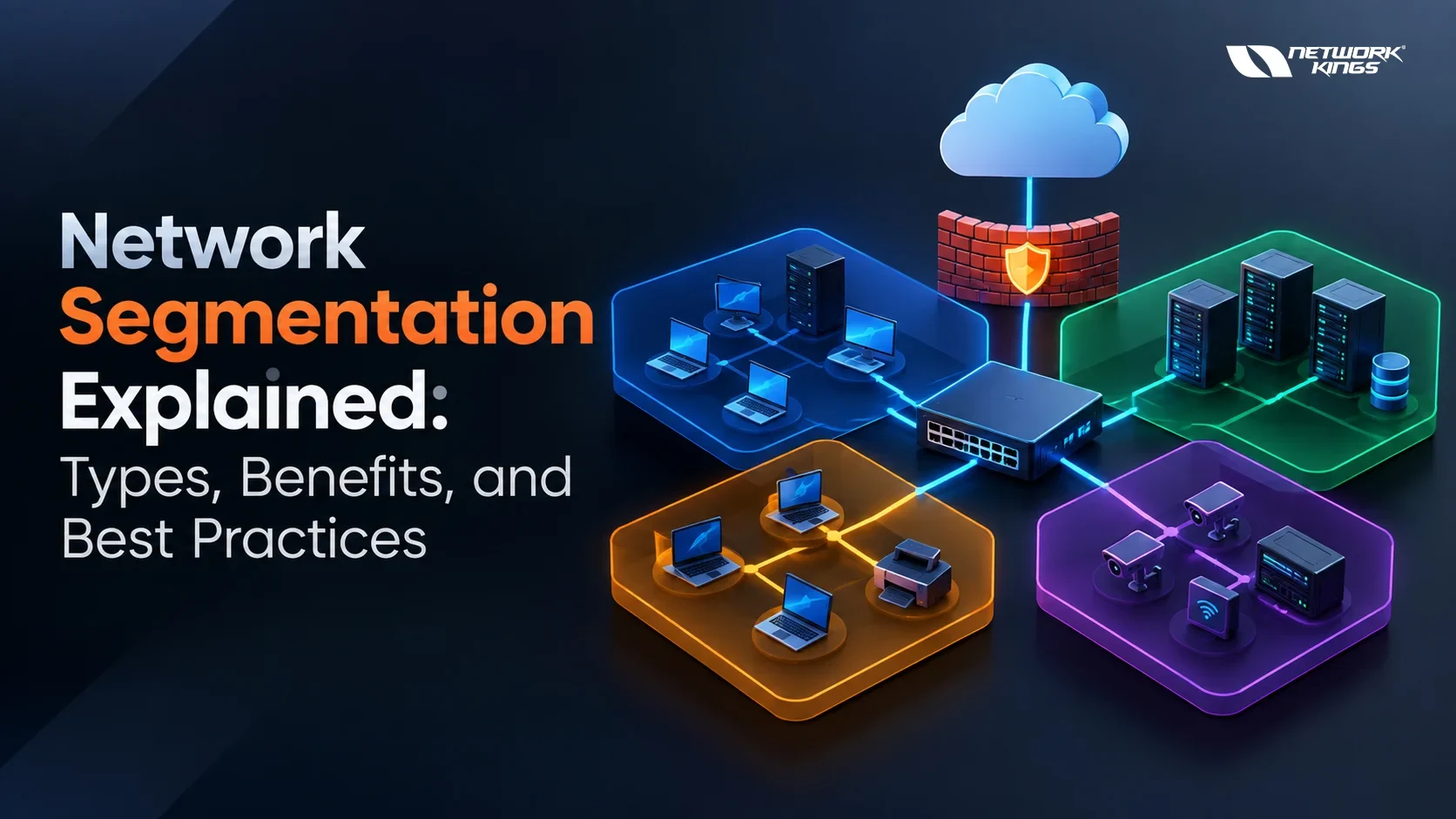
Network segmentation is a network security strategy that divides a large network into smaller, controlled sections. Instead of allowing every device and user to communicate freely, organizations create separate network segments and apply security policies between them. This approach can reduce security risks, limit unauthorized access, and make it easier to contain threats when an incident occurs.
For businesses managing users, servers, applications, databases, cloud workloads, and connected devices, network segmentation is an important part of building a secure and manageable infrastructure.
What Is Network Segmentation?
Network segmentation is the practice of dividing a computer network into smaller, isolated sections called segments or zones, each with its own access controls and traffic rules. Instead of every device communicating freely with every other device, traffic between segments is inspected, restricted, or blocked based on policy.
A simple real-world example helps illustrate this. Think of an office building where the front lobby, employee workspace, and server room all have different access requirements. Visitors can enter the lobby but not the server room. Employees can access their workspace but not necessarily the finance department. Network segmentation applies this same logic to digital traffic, separating guest devices, employee workstations, servers, and sensitive systems into distinct zones.
How Network Segmentation Works
At a technical level, network segmentation works by creating logical or physical boundaries and then enforcing rules about what traffic can cross those boundaries. This is typically done using a combination of VLANs, routers, firewalls, and access-control policies.
When a network is segmented, devices within the same segment can usually communicate with each other relatively freely, since they share a similar trust level and purpose. Traffic that needs to move between segments, for example from a user workstation to a database server, has to pass through a control point such as a firewall or access-control list. That control point checks the request against defined rules and allows, restricts, or logs the traffic accordingly.
This approach shrinks the effective attack surface. Even if one segment is compromised, the attacker does not automatically gain access to every other part of the network. They have to bypass additional controls at each boundary, which slows them down and increases the chance of detection.
Types of Network Segmentation
There is no single correct way to segment a network. The right approach depends on the size of the organization, the sensitivity of the data involved, and the level of control required.
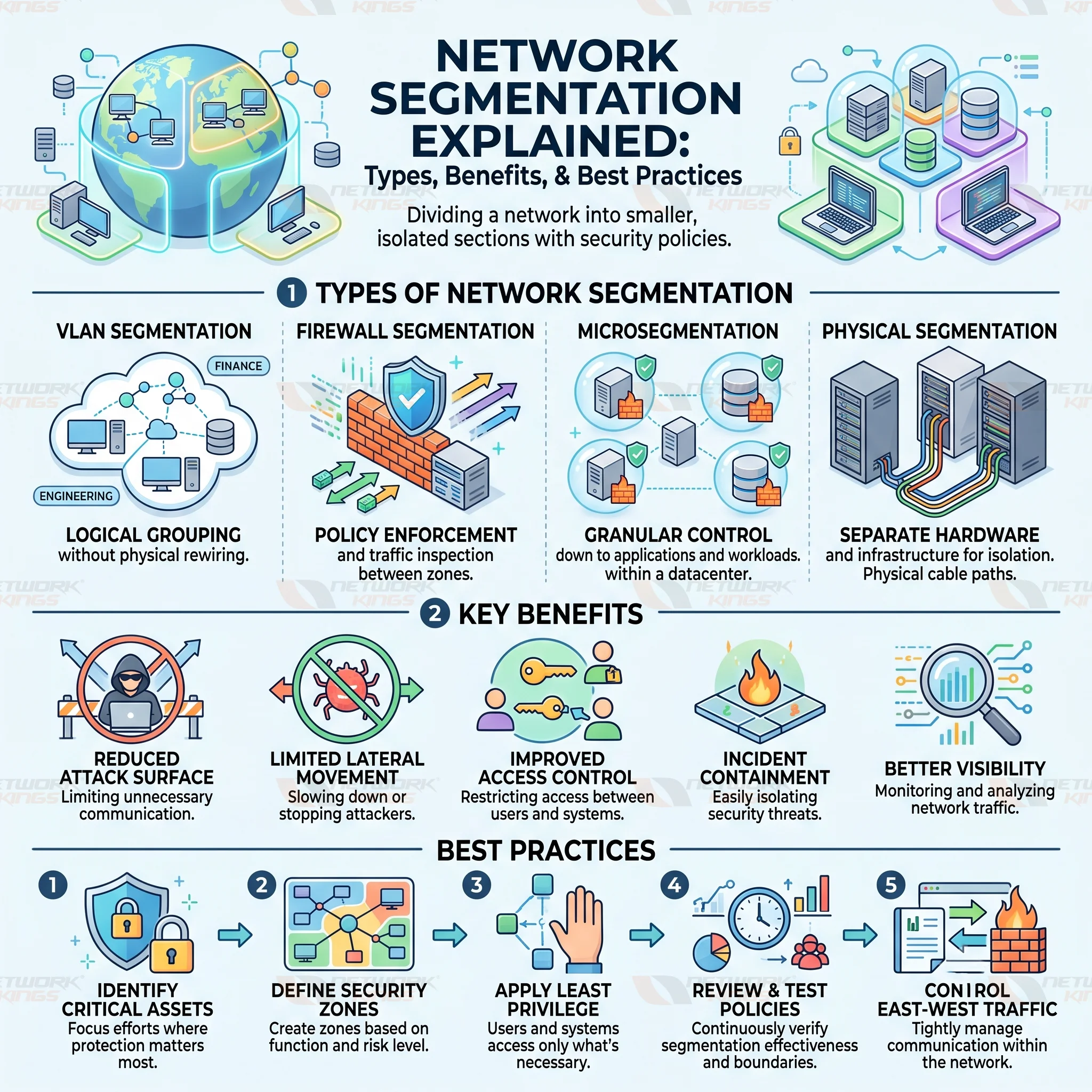
VLAN segmentation is one of the most common starting points. Virtual LANs group devices logically regardless of their physical location, allowing administrators to separate departments or device types, such as putting finance workstations on one VLAN and manufacturing equipment on another, without rewiring the physical network.
Firewall segmentation adds a policy enforcement layer between zones. Rather than just separating traffic logically, firewalls actively inspect and filter it, making this approach useful when different segments carry very different risk levels, such as separating a public-facing DMZ from internal servers.
Physical network segmentation relies on separate hardware, cabling, or switches for different network sections. It offers strong isolation and is often used in highly regulated environments like industrial control systems, though it comes with higher cost and less flexibility.
Software-defined segmentation uses centralized software controllers to define and enforce segmentation policies across the network, including in virtualized and cloud environments. This approach is well suited to organizations that need to adapt segmentation rules quickly as infrastructure changes, without manually reconfiguring hardware.
Microsegmentation takes granularity even further by enforcing policies down to the individual workload or application level, often inside a data center or cloud environment. It is particularly valuable when organizations need tight control over east-west traffic between servers rather than just north-south traffic entering or leaving the network.
Benefits of Network Segmentation
One of the biggest network segmentation benefits is improved security. If an attacker compromises one device, segmentation can make it harder to move toward more valuable systems.
Other benefits include:
Reducing the attack surface by limiting unnecessary communication
Limiting lateral movement after a device or account is compromised
Protecting sensitive servers and databases
Improving access control between users and systems
Containing security incidents within smaller network areas
Providing better visibility into network traffic
Supporting security and compliance requirements
Making network policies easier to manage
Segmentation can also improve troubleshooting. When systems are logically organized into appropriate zones, administrators can more easily understand traffic patterns and identify unusual communication.
However, segmentation is not automatically secure. Poorly designed rules, excessive exceptions, or unrestricted traffic between segments can weaken the security benefits.
Network Segmentation vs Microsegmentation
Network segmentation and micro segmentation are related but operate at different levels of granularity. Traditional segmentation typically divides a network into broader zones, such as separating guest Wi-Fi from the corporate network, and is usually enforced at the network perimeter or between major zones. Micro segmentation narrows this down to individual workloads, applications, or even specific processes, often within a single data center or cloud environment.
Aspect | Network Segmentation | Microsegmentation |
Scope | Broad zones or VLANs | Individual workloads or applications |
Enforcement point | Firewalls, routers, switches | Host-based or hypervisor-level policies |
Traffic focus | Mostly north-south traffic | Primarily east-west traffic |
Typical use case | Separating departments, guest networks, DMZs | Isolating workloads within data centers or cloud platforms |
Management complexity | Moderate | Higher, requires granular policy management |
Neither approach replaces the other. Many organizations use broad network segmentation for overall structure and layer microsegmentation on top for high-value environments like cloud workloads or critical application servers.
Network Segmentation Best Practices
Effective segmentation starts with identifying critical assets, including sensitive databases, financial systems, and intellectual property, so that protection efforts are focused where they matter most. From there, organizations should define clear security zones based on function and risk level rather than convenience.
Applying least-privilege access is essential, meaning users and systems should only be able to reach what they genuinely need. Traffic between segments should be tightly controlled using firewalls and access-control policies, with default-deny rules rather than default-allow. East-west traffic, meaning communication between internal systems, deserves particular attention since it is often overlooked compared to traffic entering or leaving the network.
Segmentation policies are not a one-time project. They should be reviewed regularly as infrastructure changes, applications are added, and business needs evolve. Just as important, organizations should periodically test segmentation effectiveness through techniques like penetration testing or red team exercises to confirm that boundaries actually hold up under real attack conditions rather than assuming policies work as intended.
Network Segmentation Example
Consider a mid-sized enterprise with employee workstations, internal application servers, a customer database, guest Wi-Fi, and industrial control systems for a manufacturing line. In a segmented design, guest devices sit on an isolated VLAN with internet access only and no route to internal resources. Employee workstations occupy a separate segment with access to approved application servers but not direct access to the database.
The customer database sits in its own restricted zone, reachable only by specific application servers through defined firewall rules, never directly by end users. Industrial control systems are physically or logically isolated from the general IT network entirely, since a breach there could have safety implications beyond data loss. If an employee workstation is compromised through a phishing email, the attacker is confined to that segment and blocked from reaching the database or control systems without bypassing additional layers of defense.
Is Network Segmentation Important for Cybersecurity
Yes, network segmentation is a foundational element of modern cybersecurity because it limits how far an attacker can move once they gain initial access. It directly supports Zero Trust principles, which assume no device or user should be automatically trusted regardless of network location, and it reinforces defense in depth by adding another layer attackers must overcome.
Segmentation is particularly effective against ransomware, since containing an infected segment can prevent malware from encrypting systems across the entire network. Combined with network access control, which verifies devices before granting network access, segmentation forms a practical, layered defense rather than relying on a single perimeter firewall to stop every threat.
Conclusion
Network segmentation is not just a network design choice; it is a core cybersecurity strategy. By dividing networks into logical or physical zones, organizations reduce their attack surface, limit lateral movement, and protect sensitive systems from unnecessary exposure. Whether implemented through VLANs, firewalls, software-defined controls, or micro segmentation, the goal remains the same: control what can talk to what, and contain damage before it spreads. As networks grow more complex across on-premises and cloud environments, a well-planned network segmentation strategy remains one of the most reliable ways to strengthen enterprise network security.
FAQs
1. How does network segmentation affect east-west traffic in an enterprise network?
Network segmentation can restrict east-west traffic, which is communication between systems within the same internal environment. By controlling these connections with firewalls, ACLs, or security policies, organizations can reduce unnecessary communication and make lateral movement more difficult.
2. What is the role of ACLs in network segmentation?
Access Control Lists (ACLs) define which traffic is permitted or denied between network segments. For example, an ACL can allow application servers to communicate with a database while preventing general user devices from accessing the same database directly.
3. How should security zones be designed for network segmentation?
Security zones should be designed around business functions, asset sensitivity, trust levels, and communication requirements rather than simply separating devices by department. Common zones may include user networks, guest networks, server networks, management networks, and restricted systems.
4. What are common mistakes organizations make when implementing network segmentation?
Common mistakes include creating segments without defining security objectives, allowing overly broad traffic between zones, keeping unnecessary firewall rules, failing to monitor internal traffic, and not updating segmentation policies as applications and infrastructure change.
5. How does network segmentation support Zero Trust architecture?
Segmentation supports Zero Trust by creating smaller trust boundaries and limiting unnecessary access between resources. When combined with identity-based access controls, continuous verification, and least-privilege policies, segmentation can help enforce more granular access decisions.
6. How can network segmentation be tested for security effectiveness?
Organizations can test segmentation by reviewing firewall and ACL rules, validating allowed and denied traffic paths, conducting controlled vulnerability assessments, and attempting authorized connectivity tests between security zones. Regular testing helps identify unintended access created by configuration changes.
7. What is the difference between north-south and east-west network traffic?
North-south traffic generally moves between internal networks and external environments such as the internet. East-west traffic moves between systems within the internal network or data center. Effective segmentation needs to address both traffic directions because internal system-to-system communication can also create security risks.
8. How does network segmentation work with cloud security groups and subnets?
In cloud environments, subnets can provide logical network boundaries while security groups, network ACLs, and cloud firewalls control traffic between resources. A strong cloud network segmentation strategy combines these controls according to workload sensitivity and application communication requirements.