How AI Is Revolutionizing Cybersecurity

Cybersecurity teams are dealing with more data, alerts, devices, cloud workloads, and attack attempts than manual processes can comfortably handle. Attackers can automate reconnaissance and social engineering, while defenders must continuously monitor networks, endpoints, identities, and applications. This growing scale is one reason Artificial Intelligence has become increasingly important in cybersecurity.
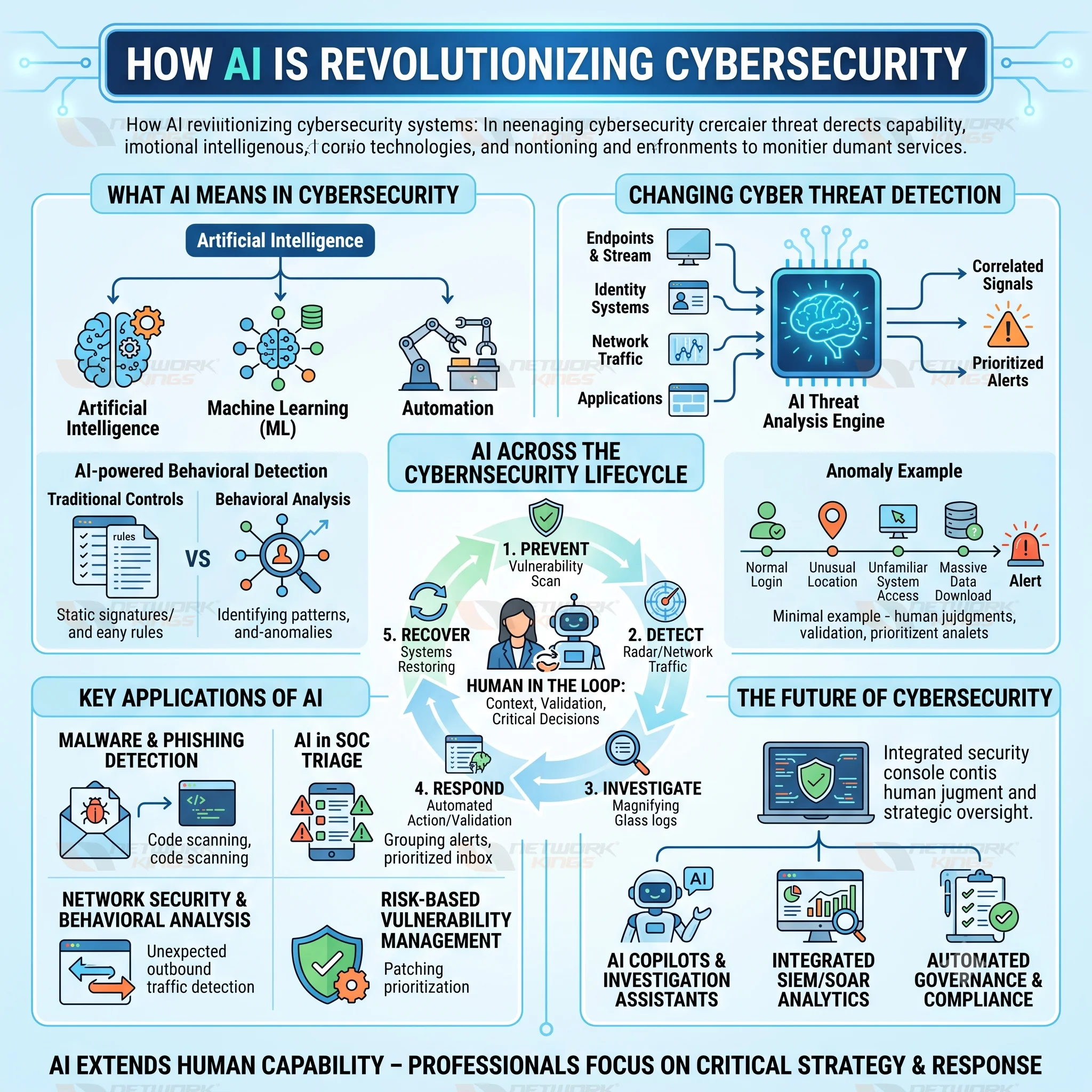
AI is changing cybersecurity by helping teams identify unusual behavior, analyze security data, prioritize alerts, detect suspicious activity, and accelerate incident investigations. It does not replace security professionals. Instead, AI can extend their ability to analyze complex environments and automate selected tasks while humans remain responsible for context, validation, and critical decisions.
What AI Means in Cybersecurity
AI in cybersecurity refers to using artificial intelligence techniques to analyze security data, identify patterns, detect potential threats, and support security operations.
It is important to distinguish AI from machine learning and automation. AI is the broader technology category, while machine learning is a subset that learns patterns from data. Automation, meanwhile, executes predefined actions or workflows. Modern security platforms can combine all three, using machine learning to identify suspicious activity and automation to trigger an appropriate workflow.
This is particularly valuable because traditional security controls often depend heavily on known indicators, signatures, and predefined rules. Those controls remain important, but behavioral analysis can provide another layer of detection when suspicious activity does not match a previously defined pattern.
How AI Is Changing Cyber Threat Detection
AI-powered threat detection allows security systems to examine large volumes of telemetry and identify relationships that may be difficult to spot manually.
Consider an employee account that normally logs in during business hours. Suddenly, it authenticates from an unusual location, accesses unfamiliar systems, and downloads an unusually large amount of data. None of these events alone necessarily proves compromise. Together, however, they may represent a meaningful behavioral anomaly that deserves investigation.
AI can help correlate those signals and raise the priority of the event. A security analyst can then examine the evidence and determine whether the activity represents legitimate business behavior, a compromised account, or another security issue.
How AI Works Across the Cybersecurity Lifecycle
AI can support multiple stages of cybersecurity rather than functioning only as a threat detector.
Prevent by helping analyze risk and prioritize vulnerabilities
Detect by identifying anomalous network, endpoint, identity, or application behavior
Investigate by correlating alerts, logs, and threat intelligence
Respond by supporting selected automated or analyst-approved actions
Recover by helping summarize incidents and identify patterns that can improve future defenses
The important point is that AI can assist throughout the workflow, while security teams still control important decisions.
Key Applications of AI in Cybersecurity
Malware and Phishing Detection
Machine learning can analyze files, URLs, email characteristics, sender behavior, and other signals to identify potentially malicious activity.
For malware, behavioral analysis can complement traditional signature-based detection by looking at what a program attempts to do rather than relying only on whether its exact signature is already known. In phishing detection, AI can help identify suspicious links, unusual sender behavior, domain characteristics, and other indicators that may suggest a fraudulent message.
AI in Security Operations Centers
Security Operations Centers receive telemetry from endpoints, firewalls, identity platforms, cloud environments, and other security tools. The resulting alert volume can make manual triage difficult.
AI can help correlate related events, enrich alerts with context, summarize investigations, and prioritize activity for SOC analysts. When combined with SIEM and SOAR technologies, it can also support selected response workflows.
For example, if multiple endpoints report related suspicious activity, AI can help connect those events into a broader incident rather than forcing an analyst to investigate each alert independently.
Network Security and Behavioral Analysis
AI can also assist with network monitoring. Suppose a workstation that normally communicates with a predictable set of services suddenly starts making repeated outbound connections to unfamiliar destinations. AI-assisted network analytics can identify that deviation from the device's normal communication pattern.
This does not automatically mean the workstation is compromised. It gives the security team a signal to investigate alongside other evidence such as DNS activity, endpoint processes, authentication events, and threat intelligence.
Vulnerability Management
AI can help security teams prioritize vulnerabilities instead of treating every finding equally. Factors such as asset importance, exposure, configuration, and observed activity can provide additional context when deciding which weaknesses deserve attention first.
This can make vulnerability management more closely aligned with actual organizational risk rather than simply producing a long list of technical findings.
Benefits of AI for Security Teams
When implemented correctly, AI can provide several practical advantages:
Faster analysis of large volumes of security data
More effective alert prioritization
Reduced repetitive investigation work
Improved behavioral visibility
Faster access to relevant incident context
Greater scalability for security operations
More focused vulnerability prioritization
For a SOC analyst, the benefit is not simply processing information faster. It is spending less time collecting routine evidence and more time determining what an incident actually means and how the organization should respond.
How Attackers Are Using AI
AI is also changing the offensive side of cybersecurity. Attackers can use generative AI to create convincing phishing content, personalize social engineering attempts, automate parts of reconnaissance, and scale existing attack techniques.
AI-generated voice and video can add another layer to impersonation attacks. Attackers may also experiment with techniques intended to bypass or manipulate machine-learning-based defenses.
This creates an ongoing contest between offensive and defensive AI. Organizations therefore need to secure not only their traditional infrastructure but also the AI systems and workflows they increasingly depend on.
AI Cybersecurity Risks and Limitations
AI is not an infallible security layer. Its effectiveness depends on the quality of the data, telemetry, models, configuration, and surrounding security processes.
False positives can overwhelm analysts, while false negatives can allow malicious activity to go undetected. Models can also become less effective when environments or attacker behavior change.
Other concerns include:
Sensitive security data being exposed to inappropriate AI systems
Adversarial manipulation of AI models
Incorrect or misleading recommendations
Limited explainability
Model drift
Overreliance on automated decisions
Security vulnerabilities within AI applications
For high-impact actions, human oversight remains essential. An AI recommendation to disable an account or isolate a critical system should be evaluated in its operational context before action is taken.
Can AI Replace Cybersecurity Professionals
AI is unlikely to eliminate the need for cybersecurity professionals because security decisions require context, risk assessment, and accountability.
SOC analysts, network engineers, security engineers, cloud security professionals, and incident responders will increasingly work alongside AI-assisted tools. Their roles may shift away from repetitive log review toward investigation, threat hunting, architecture, validation, governance, and strategic decision-making.
Professionals who understand cybersecurity fundamentals while learning how to evaluate and use AI effectively can turn automation into a productivity advantage.
What the Future of AI and Cybersecurity May Look Like
AI is likely to become increasingly embedded within everyday security platforms rather than existing as a separate layer that analysts interact with occasionally.
AI copilots may assist with threat hunting, investigation queries, incident summaries, and security documentation. SIEM and SOAR platforms may combine better analytics with more intelligent automation, while vulnerability-management systems may use broader risk context to improve prioritization.
At the same time, organizations will need stronger AI governance and security controls as attackers adopt similar technologies. The future is therefore less about AI replacing cybersecurity teams and more about AI-assisted security operations, where machines handle large-scale analysis and repetitive workflows while professionals provide judgment and accountability.
Traditional Cybersecurity vs AI-Powered Cybersecurity
Aspect | Traditional Approach | AI-Powered Approach |
Detection | Rules, signatures, and known indicators | Rules combined with behavioral and pattern analysis |
Data analysis | More manual investigation | Large-scale automated analysis |
Alert triage | Analysts review and prioritize alerts | AI can help correlate and prioritize events |
Novel behavior | May require new rules or signatures | Behavioral models can flag suspicious deviations |
Response | Often requires manual workflow execution | Can support selected automated responses |
Scalability | Constrained by analyst capacity | Can analyze larger volumes of telemetry |
Human role | Detection, investigation, and response | Validation, investigation, risk decisions, and oversight |
Frequently Asked Questions
How does AI detect unusual behavior in cybersecurity
AI can establish patterns from historical security data and compare new activity against those patterns. Unusual authentication, network connections, endpoint behavior, or data access can then be flagged for investigation. The anomaly itself is not proof of an attack, so analysts still need to evaluate the surrounding context.
How is AI used in SIEM and SOAR?
AI can help SIEM platforms correlate events and identify relationships across large volumes of logs and alerts. Within SOAR workflows, AI can assist with investigation and recommendations, while predefined automation can execute approved response actions. Organizations should maintain appropriate controls around automated actions that could affect critical systems.
Can AI detect zero-day threats?
AI cannot guarantee detection of zero-day attacks. However, behavioral and anomaly-based approaches can sometimes identify suspicious activity even when there is no existing signature for the specific threat. This makes AI a useful additional detection capability rather than a replacement for established security controls.
What are the biggest AI cybersecurity risks?
Major risks include inaccurate predictions, false positives, false negatives, adversarial manipulation, poor-quality data, privacy issues, model drift, and excessive dependence on automated recommendations. Organizations also need to protect AI applications themselves because weaknesses in AI systems can create additional attack surfaces.
How does generative AI affect cybersecurity?
Generative AI can help defenders summarize incidents, generate investigation queries, analyze documentation, and support security workflows. Attackers can also use it to produce convincing social engineering content and scale certain activities. Organizations therefore need policies, access controls, data protections, and human review when using generative AI.
What skills do cybersecurity professionals need for an AI-driven environment?
Cybersecurity fundamentals remain essential. Professionals should also develop skills in security automation, data analysis, AI-assisted investigation, prompt design where relevant, model limitations, and AI security risks. Network, cloud, endpoint, identity, and incident-response knowledge remain important because AI operates within these environments rather than replacing them.
Will AI eliminate the need for Security Operations Centers
AI is more likely to change how SOCs operate than eliminate them. Automated systems can handle more initial triage, enrichment, and repetitive tasks, allowing analysts to focus on complex investigations and strategic decisions. Human oversight remains important for ambiguous incidents and actions with significant operational or business consequences.

The founder of Network Kings, is a renowned Network Engineer with over 12 years of experience at top IT companies like TCS, Aricent, Apple, and Juniper Networks. Starting his journey through a YouTube channel in 2013, he has inspired thousands of students worldwide to build successful careers in networking and IT. His passion for teaching and simplifying complex technologies makes him one of the most admired mentors in the industry.