Top Cloud Computing Trends Shaping the Future of IT Infrastructure
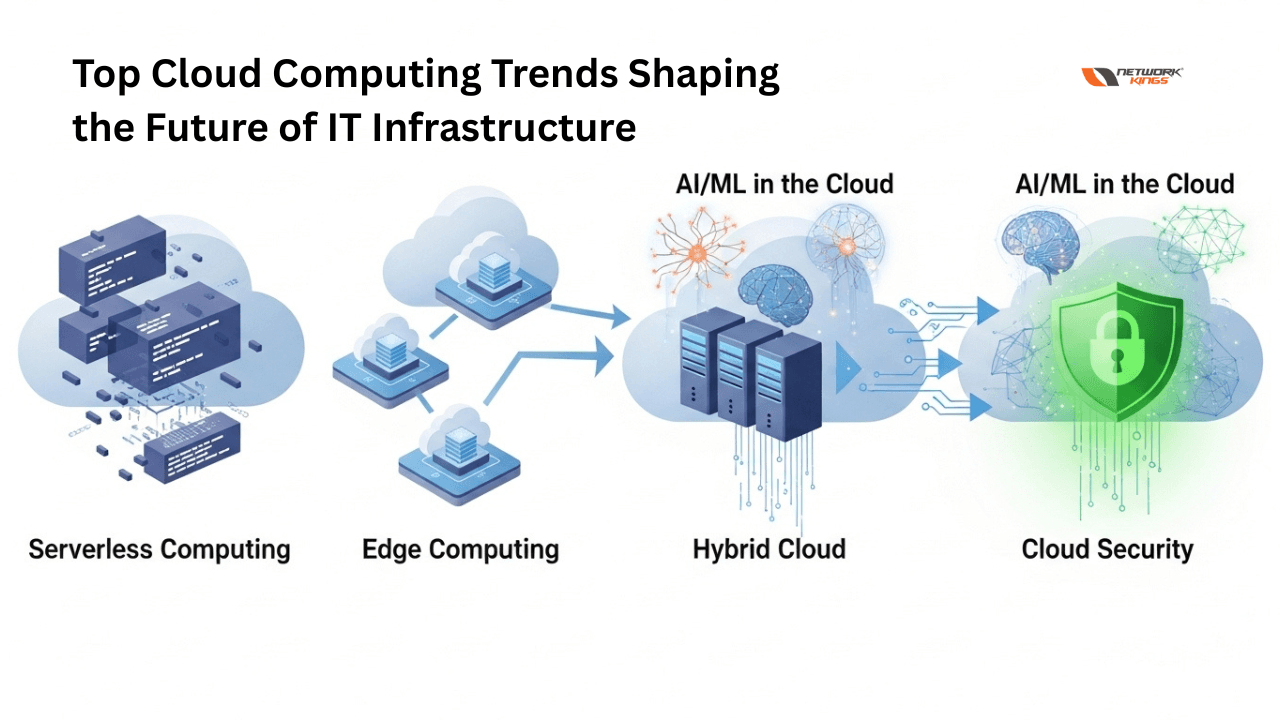
The cloud is no longer just a place to store files or offload servers. In 2026, it has become the central nervous system of modern business — powering AI workloads, enabling real-time decisions at the network edge, and driving digital transformation at a pace few anticipated even five years ago.
According to recent industry data, global cloud spending is projected to surpass $1 trillion in 2026, with enterprises of all sizes racing to modernize infrastructure, reduce operational overhead, and unlock the power of intelligent automation. Whether you're a CTO navigating a complex multi-cloud environment or an IT manager evaluating your next infrastructure investment, understanding where the cloud is headed is no longer optional — it's a strategic imperative.
Here are the most impactful cloud computing trends shaping IT infrastructure in 2026.
1. AI-Native Cloud Platforms Are the New Standard
Artificial intelligence has moved from a feature to a foundation. In 2026, leading cloud providers — AWS, Microsoft Azure, and Google Cloud — have deeply embedded AI and machine learning capabilities directly into their core infrastructure services, not as add-ons, but as default layers.
What this means for IT teams:
Automated resource scaling driven by predictive AI models that anticipate traffic spikes before they happen
Intelligent cost optimization that continuously reallocates workloads to the most efficient compute options
AI-assisted security monitoring that identifies anomalies in real time without manual intervention
Organizations that adopt AI-native cloud architectures are reporting measurable gains in operational efficiency and faster time-to-market for new services.
2. Edge Computing and the Distributed Cloud Model
Centralized cloud architecture is giving way to a distributed model. With the explosion of IoT devices, autonomous systems, and real-time applications, processing data closer to the source — at the "edge" — has become essential.
In 2026, the distributed cloud model allows businesses to run cloud services across multiple physical locations while maintaining centralized management. This is especially transformative in sectors like manufacturing, healthcare, and retail, where latency-sensitive workloads cannot afford a round trip to a distant data center.
Actionable advice: If your organization relies on real-time data processing — whether from factory-floor sensors, point-of-sale systems, or patient-monitoring devices — evaluate edge-cloud hybrid solutions from providers such as AWS Outposts, Azure Arc, or Google Distributed Cloud.
3. Multi-Cloud and Cloud-Agnostic Strategies Mature
Vendor lock-in is increasingly seen as a strategic liability. In 2026, the majority of enterprise organizations operate across two or more cloud providers — not by accident, but by design. Multi-cloud strategies allow businesses to select best-in-class services from different vendors, optimize costs, and ensure resilience through redundancy.
Cloud-agnostic tools and platforms — such as Kubernetes, Terraform, and Crossplane — have matured significantly, making it easier than ever to deploy and manage workloads consistently across AWS, Azure, and GCP environments.
Key benefits of a well-executed multi-cloud strategy:
Reduced risk of service outages affecting the entire business
Greater negotiating leverage with cloud vendors
Freedom to adopt emerging services from the most innovative providers
Improved compliance by hosting data in region-specific clouds
4. Quantum-Ready Cloud Infrastructure
Quantum computing is no longer purely theoretical. While fully fault-tolerant quantum computers remain years away from mainstream deployment, cloud providers are already offering quantum computing services as part of their platforms — and forward-thinking enterprises are beginning to prepare their infrastructure accordingly.
In 2026, "quantum-readiness" means investing in post-quantum cryptography, running hybrid classical-quantum experiments in the cloud, and training IT teams on the fundamentals of quantum workloads. AWS Braket, Azure Quantum, and IBM Quantum are among the platforms enabling organizations to build quantum literacy before the technology reaches critical scale.
5. Sustainable Cloud and Green IT Take Center Stage
Environmental responsibility has become a core factor in cloud procurement decisions. Hyperscalers are under significant pressure from regulators, investors, and customers to demonstrate real progress on sustainability — and many are responding with measurable commitments.
In 2026, green cloud computing includes:
Carbon-aware workload scheduling — shifting compute jobs to times and regions with higher availability of renewable energy
Energy-efficient hardware — the adoption of custom silicon (like AWS Graviton and Google Axion) that delivers more performance per watt
Sustainability dashboards — built-in tools that give organizations visibility into the carbon footprint of their cloud usage
For IT leaders, this trend isn't just about ethics — it's increasingly tied to ESG reporting requirements and corporate governance.
6. Cloud Security Shifts Left — and Gets Smarter
The threat landscape in 2026 is more sophisticated than ever, and cloud security has had to evolve accordingly. The "shift left" principle — embedding security into the earliest stages of development rather than bolting it on at the end — is now a standard practice in cloud-native organizations.
Key developments shaping cloud security this year include the rise of Cloud-Native Application Protection Platforms (CNAPPs), which consolidate workload protection, configuration management, and threat detection into a single solution. Zero-trust architecture, once an aspirational framework, is now an operational reality for most mature cloud environments.
Conclusion: Build for Agility, Not Just Efficiency
The cloud computing landscape in 2026 is defined by intelligence, distribution, resilience, and responsibility. Organizations that thrive will be those that treat their cloud strategy not as a cost center to be optimized, but as a platform for continuous innovation.
The trends outlined here — AI-native platforms, edge computing, multi-cloud maturity, quantum readiness, sustainability, and smarter security — aren't independent forces. They're interconnected capabilities that, when combined, give modern enterprises an infrastructure advantage that is genuinely difficult to replicate.
The most important step? Start with a clear-eyed assessment of where your infrastructure stands today, identify the gaps, and build a roadmap that prioritizes agility alongside efficiency. The future of IT infrastructure is already being written in the cloud.

The founder of Network Kings, is a renowned Network Engineer with over 12 years of experience at top IT companies like TCS, Aricent, Apple, and Juniper Networks. Starting his journey through a YouTube channel in 2013, he has inspired thousands of students worldwide to build successful careers in networking and IT. His passion for teaching and simplifying complex technologies makes him one of the most admired mentors in the industry.