What is GCP (Google Cloud Platform)? Introduction to Cloud Computing
What is GCP? GCP (Google Cloud Platform) is a suite of cloud computing services that offers hosting, storage, data analytics, machine learning, and more.
Imagine you want to start your own start-ups like Uber or Flipkart. What would you choose out of the two? Run and buy 200+ servers, create a runtime, or rent a service provider? After all, everyone will choose the latter.
Welcome to the world of cloud computing. This blog covers what is GCP – Google Cloud Platform, what GCP means, its infrastructure, advantages and disadvantages of Google Cloud Platform. If you’re interested in getting to know more about Google cloud computing and where can you start learning GCP, keep on reading this guide!
What is GCP(Google Cloud Platform )?
When an individual or an organization wishes to set up a large-scale business organization, such as a door-to-door food delivery service, he needs to set up connections with various restaurants, store all the databases of the pertaining restaurants, customers, etc., and set up a app/website for customers to access it.
For the successful operation of the complete business model, he needs to do the following:
Needs storage to store all the restaurants, and customers’ data in various databases.
Needs processing power to process huge amounts of data.
Databases to maintain business-related data.
Content Delivery Network (CDN) which involves setting up various servers across the world for fast content access to the user.
Hardware and Operating System (OS) to manage all the servers and run core operations.
Spending capital on all of these amenities could cost a fortune to the organizations. What if I told you that cloud computing is the solution to all these tangible problems?
Yes, it is true! You can get all these services on the cloud by buying the cloud package that suits your pocket. This is when it’s time to turn to cloud service providers.
GCP is one of the most popular cloud service providers. The full form of GCP is the Google Cloud Platform. Other cloud service providers include Amazon Web Services (AWS) and Microsoft Azure.
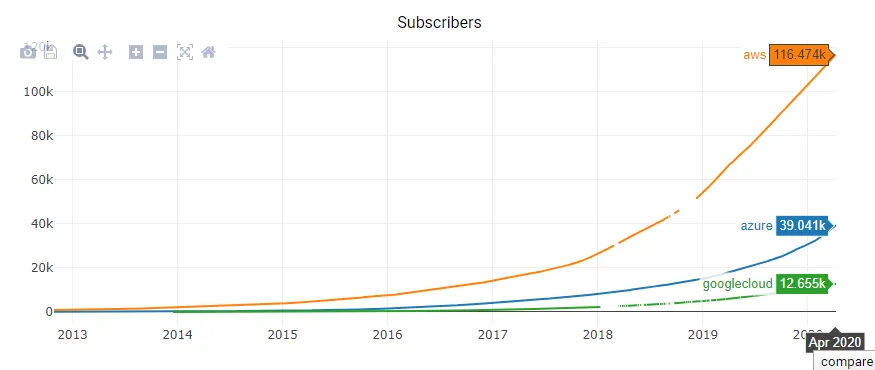
As is evident from the above image the Google Cloud Platform (GCP) has over 12 thousand subscribers in 2020. Now, the market share has nearly doubled to 11% in 2022.
Therefore, GCP is the third most popular choice among business organizations after AWS and Microsoft Azure.
What are the products and services offered by GCP?
1. Google Kubernetes Engine (GKE):
With GKE, you can run your enterprise workloads and scale them up as well
There are over 100 products offered by GCP. The access to these services can however depend on its availability in a region. The lineup usually focuses on the following services:
Artificial Intelligence (AI)
Machine Learning
Data Analytics
Networking
Big Data
Storage
Database
Computing
Hosting
Some of the most popular ones are mentioned as follows:
2. Compute engine:
This computing service reduces computing costs by 91%. You can create as many Virtual Machines (VMs) as needed that come pre-configured and ready to use. This can help you optimize resource usage.
3. Big Query:
Big Query is a cloud-hosted data warehouse where you can make use of built-in AI/ML to bring out useful insights from data. You can perform data ingestion, exploration, and visualization in the Big Query studio.
4. Cloud CDN:
If a business organization wishes to expand its business across the globe and enhance its accessibility, you can make use of Cloud CDN to speed up your applications anywhere across the world. It cuts the need to set up various servers across the world for fast content delivery.
5. API Gateway:
If your target is scalability and flexible deployment while building a web application, you can make use of GCP’s API Gateway to monitor, create, and secure APIs. This service provides seamless access to APIs equally to developers and consumers.
6. Google TPUs:
The Google Tensor Processing Units (TPUs) are AI accelerators that train large and complex AI models. You can generate media content, code, synthetic speech, chatbots, vision services, personalization models, etc., by using Google TPUs.
as put your containers on auto-pilot. You get pod and cluster autoscaling, container-native networking and security, serverless Kubernetes experience, and much more.
What are the advantages of the Google Cloud Platform?
The various advantages of using Google Cloud Platform are as follows:
Open-source friendly: The Google Cloud Platform is open-source friendly.
High readability: The Google Cloud Platform documentation is one of the easiest docs to go through. You can easily understand its services and products.
VPC-based designing: As GCP uses a Virtual Private Cloud (VPC) to design architectures, it is the fastest, most secure, and consistent cloud service.
Scalable storage: GCP gives you a large number of regions to store your data such as Europe, Australia, South and North America.
Free SDKs trial: You can get a free trial of various SDKs presented by GCP by using the ‘console’ button.
What are the disadvantages of the Google Cloud Platform?
The disadvantages of the Google Cloud Platform are as follows:
Fewer services: Google Cloud Platform offers fewer services as compared to those provided by Amazon Web Services (AWS) or Microsoft Azure.
Expensive services: The cost of Google Cloud Storage is higher than Microsoft Azure or Back blaze B2. Also, the amount of support fee is really high. It costs around $150 USD per month even for the most basic GCP plan.
Unclear UI: The user interface of GCP is sometimes not easy to understand. It can get confusing.
Software-intensive: Most of the cloud services offered by GCP are focused on software developers and for their ease.
Where can you learn GCP from?
There are many different online platforms from where you can learn GCP Course and get started. However, it is important to enroll in a course that provides a hands-on approach to learning such an advanced technology.
You can start learning GCP from Network Kings, the world’s leading engineering community where you can learn directly from Engineers. The advantages of learning here include:
24/7 access to virtual labs.
Learn directly from top-notch Cloud Engineers with 12+ years of experience.
Get support from career counselors.
Access the latest learning materials.
Get a certificate of completion.
You can check out more about the GCP course here.
What are the available Google Cloud certifications?
If you want to start a career in Google cloud computing, you can check out the following certifications:
Cloud Architect Professional
Cloud Developer Professional
Cloud Architect Professional
Cloud Security Engineer Professional
G Suite Certification
Cloud Network Engineer Professional
Conclusion
Google Cloud Platform is indeed a popular choice amongst business organizations when choosing a cloud service provider. This blog is a soft introduction to Google Cloud Platform, cloud computing, and the various services offered by Google Cloud Platform.
If the world of GCP attracts you enough, you can start your cloud learning journey and begin your career as a successful Cloud Architect. To conclude, you learned what is GCP cloud, what are its popular services and products, its advantages and disadvantages, and finally, how you can get started with GCP.