
CCNA vs CCNP Career Path Which Offers Better Opportunities
Compare CCNA vs CCNP career paths, jobs, skills, salary potential, difficulty, and career growth to choose the right Cisco certification for your goals.
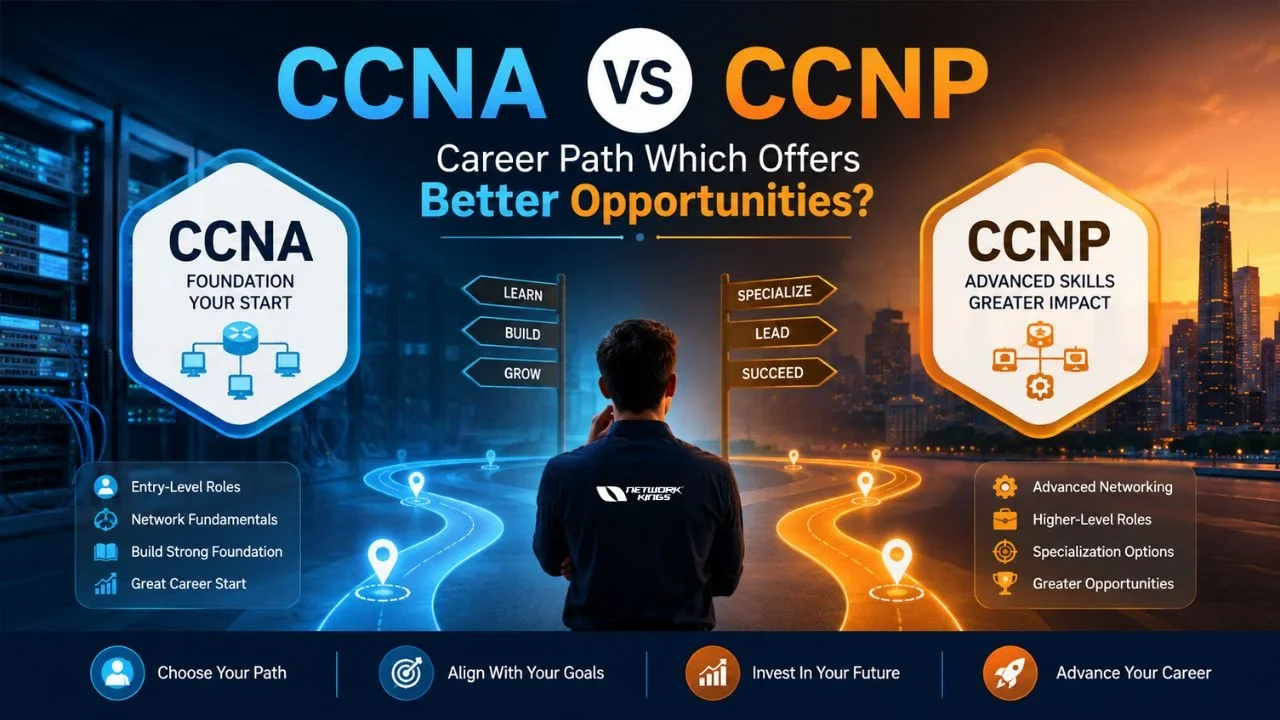
If you are planning a career in networking, choosing between CCNA and CCNP can have a major impact on how you build your skills and progress professionally. The short answer is simple: CCNA is generally the better starting point for beginners, while CCNP is better suited to networking professionals who already have solid fundamentals and practical experience.
However, the decision is not simply about choosing the "better" certification. CCNA and CCNP represent different stages of a networking career. Understanding their differences in difficulty, skills, job opportunities, experience requirements, and long-term career growth can help you choose the right path for your goals.
What Is CCNA
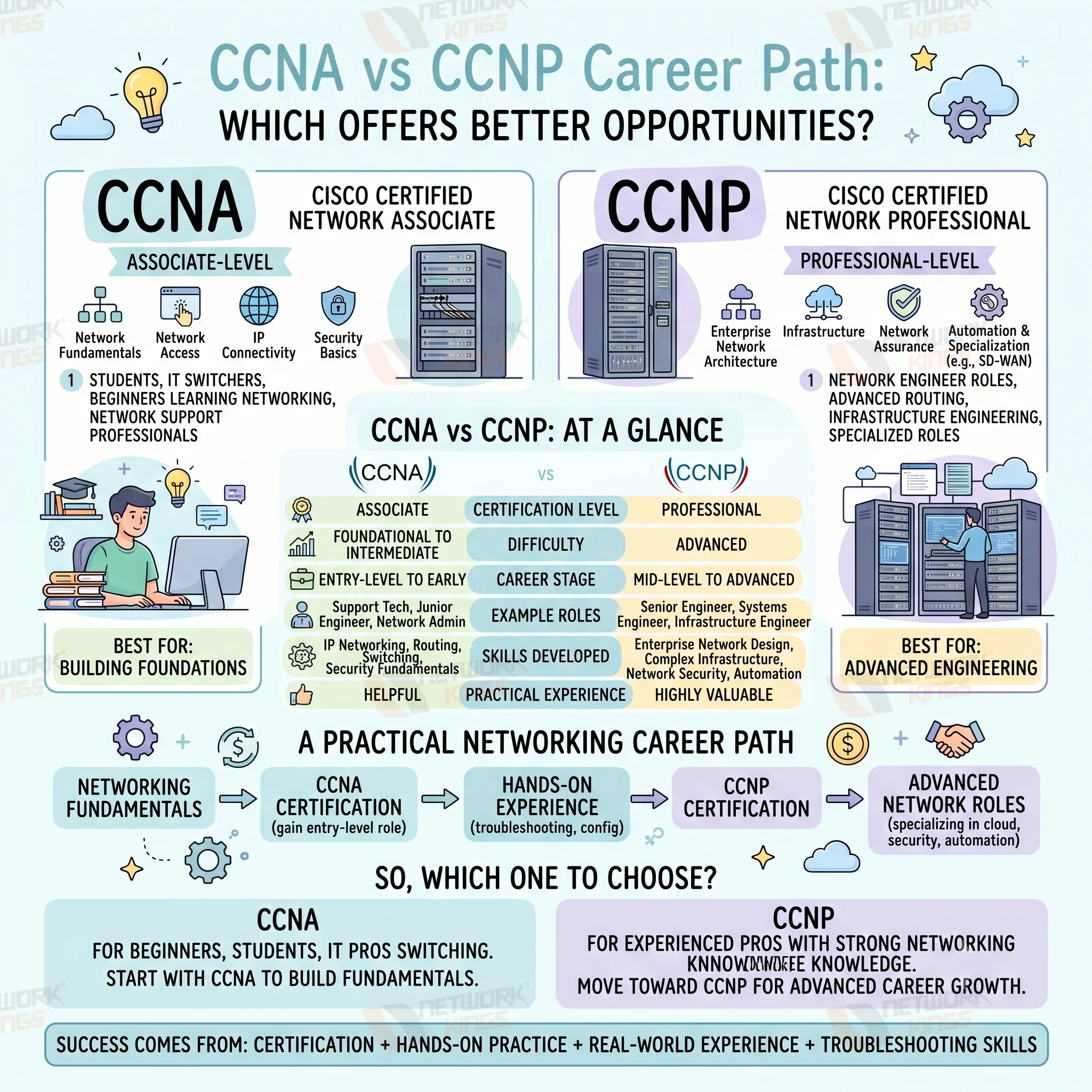
CCNA, or Cisco Certified Network Associate, is an associate-level Cisco certification designed to validate foundational networking knowledge. The current CCNA exam covers areas including network fundamentals, network access, IP connectivity, IP services, security fundamentals, automation, and programmability.
For beginners, these concepts provide the foundation needed to understand how networks operate and how to troubleshoot common connectivity problems.
CCNA is a good fit for:
Students starting a networking career
IT professionals moving into networking
Beginners learning routing and switching
Network support professionals
Candidates preparing for entry-level networking roles
The real value of CCNA increases when certification study is combined with hands-on practice. Configuring VLANs, working with IP addressing, practicing routing, troubleshooting connectivity, and building network simulations can help turn theoretical knowledge into practical skills.
For learners considering CCNA online training, look for a program that includes labs and troubleshooting exercises rather than relying only on recorded lectures or exam-focused preparation.
What Is CCNP
CCNP, or Cisco Certified Network Professional, is a professional-level certification path designed for more advanced networking knowledge.
For example, the CCNP Enterprise certification requires a core exam and one concentration exam. Its core technologies include areas such as enterprise network architecture, infrastructure, network assurance, security, virtualization, and automation.
CCNP is therefore more appropriate for professionals who already understand networking fundamentals and want to take on more complex technical responsibilities.
CCNP can be a strong choice for professionals targeting:
Network engineering roles
Enterprise networking
Advanced routing and infrastructure
Network automation
SD-WAN technologies
Infrastructure engineering
Specialized networking roles
A CCNP Online Training program can be particularly useful when it combines advanced theory with enterprise-style labs, troubleshooting scenarios, and configuration practice.
CCNA vs CCNP at a Glance
Factor | CCNA | CCNP |
Certification level | Associate | Professional |
Best for | Beginners and early-career professionals | Experienced networking professionals |
Difficulty | Foundational to intermediate | Advanced |
Main focus | Core networking concepts | Advanced enterprise networking |
Typical career stage | Entry-level to early career | Mid-level to advanced |
Practical experience | Helpful | Highly valuable |
Example roles | Network Support, Network Administrator, Junior Network Engineer | Network Engineer, Senior Network Engineer, Infrastructure Engineer |
Skills developed | IP networking, routing, switching, security fundamentals, automation basics | Enterprise networking, advanced routing, infrastructure, assurance, automation and specialization |
Career objective | Enter the networking field | Progress toward advanced networking roles |
Best approach | Build fundamentals and gain practical experience | Build on existing knowledge and professional experience |
One important point is that Cisco does not require candidates to hold CCNA before pursuing CCNP Enterprise. However, not having a formal prerequisite does not mean that foundational networking knowledge is unnecessary. A learner who lacks those fundamentals may find professional-level material significantly more difficult.
CCNA Career Opportunities
The CCNA career path typically begins with foundational networking and entry-level IT responsibilities.
Depending on the employer and the candidate's broader skill set, CCNA-level knowledge can support opportunities such as Network Support Technician, IT Support Specialist, Network Administrator, Junior Network Engineer, and technical support positions.
But certification alone does not guarantee a networking job.
Employers may also evaluate your ability to troubleshoot real problems, communicate with users and teams, work with operating systems, understand security basics, and demonstrate practical networking skills.
This is where hands-on labs become important. A candidate who can explain why a device cannot reach a particular subnet, identify a VLAN configuration problem, or troubleshoot a routing issue can demonstrate a level of practical understanding that an exam certificate alone cannot show.
CCNP Career Opportunities
The CCNP career path generally moves toward more complex networking responsibilities.
Professionals with advanced networking knowledge may target roles such as Network Engineer, Senior Network Engineer, Systems Engineer, Infrastructure Engineer, or specialized networking positions.
At this level, employers may expect professionals to do more than configure individual devices. They may be responsible for designing, implementing, troubleshooting, monitoring, securing, or optimizing larger network environments.
Advanced networking can also overlap with areas such as network security, cloud connectivity, automation, virtualization, and software-defined networking.
This is one reason CCNP can become more valuable later in a networking career. Its benefit comes from developing skills that support more complex responsibilities, not simply from having a higher-level certification on your resume.
CCNA vs CCNP Salary and Career Growth
When people search for CCNA vs CCNP salary, they often expect a simple answer such as "CCNP pays more." The reality is more nuanced.
Professionals with advanced networking skills and several years of relevant experience may qualify for higher-level positions, and those positions can offer greater earning potential. However, certification is only one factor in compensation.
Salary can vary based on:
Years of professional experience
Job responsibilities
Location
Employer
Industry
Networking specialization
Cloud and security skills
Automation experience
For example, someone with CCNA, strong troubleshooting skills, cloud networking knowledge, and several years of experience may have a stronger career profile than someone who recently earned CCNP but has little practical exposure.
Think of certification as a career accelerator rather than a salary guarantee.
Should You Choose CCNA or CCNP
The best choice depends on your current level.
If you are completely new to networking, CCNA is usually the logical starting point. It helps you build the knowledge required to understand more advanced networking concepts later.
If you already work with networks and can confidently handle core networking concepts, CCNP may be the more appropriate next step.
A practical way to decide is:
Complete networking beginner → Start with CCNA
Student building networking fundamentals → CCNA
IT support professional moving into networking → Usually CCNA first
Networking professional with strong fundamentals → Consider CCNP
Experienced network engineer → CCNP
Professional targeting advanced enterprise networking → CCNP
The important thing is not to rush into CCNP simply because it is a higher-level certification. If your fundamentals are weak, strengthening them first can save considerable time later.
A Practical Networking Career Path
A common networking career path can look like this:
Networking Fundamentals → CCNA → Entry-Level Networking Role → Hands-On Experience → CCNP → Advanced Networking Role
This is not a mandatory sequence. Some professionals enter networking through IT support, systems administration, cloud infrastructure, or cybersecurity.
What matters is progressively building skills.
After learning the fundamentals, focus on troubleshooting and real-world practice. As your experience grows, add areas such as enterprise networking, network security, cloud networking, automation, and infrastructure technologies.
For example, a beginner might start by understanding IP addressing and VLANs. Later, they may troubleshoot routing protocols in a lab, work with enterprise infrastructure, learn automation, and eventually take responsibility for larger network environments.
That progression demonstrates why certification and experience should work together.
Is CCNP Better Than CCNA
CCNP is not automatically better than CCNA. It is more advanced, but "better" depends on the person taking it.
For someone starting from zero, CCNA can provide considerably more value because it builds the foundation needed to enter networking.
For an experienced network professional, however, CCNP may provide a more relevant path toward advanced responsibilities and specialization.
The better question is not "Which certification is better?"
It is:
"Which certification matches my current skills and the networking role I want next?"
Final Verdict
So, CCNA vs CCNP career path, which offers better opportunities?
For beginners, CCNA is generally the better starting point because it establishes the networking fundamentals needed for an entry-level career. Once you gain practical experience, CCNP can become a logical next step toward more advanced networking and enterprise infrastructure roles.
For professionals who already have strong networking fundamentals and relevant experience, CCNP can offer a stronger path toward advanced career opportunities.
The strongest networking career is not built through certification alone. A combination of Cisco certification, hands-on labs, troubleshooting ability, real-world experience, security knowledge, cloud networking, and automation skills can make you considerably more competitive.
In short, start with CCNA if you are building your foundation. Move toward CCNP when your knowledge and experience are ready for the next level.
(FAQs)
Is CCNA better than CCNP for beginners
Yes. CCNA is generally more appropriate for beginners because it focuses on foundational networking concepts. CCNP is designed for more advanced professional-level knowledge.
Is CCNP worth pursuing after CCNA
Yes, if your career goal involves advanced network engineering or enterprise networking and you have developed enough practical experience to handle professional-level concepts.
Can I get a network engineer job with CCNA
CCNA can support applications for entry-level and junior networking positions, but certification alone does not guarantee employment. Practical skills, troubleshooting ability, experience, and related IT knowledge are also important.
Can I take CCNP without CCNA
Yes. Cisco does not require CCNA as a prerequisite for CCNP Enterprise. However, you should have a strong understanding of networking fundamentals before attempting professional-level material.
Which is harder, CCNA or CCNP
CCNP is generally more advanced. Its professional-level content and certification structure require deeper knowledge than the foundational concepts covered by CCNA.
Which has better career opportunities, CCNA or CCNP
CCNA is valuable for entering the networking field, while CCNP can support progression into more advanced networking roles. The better option depends on your experience and career objectives.
Should I start with CCNA or go directly to CCNP
If you are new to networking, start with CCNA-level knowledge. If you already have strong networking fundamentals and relevant professional experience, you may be ready to pursue CCNP.