VPC vs Traditional Data Center Networks: Key Differences You Should Know
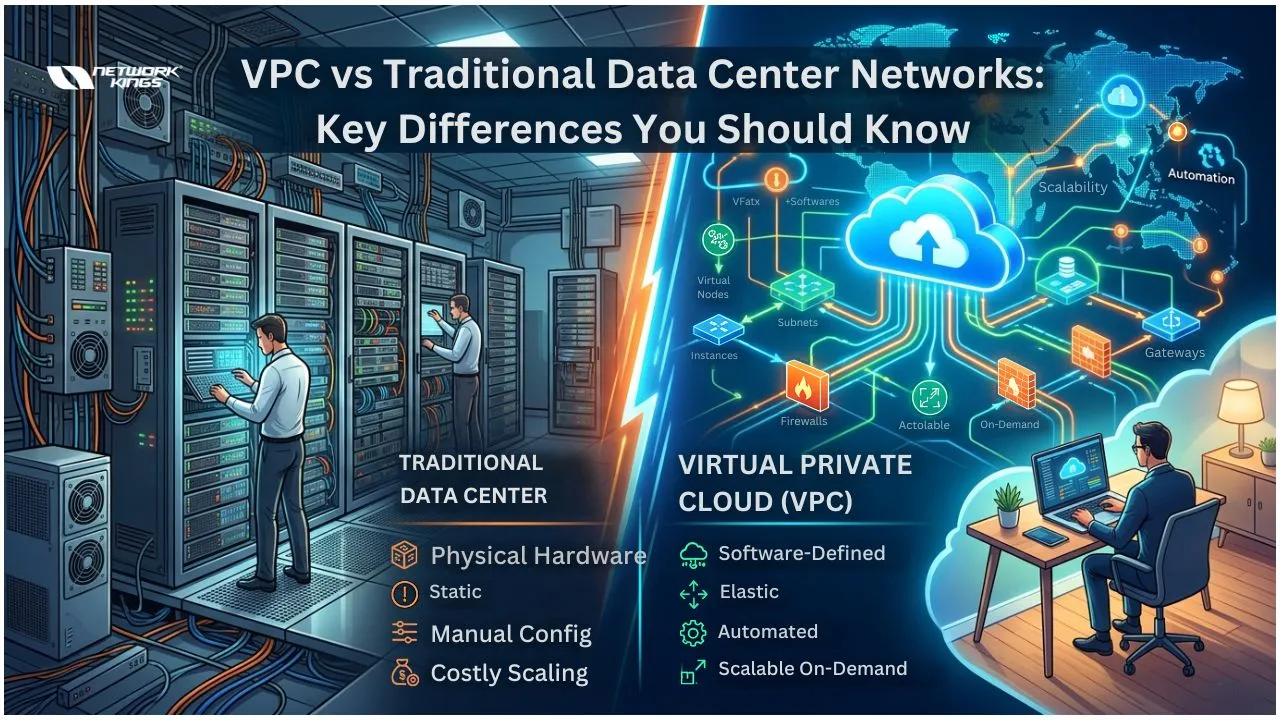
As organizations shift toward cloud-first strategies, one question comes up again and again: how does a Virtual Private Cloud (VPC) compare to traditional data center networks? If you’re building a career in networking or cloud computing, understanding this difference isn’t just helpful—it’s essential.
Both models aim to deliver secure, reliable networking. But the way they operate, scale, and are managed is fundamentally different. Let’s break it down in a practical, real-world way so you can clearly understand where each fits—and how mastering these concepts can boost your career.
What Exactly Are We Comparing?
Before diving into the differences, it helps to get grounded in what each term actually means.
A traditional data center network is a physical setup — servers, routers, switches, and cables housed in a facility that your organization either owns or leases. You're dealing with hardware procurement cycles, physical cabling, and on-site maintenance teams.
A Virtual Private Cloud (VPC), on the other hand, is a logically isolated section of a public cloud provider's infrastructure — think AWS, Google Cloud, or Microsoft Azure. It mimics the structure of a traditional network, but entirely in software. You define your subnets, routing tables, and access controls through a console or API, not by plugging in a cable.
1. Infrastructure Ownership and Responsibility
One of the starkest differences is who owns and maintains the underlying hardware.
With a traditional data center, your organization is responsible for:
Purchasing and refreshing physical hardware every 3–5 years
Managing power, cooling, and physical security
Hiring and retaining specialized networking staff
Planning capacity well ahead of actual demand
With a VPC, the cloud provider handles all of that. You consume infrastructure as a service. Your team's focus shifts from "keeping the lights on" to actually building and optimizing workloads. That's a meaningful shift in how IT teams spend their time and budget.
2. Scalability and Flexibility
Traditional data center networks are built for predictability. You plan your capacity, buy your gear, and hope your projections were accurate. Scaling up usually means another hardware procurement cycle — which can take weeks or months.
VPCs flip that model entirely. Need to spin up 50 more servers for a product launch? Done in minutes. Traffic spike at midnight? Auto-scaling handles it automatically. Traffic drops off? You scale down and stop paying for what you don't use.
This elasticity is arguably the single biggest operational advantage of VPCs over traditional networks, especially for businesses with unpredictable or rapidly growing workloads.
3. Network Architecture and Design
In a traditional data center, your network architecture is largely fixed. VLANs, physical subnets, and hardware firewalls define your segmentation. Changes require coordination between teams and sometimes physical reconfiguration.
In a VPC, the architecture is defined in software. You can:
Create multiple subnets (public and private) with a few clicks
Define security groups that act as virtual firewalls at the instance level
Set up network access control lists (NACLs) for subnet-level traffic filtering
Configure route tables to control exactly where traffic flows
This software-defined approach means you can iterate on your network design rapidly, test different configurations, and roll back changes without touching a single piece of hardware.
4. Security Model
Both environments take security seriously, but the tools and shared responsibility look very different.
In a traditional data center, security is largely your team's full responsibility — firewalls, intrusion detection, patch management, and physical access controls. You have complete control, but you also carry all the weight.
In a VPC, security operates under a shared responsibility model. The cloud provider secures the physical infrastructure, while you're responsible for securing what's inside your VPC — access controls, encryption, identity management, and network rules. Cloud providers also offer native security services (like AWS GuardDuty or Azure Defender) that would be expensive and complex to replicate on-premises.
Neither model is inherently more secure — but VPCs reduce the surface area your team needs to manage directly.
5. Cost Structure
Traditional data center costs are largely CapEx-heavy — big upfront investments in hardware, real estate, and talent, with slower depreciation over time.
VPC costs are primarily OpEx-based — you pay for what you use, on a subscription or consumption model. This makes budgeting more predictable for stable workloads and more flexible for dynamic ones. That said, cloud costs can spiral without proper governance, so cost management becomes a skill in itself.
6. Connectivity and Hybrid Setups
Modern enterprises rarely live entirely in one world. Many use hybrid architectures — a traditional data center for sensitive workloads or legacy systems, and a VPC for cloud-native applications or burst capacity.
Cloud providers make this easier with tools like AWS Direct Connect, Azure ExpressRoute, or VPN gateways, which create secure, low-latency connections between your on-premises network and your VPC. This gives organizations a migration path that doesn't require flipping a switch overnight.
Which One Should You Know?
The real-world answer for anyone building a career in cloud infrastructure, networking, or DevOps is: both. Understanding traditional networking fundamentals — subnets, routing protocols, firewall rules — makes you a far better VPC architect, because the underlying concepts translate directly.
But if you're investing in your skills right now, VPC expertise is where demand is surging. Certifications like AWS Certified Solutions Architect, Google Cloud Professional Cloud Network Engineer, and Microsoft Azure Network Engineer Associate all test your ability to design, implement, and secure VPC environments. These credentials signal to employers that you understand not just the theory, but the practical trade-offs involved in real-world cloud infrastructure decisions.
Final Thoughts
VPCs didn't make traditional data centers obsolete overnight — and they won't anytime soon. But they've fundamentally changed how we think about network design, infrastructure ownership, and operational agility. Whether you're a seasoned network engineer leaping to cloud or a developer looking to deepen your infrastructure knowledge, understanding the difference between VPCs and traditional data center networks is foundational knowledge for the modern tech landscape.
The best professionals aren't those who favor one over the other — they're the ones who know when to use each, and how to make them work together.
FAQs
1. What is the main architectural difference between a VPC and a traditional data center?
A VPC is software-defined and virtualized within a cloud environment, while a traditional data center relies on physical networking hardware and on-premise infrastructure.
2. How does routing differ in a VPC compared to traditional networks?
VPC routing is controlled via route tables and managed programmatically, whereas traditional networks use physical routers and manual configuration.
3. Can VPCs replicate traditional network segmentation?
Yes, VPCs use subnets, security groups, and network ACLs to achieve logical segmentation similar to VLANs in traditional networks.
4. How is scalability handled in VPC environments?
VPCs offer on-demand scalability through cloud resources, unlike traditional networks that require hardware upgrades.
5. What are the key security differences between VPC and traditional networks?
VPCs provide layered security with built-in features like security groups and IAM, while traditional networks rely heavily on physical firewalls and perimeter security.
6. How does high availability differ in VPCs?
VPCs support multi-region and multi-availability zone deployments, offering higher resilience compared to single-location traditional data centers.
7. Is latency higher in VPC compared to on-premise networks?
Latency can be slightly higher in VPCs due to internet dependency, but optimized cloud architecture can minimize this difference significantly.

The founder of Network Kings, is a renowned Network Engineer with over 12 years of experience at top IT companies like TCS, Aricent, Apple, and Juniper Networks. Starting his journey through a YouTube channel in 2013, he has inspired thousands of students worldwide to build successful careers in networking and IT. His passion for teaching and simplifying complex technologies makes him one of the most admired mentors in the industry.