Next-Gen Firewall vs Traditional Firewall: What Changed?
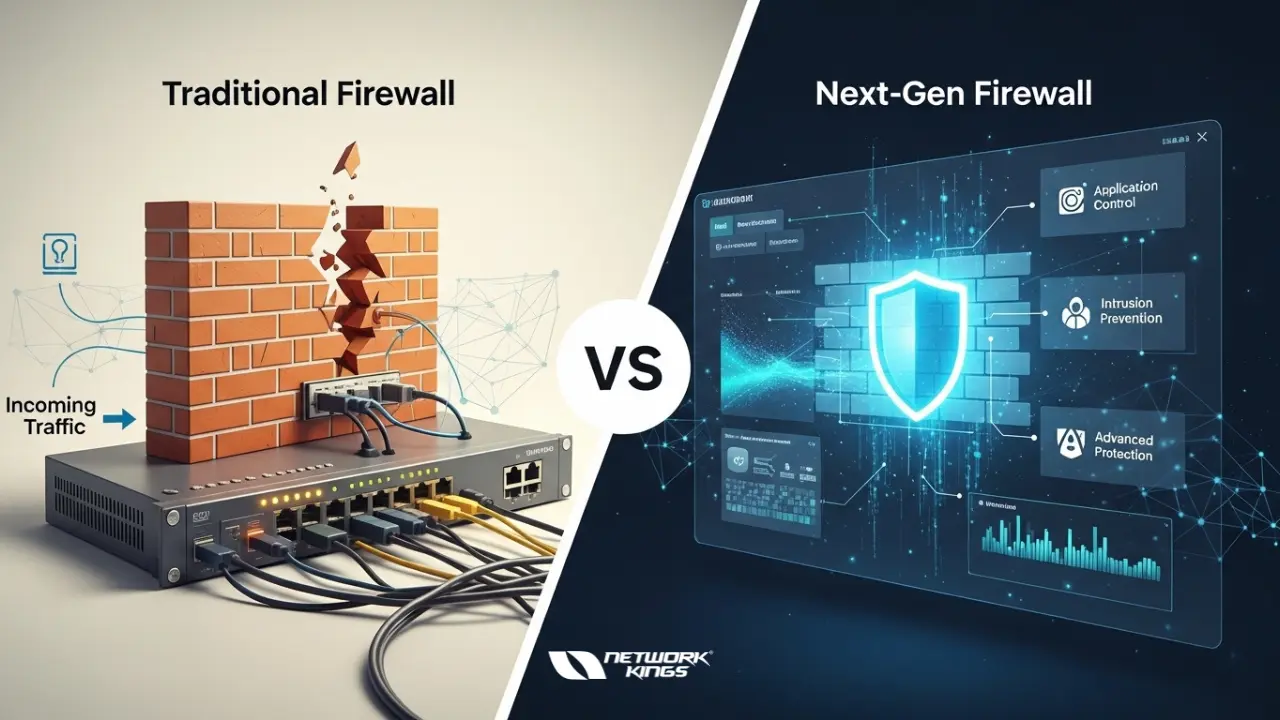
As cyber threats evolve, so must network security. Traditional firewalls were once the backbone of enterprise protection, focusing primarily on controlling traffic based on IP addresses, ports, and protocols. However, with the rise of sophisticated attacks, encrypted traffic, and application-layer vulnerabilities, organizations now require more advanced solutions. This is where Next-Generation Firewalls (NGFWs) come into play.
This article breaks down exactly what changed between traditional firewalls and next-generation firewalls (NGFWs), why it matters to your organization, and how to decide what level of protection you actually need.
What Is a Traditional Firewall?
A traditional firewall operates as a gatekeeper at the network perimeter. It monitors incoming and outgoing traffic and makes decisions based on a fixed set of rules tied to:
IP addresses (source and destination)
Port numbers (e.g., port 80 for HTTP, port 443 for HTTPS)
Protocols (TCP, UDP, ICMP)
Think of it as a bouncer who only checks what door you're trying to enter — not who you are, what you're carrying, or what you plan to do inside.
Traditional firewalls are stateful, meaning they track active connections and verify that incoming packets are part of a legitimate, established session. But they have a fundamental blind spot: they cannot look inside the packet payload. If malicious content is wrapped in an allowed protocol on an allowed port, it walks right through.
What Is a Next-Generation Firewall (NGFW)?
Next-generation firewalls, a term coined by Gartner in 2009, were built to address exactly those blind spots. An NGFW combines traditional stateful packet inspection with a suite of advanced capabilities that give security teams far deeper visibility and control.
Core capabilities of an NGFW include:
Deep Packet Inspection (DPI): Examines the actual content of data packets, not just their headers.
Application Awareness and Control: Identifies and controls traffic by application (e.g., blocking TikTok while allowing Slack), regardless of port or protocol.
Intrusion Prevention System (IPS): Actively detects and blocks known attack patterns and exploits in real time.
SSL/TLS Inspection: Decrypts and inspects encrypted HTTPS traffic, where a large percentage of modern malware hides.
User Identity Awareness: Links traffic to specific users or user groups, not just IP addresses.
Threat Intelligence Integration: Connects to live threat feeds to block emerging threats as they are discovered globally.
Key Differences at a Glance
Feature | Traditional Firewall | Next-Gen Firewall |
Packet Inspection | Header only | Deep content inspection |
Application Control | Limited (port-based) | Full application-layer visibility |
Intrusion Prevention | No | Yes (built-in IPS) |
Encrypted Traffic Inspection | No | Yes (SSL/TLS decryption) |
User Identity Awareness | No | Yes |
Threat Intelligence | No | Yes (real-time feeds) |
Performance Impact | Low | Moderate (with modern hardware) |
Cost | Lower | Higher |
Why the Shift Became Necessary
1. The Rise of Encrypted Traffic
Over 95% of web traffic is now encrypted. Traditional firewalls are effectively blind to it. An NGFW with SSL inspection can see inside that traffic and catch malware, data exfiltration attempts, and command-and-control communications that would otherwise be completely invisible.
2. Applications Hijack Standard Ports
Modern applications don't play by old rules. A peer-to-peer application or a rogue remote-access tool can tunnel over port 443 (the standard HTTPS port), making port-based blocking useless. NGFWs identify the actual application, not just the port being used.
3. The Insider Threat Problem
Traditional firewalls focus on the perimeter — what comes in from outside. But threats increasingly originate from inside: a compromised employee account, a misconfigured cloud app, or a contractor with excessive access. User-identity-aware NGFWs can detect anomalous behavior tied to specific individuals and flag or block it.
4. Zero-Day and Advanced Persistent Threats (APTs)
Sophisticated attackers use custom malware and novel techniques that no static ruleset can anticipate. NGFWs paired with sandboxing technology can execute suspicious files in an isolated environment and observe their behavior before allowing them through.
Should Every Business Upgrade to an NGFW?
Honestly, it depends — but the answer is increasingly yes for most organizations.
A traditional firewall may still be sufficient if:
You run a very small, isolated network with minimal internet-facing services.
Budget constraints are severe and compensating controls (network segmentation, endpoint security) are strong.
You operate a legacy system that cannot support NGFW integration.
You should strongly consider an NGFW if:
Your employees use cloud applications (Microsoft 365, Salesforce, Google Workspace).
Your business handles sensitive customer data subject to GDPR, HIPAA, or PCI-DSS.
You have remote workers connecting over VPN or Zero Trust architectures.
You've experienced a security incident or near-miss in the past 24 months.
Practical Tips for Choosing and Deploying an NGFW
Don't just buy features — buy what you'll actually configure. An NGFW with unused IPS policies is no better than a traditional firewall. Ensure your team has the expertise or managed service support to operate it properly.
Enable SSL inspection carefully. It's powerful, but it requires certificate management and can break certain applications. Test thoroughly before a full rollout.
Segment your network first. An NGFW is most effective when your network is properly segmented. Flat networks give attackers too much lateral movement room even if they are blocked at the perimeter.
Review and update policies regularly. Firewall rules become outdated. Schedule quarterly policy reviews to remove stale rules and tighten access.
Consider a Unified Threat Management (UTM) device for SMBs. Smaller businesses often benefit from UTM appliances, which bundle NGFW capabilities with antivirus, web filtering, and email security at a lower cost.
The Bottom Line
The threat landscape of 2026 is unrecognizable compared to when traditional firewalls were designed. Attackers exploit encrypted channels, impersonate trusted users, and weaponize legitimate applications. A traditional firewall doing port-and-protocol filtering is like trying to screen airport passengers by checking only the color of their luggage.
Next-generation firewalls don't just add features — they change the fundamental philosophy from "block what looks bad" to "understand everything and trust nothing by default."
If your organization hasn't evaluated its firewall strategy recently, now is the time. Start with an honest assessment of your current threat exposure, your data sensitivity, and your team's capacity to manage advanced security tools. The right NGFW, properly deployed, is one of the highest-leverage investments you can make in your security posture.
FAQs
1. What is the main difference between a traditional firewall and a Next-Gen Firewall (NGFW)?
A traditional firewall filters traffic based on IP addresses, ports, and protocols, while an NGFW provides deep packet inspection, application awareness, and advanced threat prevention capabilities.
2. Why are traditional firewalls no longer sufficient for modern networks?
Traditional firewalls cannot inspect encrypted traffic or detect advanced threats like zero-day attacks, making them ineffective against modern cyber threats.
3. How does a Next-Gen Firewall improve network security?
An NGFW enhances security by combining features like intrusion prevention (IPS), SSL inspection, application control, and real-time threat intelligence to detect and block sophisticated attacks.
4. What is Deep Packet Inspection (DPI) in NGFWs?
Deep Packet Inspection allows NGFWs to analyze the actual content of data packets, not just headers, enabling detection of hidden malware and malicious activity.
5. Can a Next-Gen Firewall inspect encrypted HTTPS traffic?
Yes, NGFWs can decrypt and inspect SSL/TLS traffic, which helps identify threats hidden within encrypted communications.

The founder of Network Kings, is a renowned Network Engineer with over 12 years of experience at top IT companies like TCS, Aricent, Apple, and Juniper Networks. Starting his journey through a YouTube channel in 2013, he has inspired thousands of students worldwide to build successful careers in networking and IT. His passion for teaching and simplifying complex technologies makes him one of the most admired mentors in the industry.