How to Automate Cisco, Juniper & Cloud Networks Together
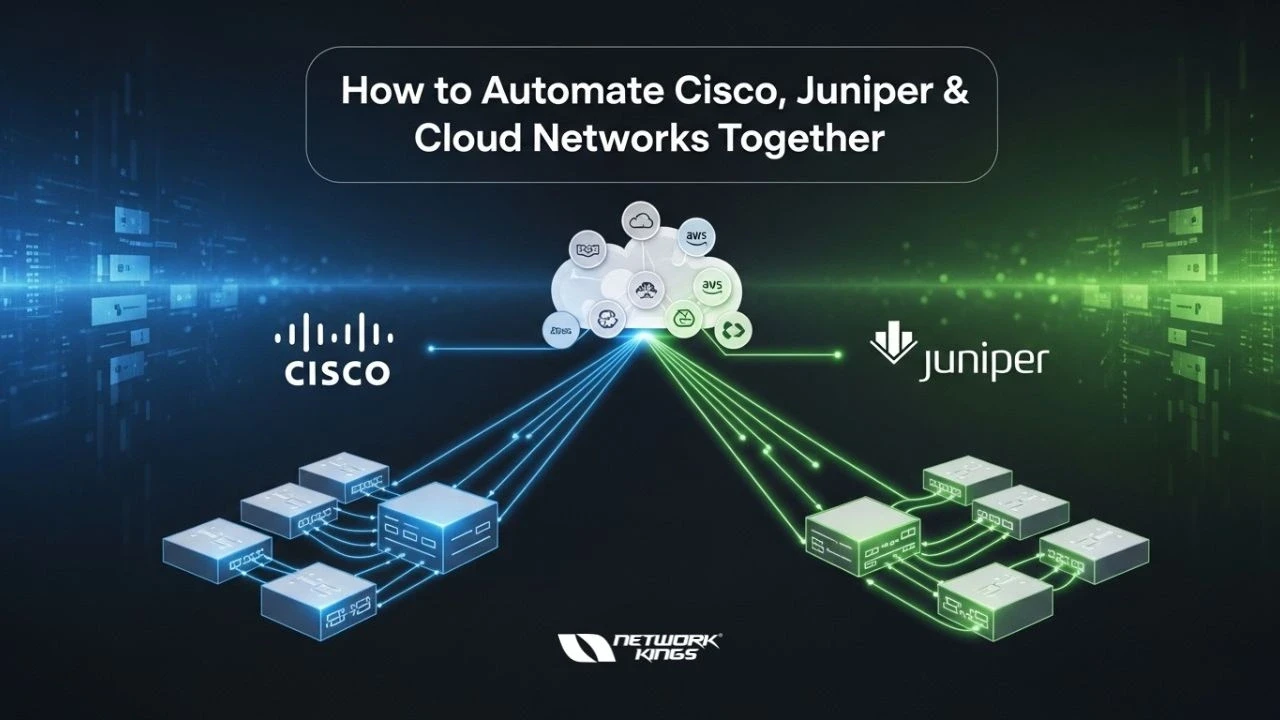
Managing a multi-vendor network is a bit like cooking in three kitchens at the same time — each one has its own rules, its own quirks, and its own way of burning your dinner if you're not paying attention. If you're running Cisco gear in the data center, Juniper at the edge, and spinning up workloads in AWS or Azure, you already know the pain: separate CLI syntax, different configuration models, and cloud APIs that speak an entirely different language.
The good news? Unified network automation is no longer a dream reserved for hyper scalers with teams of 50 engineers. With the right tools and a solid strategy, you can build an automation pipeline that talks to Cisco, Juniper, and cloud platforms simultaneously — and actually keeps your sanity intact.
Why Multi-Vendor Automation Is Harder Than It Looks
Most network automation guides assume you're working with a single vendor. That's rarely the reality on the ground. In practice, enterprise networks are a patchwork of acquisitions, budget decisions, and "we already had this" legacy infrastructure.
The core challenge comes down to three things:
Inconsistent data models — Cisco IOS-XE, Cisco NX-OS, Juniper Junos, and cloud VPCs all describe network state differently.
Different transport mechanisms — some devices use SSH, others NETCONF or RESTCONF, and cloud platforms rely entirely on REST APIs.
Drift between intended and actual state — without a source of truth, your automation scripts are essentially flying blind.
Understanding these friction points before you write a single line of code will save you weeks of debugging later.
Start with a Source of Truth — Before Anything Else
This is the step most teams skip, and it's the reason their automation efforts stall within six months. Before you automate, you need a definitive record of what your network should look like.
Tools like NetBox or Nautobot work well here. Think of them as a structured inventory — not just a spreadsheet, but a living database that tracks devices, IP allocations, VLANs, interfaces, and relationships between them. When your automation scripts run, they pull the desired state from this source of truth rather than hardcoding values into scripts.
Once that foundation is in place, you're building automation that scales. Without it, you're just automating chaos.
The Right Tools for a Unified Automation Stack
You don't need to reinvent the wheel. The open-source and commercial tooling available today handles multi-vendor environments surprisingly well — you just need to pick the right layer for each job.
Ansible remains the most accessible entry point for most teams. Its vendor-specific modules (cisco.ios, cisco.nxos, junipernetworks.junos) let you write playbooks that target different platforms using a consistent YAML syntax. Pair it with cloud modules for AWS (amazon.aws) or Azure (azure.azcollection), and you've got a single automation layer spanning your entire environment.
For more complex, stateful workflows, Nornir (a Python framework) gives you more flexibility and speed than Ansible, especially when you're running tasks across hundreds of devices in parallel.
When it comes to configuration templating, Jinja2 is the glue that makes everything work. You write one template per function — say, BGP peer configuration — and feed it different variables depending on whether the device is running IOS-XE or Junos. The output is clean, vendor-specific config that you can push with confidence.
Normalizing Data Across Vendors with YANG and NETCONF
One of the more powerful (and underused) approaches to multi-vendor automation is building on top of YANG data models and NETCONF. Both Cisco and Juniper support NETCONF natively, and many modern devices support OpenConfig YANG models — a vendor-neutral schema that describes network features in a common structure.
In practice, this means you can query interface state, BGP neighbors, or routing tables from both a Cisco router and a Juniper MX using the same data model. Libraries like ncclient (Python) make NETCONF calls straightforward, and tools like pyGNMI open up the same approach for gNMI-capable devices.
For cloud networks, you're working entirely through APIs — AWS uses its own SDK and CloudFormation/Terraform, Azure has ARM templates and Bicep. The trick is to treat cloud infrastructure definitions as just another configuration file and manage them alongside your on-prem templates in the same Git repository.
GitOps: Making Your Network Changes Auditable and Reversible
Once your templates and automation playbooks live in Git, something important shifts: every change to your network is now a pull request. That means peer review, history tracking, and — critically — the ability to roll back a bad change in seconds.
A simple GitOps workflow looks like this:
An engineer opens a PR with the intended configuration change.
A CI pipeline (Jenkins, GitHub Actions, GitLab CI) runs syntax validation and a diff against the current state.
On merge, the pipeline triggers Ansible or Nornir to push the change to the relevant devices.
The source of truth (NetBox/Nautobot) is updated automatically to reflect the new state.
This is the same pattern cloud-native teams use for application deployments — and it works just as well for network infrastructure.
Where to Start: A Practical First Step
If your team is just getting started, don't try to automate everything at once. Pick one repetitive, low-risk task — VLAN provisioning, interface descriptions, NTP configuration — and build your first playbook around that. Get it working end-to-end, with proper variable handling and idempotency checks, before expanding.
As you layer in more devices and more platforms, the patterns you established early will carry you forward. Multi-vendor network automation isn't a project you finish — it's a practice you build over time.

The founder of Network Kings, is a renowned Network Engineer with over 12 years of experience at top IT companies like TCS, Aricent, Apple, and Juniper Networks. Starting his journey through a YouTube channel in 2013, he has inspired thousands of students worldwide to build successful careers in networking and IT. His passion for teaching and simplifying complex technologies makes him one of the most admired mentors in the industry.