
CCNP Automation Training Roadmap with Tools Topics and Career Opportunities
CCNP Automation Training is a practical learning path that prepares network professionals to manage, configure, and validate modern networks using code, APIs, and automation toolchains. This article explains what to learn, why it matters, how to practice with labs, and how the topics map to real-world tasks and certification goals.
What is CCNP Automation Training and who should take it?
CCNP Automation Training focuses on the intersection of networking and software: scripting, APIs, model-driven programmability, configuration-management frameworks, and infrastructure as code. It is designed for network engineers, operations staff, and architects who already understand switching, routing, and basic network protocols and want to automate repetitive tasks, reduce human error, and scale network operations.
This training is appropriate for professionals with CCNA- or CCNP-level networking knowledge who want to transition toward automation-focused roles. Basic familiarity with a programming language is helpful but not mandatory; most courses begin with elementary scripting and progress to advanced topics.
Why automation matters for CCNP-level engineers
Scale: Manual CLI changes do not scale across hundreds or thousands of devices.
Consistency: Automation enforces uniform configuration and reduces drift.
Speed: Tasks that once took hours can run in minutes with automation.
Auditability: Code and state files provide a reproducible record of changes.
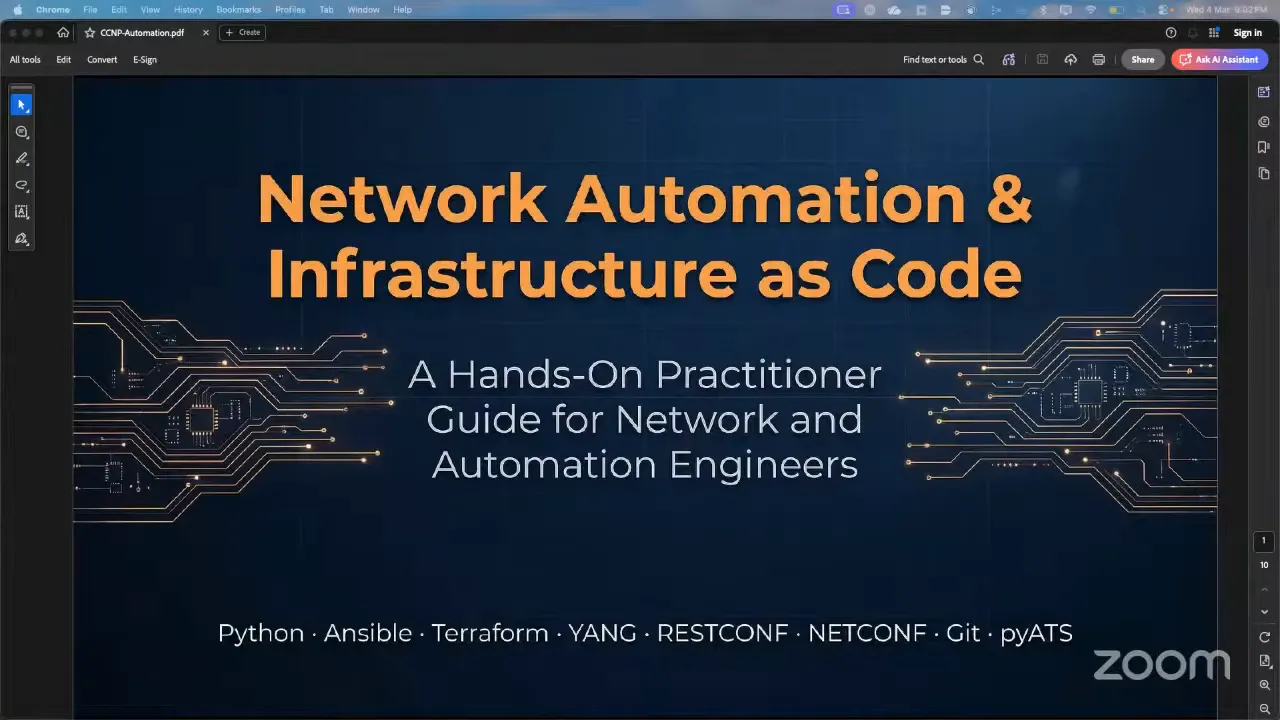
Core topics covered in CCNP Automation Training
The following components form the foundation of modern network automation and appear in most CCNP Automation Training curricula.
1. Python scripting and CLI automation
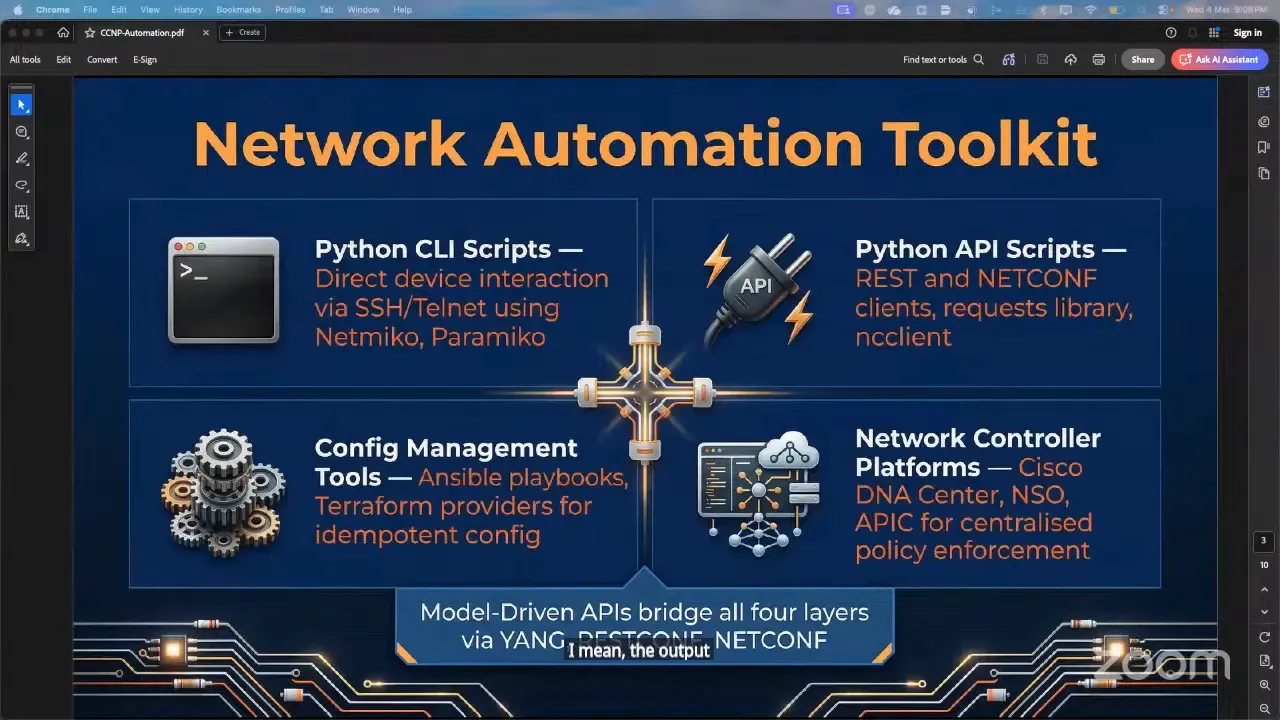
Python is the primary scripting language used in network automation because of its readability and extensive libraries. Key patterns taught in CCNP Automation Training include:
Connecting to devices via SSH using libraries such as Paramiko, Netmiko, or Nornir.
Executing show and configuration commands programmatically and parsing CLI output.
Logging, error handling, and working with concurrency to scale across devices.
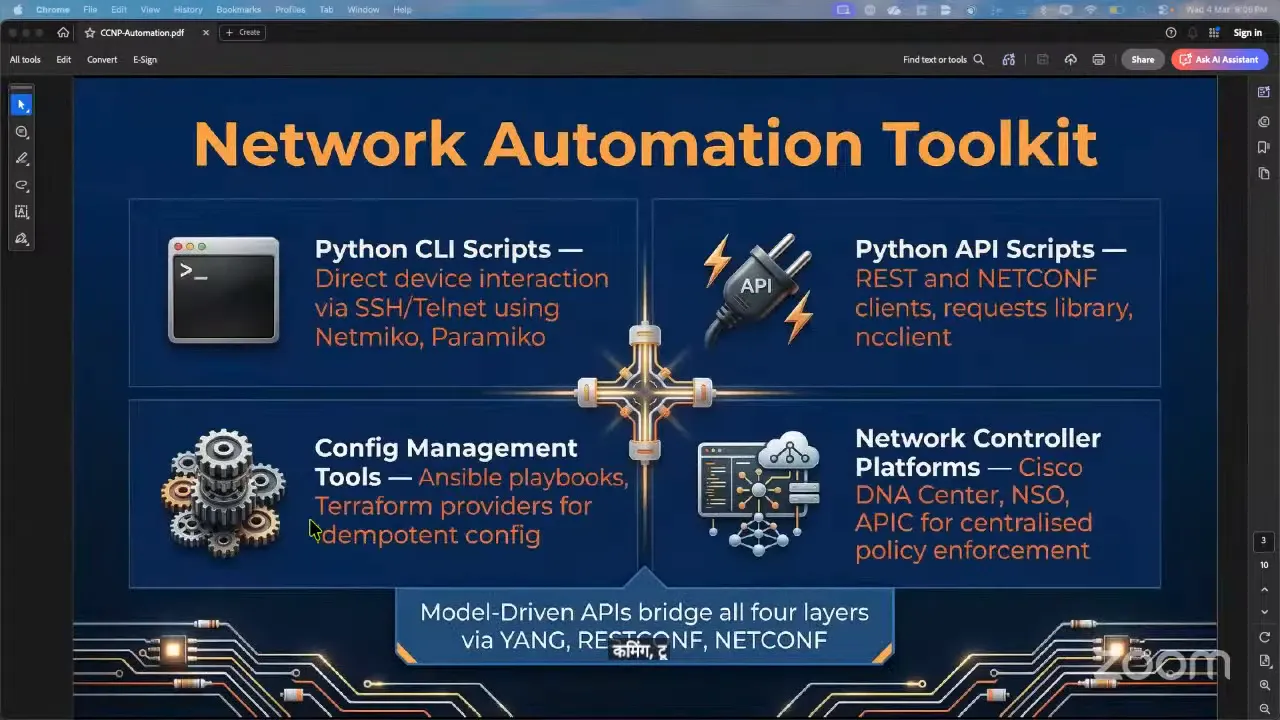
When using CLI-based scripts you typically receive text output that requires parsing. Two recommended parsing approaches are textfsm and structured parsers such as Genie. CCNP Automation Training shows how to extract structured fields (interfaces, IPs, statuses) from raw CLI output and how to transform that into JSON or Python dictionaries for downstream use.
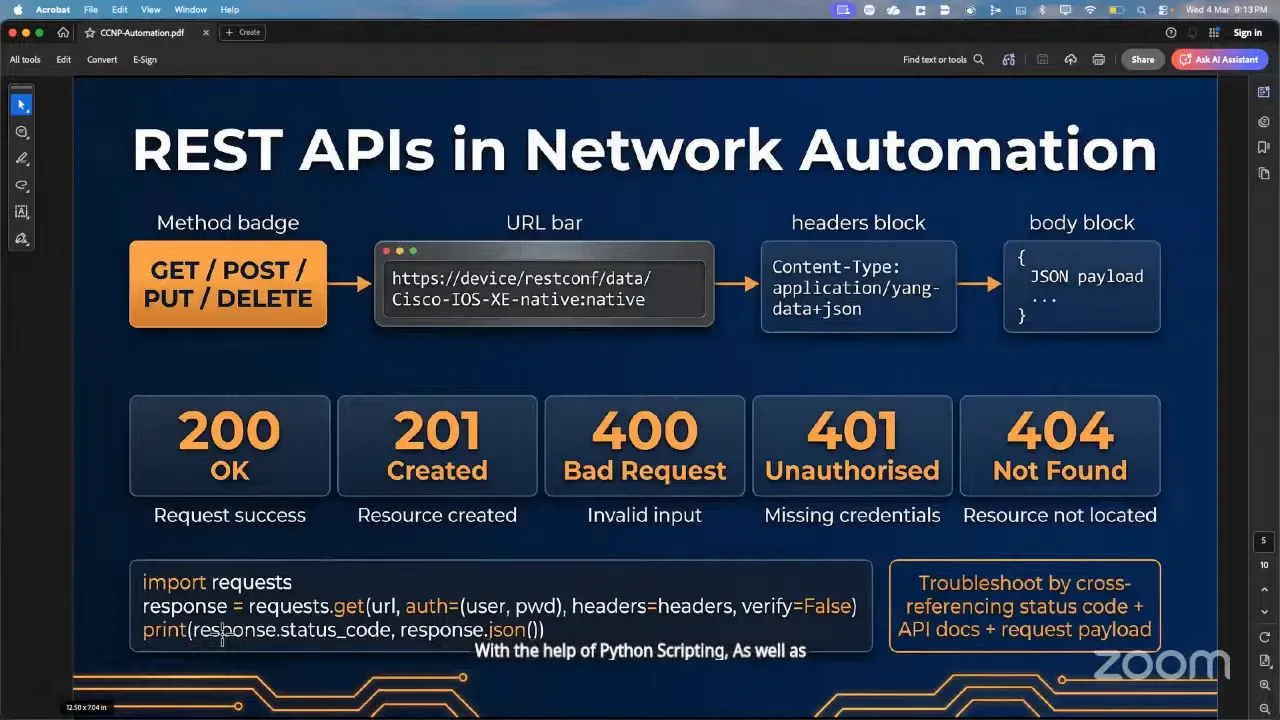
2. APIs, RESTCONF, NETCONF and YANG models
Modern devices and controllers expose structured configuration through APIs. CCNP Automation Training covers:
RESTCONF (JSON over HTTPS) for web-friendly programmability.
NETCONF (XML over SSH) for transactional configuration and locking.
YANG data models that define configuration and operational state schema.
Learning to form the correct API URL paths and payloads against a device's YANG model is a core skill. The training explains HTTP methods (GET, POST, PUT, PATCH, DELETE), typical status codes (200, 201, 204), and how to use tooling such as Postman or Python requests to interact with devices.
3. Configuration management with Ansible (declarative and idempotent)
CCNP Automation Training covers Ansible as an agentless, YAML-based automation engine. Main learning points include:
Writing playbooks that declare desired state and run modules against network devices.
Using network-specific collections (ios, iosxr, junos, nxos, arista) and their network modules for interfaces, VLANs, routing, ACLs, and more.
Ensuring idempotency so repeated runs change only divergent configuration.
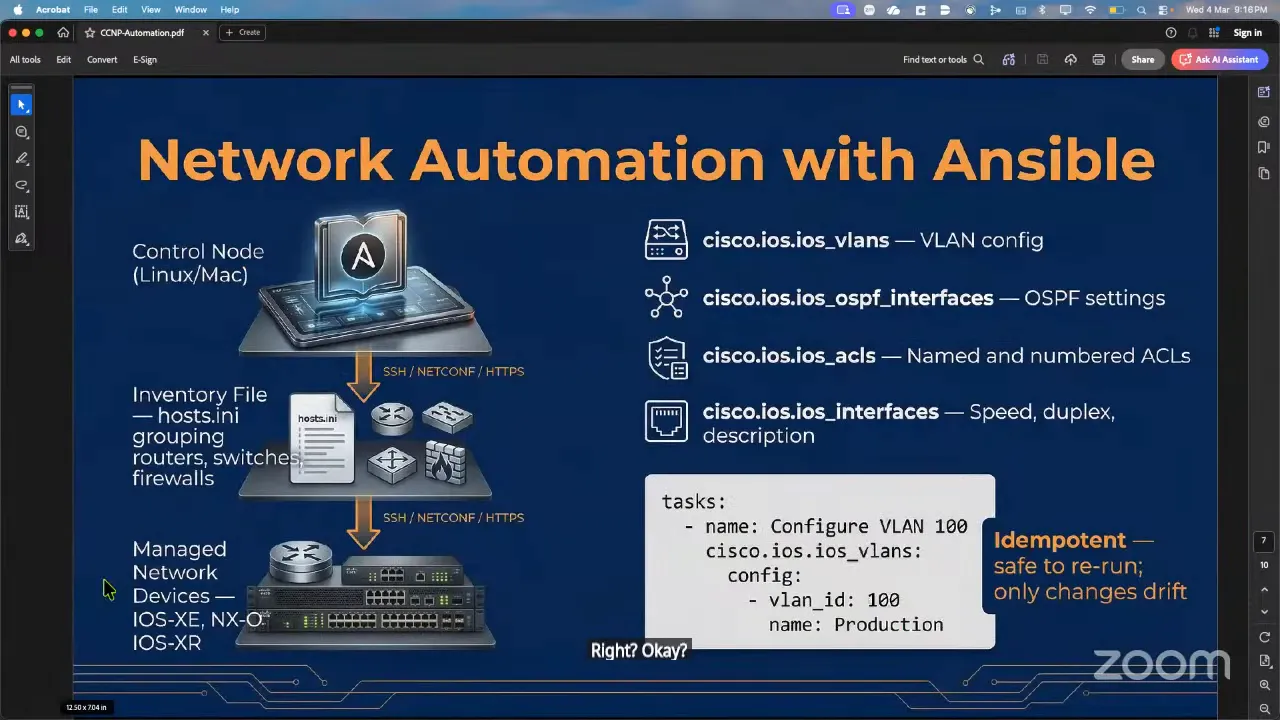
Ansible playbooks are human readable and ideal for configuration tasks like provisioning VLANs on many switches, applying OSPF settings consistently, or pushing standardized interface templates across a fleet.
4. Infrastructure as Code and Terraform
CCNP Automation Training includes Terraform to declare network resources and push changes in a plan/apply workflow. Key concepts taught:
Writing .tf files to define final desired state for resources (interfaces, virtual routers, cloud network components).
Using providers as the Terraform equivalent of modules for different vendors.
The lifecycle: terraform init, terraform plan, terraform apply, and how Terraform stores state locally or remotely.
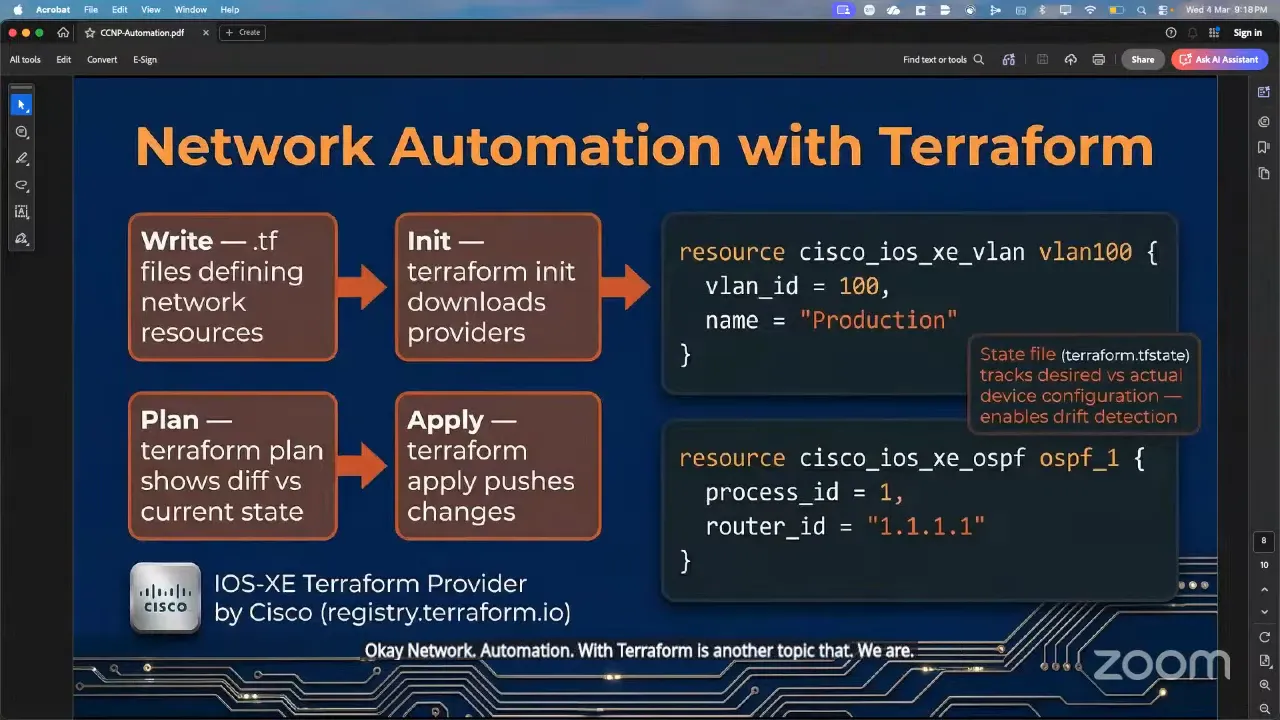
Terraform is particularly useful for cloud networking and controller-managed fabrics where you treat the network as a set of resources rather than device CLI commands.
5. Model-driven programmability and controllers
Network controllers and orchestrators provide another abstraction layer. CCNP Automation Training explains how tools such as Cisco DNA Center, NSO, and SD-WAN controllers expose REST APIs backed by YANG models. You will learn when to interact with devices directly, and when to manage via controllers.
6. Infrastructure as Code toolchain: YAML, Jinja2, Git
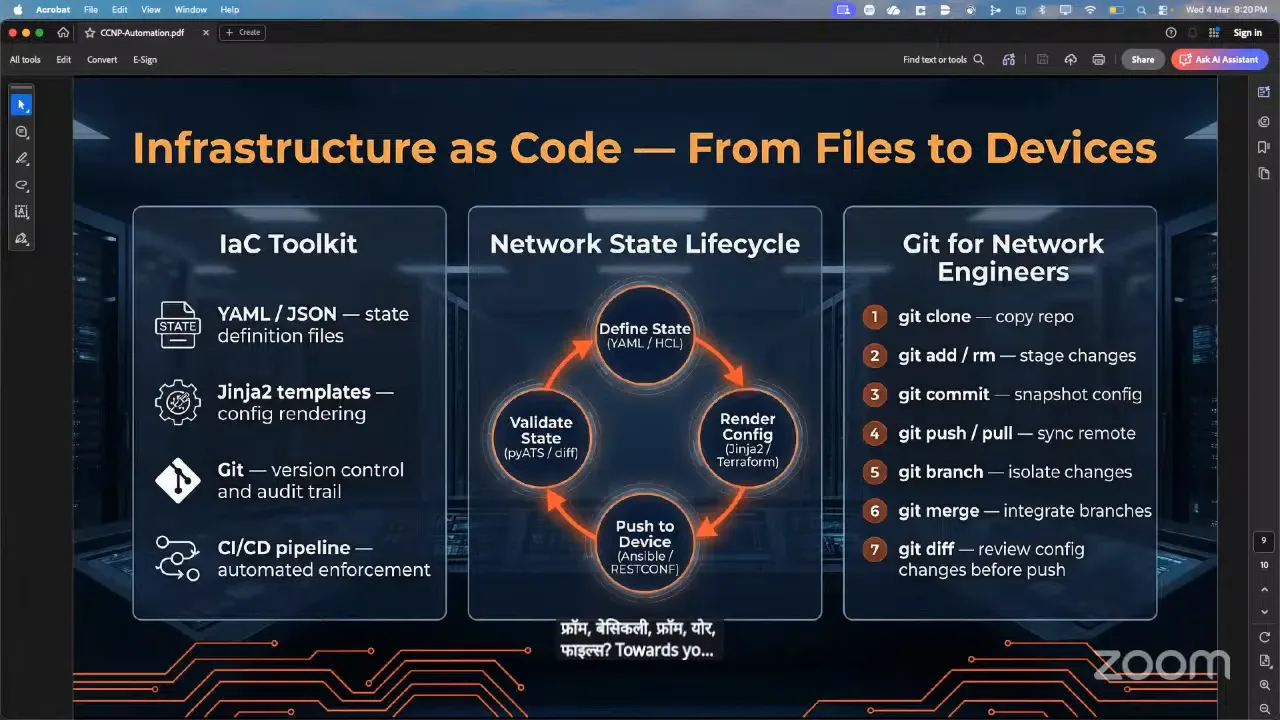
Practicing Infrastructure as Code in the CCNP Automation Training requires knowing the toolchain:
YAML/JSON: State and configuration files.
Jinja2: Templating engine to render device configurations from templates and variables.
Git: Version control for playbooks, templates, and state files with common workflows: clone, branch, commit, push, pull request, and CI hooks.
7. Validation and testing with pyATS and Genie
Verification is essential. CCNP Automation Training includes pyATS, Cisco’s Python-based test automation framework, and Genie parsers to extract structured data from device outputs. Course topics:
Capturing pre-change state across devices.
Applying changes using Ansible or Terraform.
Collecting post-change state and comparing results to ensure success.
Using existing parsers avoids writing custom parsers for common show commands and makes validation repeatable and reliable.
Practical examples you will practice in CCNP Automation Training
Hands-on labs are a central part of CCNP Automation Training. Typical lab exercises include:
Provision VLAN 100 on 50 access switches and apply port descriptions using Ansible playbooks.
Configure OSPF across multiple routers with a standardized hello timer and area definitions via an Ansible role or a Terraform provider.
Use RESTCONF to set an OSPF router ID via a YANG path and verify the result with pyATS.
Deploy VMs and network interfaces in a cloud environment using Terraform and validate connectivity.
Automate bulk IOS upgrades with pre-checks and post-upgrade validations.
Sample RESTCONF request (Python)
This example demonstrates sending a JSON payload to a RESTCONF endpoint. CCNP Automation Training breaks down how to find the correct YANG container path, choose proper headers, and handle authentication securely.
Setting up a lab for CCNP Automation Training
Effective lab work requires an environment with preinstalled tooling and virtual or physical devices. A recommended lab setup includes:
A candidate workstation with VS Code, Postman, Python, Ansible, Terraform, and Git installed.
Virtualized routers and switches (or remote racks) that support RESTCONF/NETCONF and SSH.
Access to a repository with playbooks, templates, and examples to run and modify.
Optional: cloud-managed devices or vendor controllers for exploring controller-based automation.
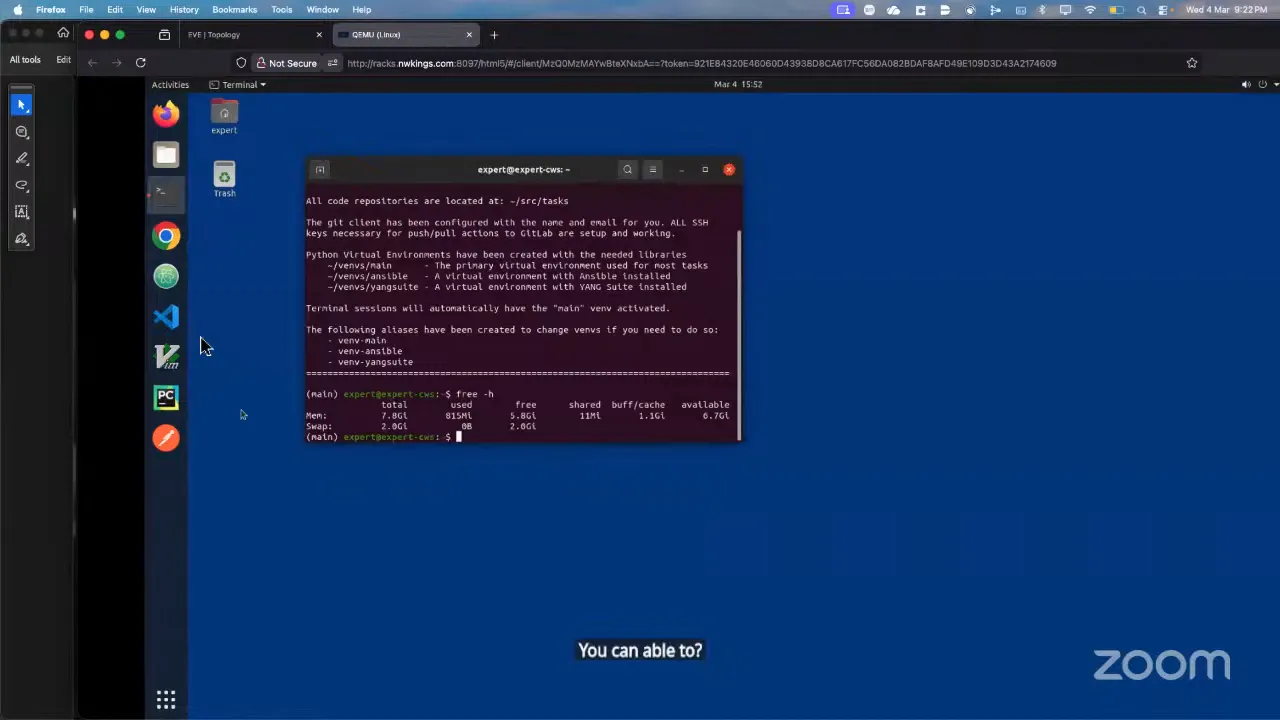
Many training providers give 24x7 access to a shared rack or lab network so learners can run scripts against live devices without needing to install vendor software locally.
Learning path and prerequisites
CCNP Automation Training typically assumes the following prerequisites to be effective:
Working knowledge of networking fundamentals (routing, switching, VLANs, basic security).
Familiarity with command-line device management and configuration modes.
Basic understanding of Linux command line and file editing.
Basic familiarity with a programming language (preferably Python) is helpful but many programs include introductory Python modules so network engineers can progress from first principles to advanced automation tasks.
Multi-vendor automation and controller integration
Production networks are rarely single-vendor. CCNP Automation Training covers multi-vendor strategies:
Use vendor-specific Ansible modules and conditional logic in playbooks to handle platform differences.
Adopt naming conventions or inventory groups to select the correct modules for a device type.
Interact with cloud-based controllers via their REST APIs and incorporate controller workflows into your automation pipeline.
For example, a single Ansible playbook can apply different templates based on an inventory variable such as platform: ios, iosxr, junos, nxos, or eos (Arista).
Common mistakes to avoid
Skipping validation: Always collect pre-change and post-change state to verify success. Relying on task success without validation can leave configurations partially applied.
Poor secret management: Avoid embedding credentials in plaintext. Use vaults, encrypted variables, or secret managers.
No testing environment: Never run untested scripts directly in production. Use a test lab or staging devices to validate changes.
Ignoring idempotency: Ensure playbooks and templates are idempotent to avoid unintentional repeated changes.
Vendor model blind spots: Expect differences in YANG models and API implementations and plan for them in playbooks and provider selection.
How validation and testing are taught in CCNP Automation Training
Verification is part of each automation workflow. Typical validation steps taught include:
Run pyATS or custom scripts to collect baseline show-output across the device fleet.
Render templates and run dry runs or Ansible check-mode where possible.
Apply changes to a small pilot group and validate with parsers and telemetry.
Scale changes once pilot validation is successful and use CI pipelines to gate deployments.
Use of standardized parsers (Genie) makes it fast to convert command output into structured data for assertions such as "is interface up" or "is OSPF neighbor established".
How this training maps to certifications and career goals
CCNP Automation Training prepares engineers for automation responsibilities and aligns with emerging certification tracks that include automation and programmability. Topics map closely to vendor automation certifications and multipliers such as:
DevNet / Cisco automation credentials that emphasize APIs, YANG, and automation toolchains.
Cloud networking and Terraform skills for cloud-native networking roles.
Operational roles where pyATS, Ansible, and Git-centered workflows are part of daily operations.
Completing CCNP Automation Training makes you more marketable for roles like network automation engineer, SRE with networking focus, or network architect working on programmatic provisioning and telemetry.
Sample study plan for a 4-month CCNP Automation Training program
Weeks 1–3: Python fundamentals and SSH-based CLI automation (Netmiko, Nornir).
Weeks 4–6: RESTCONF and NETCONF basics; interacting with device APIs and YANG models.
Weeks 7–10: Ansible for network automation — playbooks, roles, collections, idempotency.
Weeks 11–13: Terraform for networking; providers and state management.
Weeks 14–15: Testing and validation with pyATS and Genie; CI/CD basics with Git.
Weeks 16: Capstone labs — multi-vendor provisioning, controller API integration, and validation.
Checklist: tools and resources to install before starting
Python 3.x and pip
VS Code or another code editor
Postman or HTTP client
Ansible and collections for target platforms
Terraform and provider plugins
pyATS and Genie parsers (or vendor equivalents)
Git client and a GitHub/GitLab account for practice
Real-world use cases where CCNP Automation Training skills are applied
Automated onboarding of new sites: templates for VLANs, L2/L3 interfaces, and routing.
Mass firmware updates with pre- and post-checks to reduce failure rates.
Traffic engineering changes across WAN links coordinated through an API-driven controller.
Continuous compliance checks to detect configuration drift and policy violations.
Capacity planning reports generated by automations that collect interface utilization from device telemetry.
How to handle multi-vendor and cloud-controller environments
When networks include cloud controllers, cloud-managed wireless, and multiple vendors, practical CCNP Automation Training shows you how to:
Use vendor API endpoints for controllers and incorporate those calls into a unified automation pipeline.
Rely on common abstractions (for example, inventory variables that map to platform-specific modules) so a single playbook can handle multiple platforms.
Employ telemetry and monitoring APIs to collect metrics and then process them with scripts or dashboards for decision making.
Troubleshooting automation failures: common scenarios and fixes
Authentication errors: Rotate credentials and use a secrets manager; check API endpoint certificates and trust stores.
Schema mismatch: Confirm YANG model versions and vendor-specific extensions before sending payloads.
State drift: Use periodic audits with pyATS or scheduled playbooks to detect and reconcile drift.
Partial failures on scale: Build retries and idempotent logic into playbooks and scripts. Use transactional APIs (NETCONF) if atomicity is required.
Career advice: applying CCNP Automation Training to your job
To maximize value from CCNP Automation Training:
Start by automating small repeatable tasks you already do daily and expand coverage gradually.
Document automation as code and commit to Git with clear commit messages and change control.
Keep a lab and a staging environment to validate changes safely before production deployment.
Use automation to free time for higher-value tasks like architecture, performance tuning, and security hardening.
FAQ
What are the prerequisites for CCNP Automation Training?
Prior networking knowledge at CCNA or CCNP level is recommended. Basic familiarity with the command line and an introductory understanding of programming (especially Python) make the learning curve easier. Many programs include beginner Python modules if you are new to programming.
Does CCNP Automation Training cover firewalls and SD-WAN controllers?
The core curriculum focuses on routers and switches, APIs, Ansible, Terraform, and validation workflows. Firewall and SD-WAN controller automation are applicable concepts, and many courses show how to integrate vendor-specific APIs. Some providers offer separate dedicated modules for SD-WAN or firewall automation.
How long does a typical CCNP Automation Training program take?
A comprehensive, instructor-led program usually lasts several months with about 80–120 hours of instruction and labs. Self-paced learners can accelerate or extend this schedule depending on prior experience and time availability.
Will I need a lab? What does a lab look like?
Yes. A lab can be virtual devices accessible via SSH and APIs or a hosted rack with real devices. Essential tools include a workstation with VS Code, Postman, Python, Ansible, Terraform, and Git configured. Many training providers grant remote access to preconfigured lab racks.
How does Terraform differ from Ansible in network automation?
Terraform is resource-driven and manages infrastructure state (useful for cloud and controller-managed resources). Ansible is procedural and agentless, ideal for device configuration and procedural workflows. Terraform emphasizes state files and plan/apply lifecycles; Ansible emphasizes idempotent playbooks and immediate execution.
How is validation done after automation runs?
Validation is typically performed by collecting pre-change state, applying changes, then collecting post-change state. Tools like pyATS and Genie parse show outputs into structured data for automated comparisons and assertions. CI pipelines can gate rollback or alerting based on validation results.
CCNP Automation Training equips network professionals to manage modern networks using code, APIs, and automation frameworks. Key skills include Python scripting, RESTCONF/NETCONF and YANG, Ansible playbooks, Terraform workflows, Git-based lifecycle management, and validation with pyATS. The practical, lab-driven approach builds repeatable patterns you can apply immediately in production: automated provisioning, consistent configuration, faster changes, and better validation.
Start by establishing a small lab, automate a simple but repetitive task, adopt version control, and expand automation coverage gradually. With these steps you will convert routine operational work into auditable, scalable, and testable automation—exactly the capability targeted by CCNP Automation Training.

The founder of Network Kings, is a renowned Network Engineer with over 12 years of experience at top IT companies like TCS, Aricent, Apple, and Juniper Networks. Starting his journey through a YouTube channel in 2013, he has inspired thousands of students worldwide to build successful careers in networking and IT. His passion for teaching and simplifying complex technologies makes him one of the most admired mentors in the industry.